There is a difference between being good at Japanese and being good at the JLPT N4, and candidates who discover it too late lose a year.
Being good at Japanese means you can read a manga, follow a conversation and enjoy a drama with subtitles. Being good at N4 means you can answer a very specific set of item types, at a specific speed, under specific conditions, without losing the marks you have already earned. Both are worth having. Only one of them earns you the certificate.
This is the preparation method that reliably converts Japanese ability into an N4 pass.
The Four Pillars of N4 Preparation
Every successful N4 plan rests on the same four things, whatever materials it uses.
Coverage without speed produces a candidate who knows everything and finishes nothing. Speed without coverage produces confident wrong answers.
Phase 1: Consolidate (Weeks 1 to 3)
Many candidates skip this phase and spend the whole twelve weeks patching holes. Three weeks of consolidation makes the next nine weeks twice as fast.
Phase 2: Expand (Weeks 4 to 7)
This is the heaviest phase, and the one that decides your overall score.
Phase 3: Read and Listen (Weeks 8 to 10)
Phase 4: Convert (Weeks 11 to 12)
How the Hours Divide
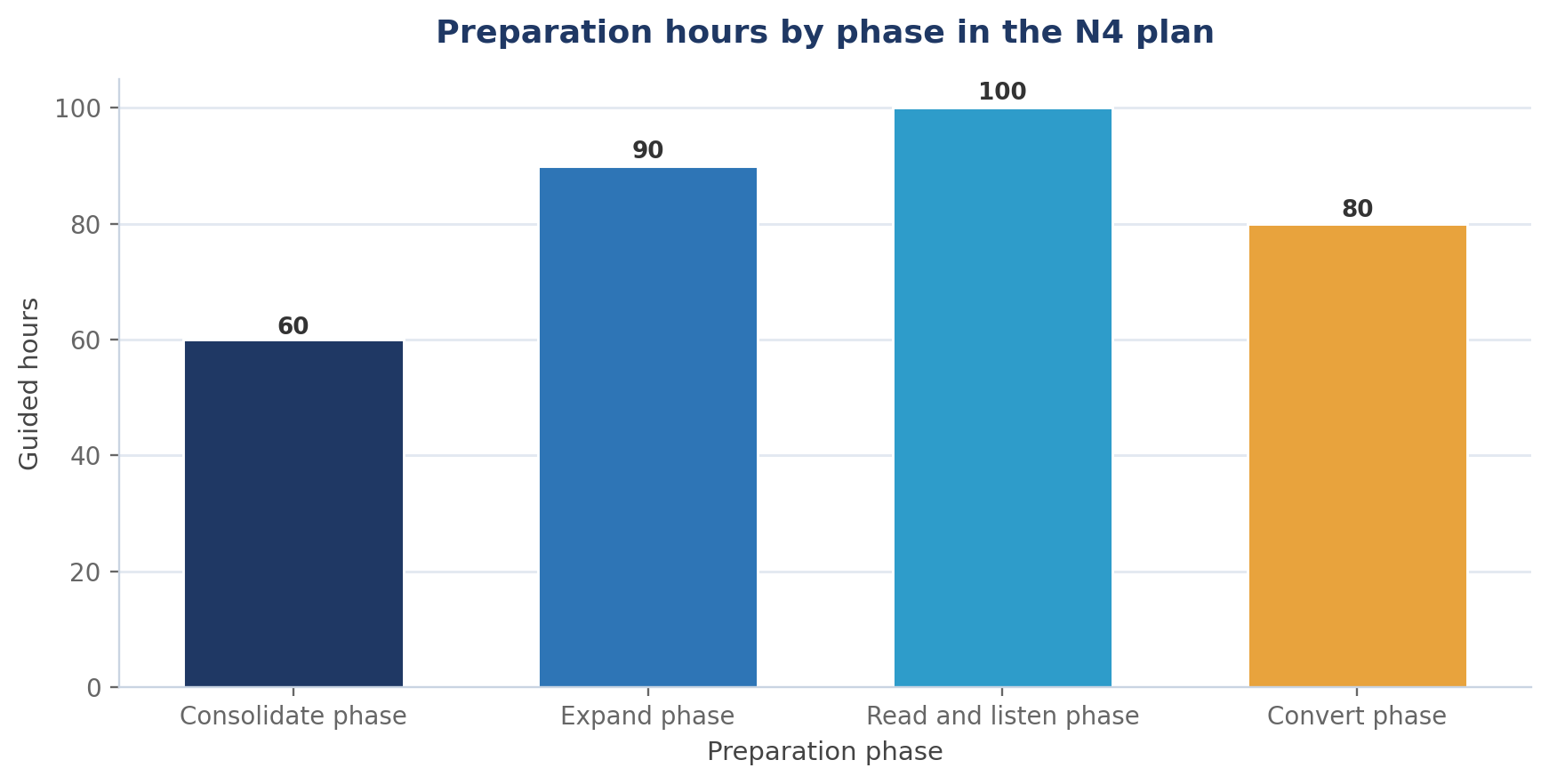
Across the plan, the guided hours distribute roughly like this.
Three hundred and thirty hours is the honest total, which is close to the commonly cited figure for N4 from a solid N5 base.
The Error Log: The Highest-Value Habit
A notebook with one entry per mistake outperforms three extra textbooks. The format is what makes it work.
Review the log weekly and re-test the oldest entries first. Most candidates find that ten recurring errors account for most of their lost marks.
The Listening Routine That Protects the Floor
Listening carries a 19-mark minimum out of 60 and cannot be rescued by any other section.
Forty-five minutes a day is what turns a listening score of 16 into a comfortable 35.
Reading Preparation
How Guided Practice Changes the Timeline
Self-study alone can pass N4, but it usually takes longer, for a structural reason: you cannot correct your own ear.
The Final Ten Days
Common Preparation Mistakes
N4 is where self-taught learners stall
The gap between reading ability and listening speed is what structured practice closes fastest. A personal AI voice tutor trains your ear at natural pace, any time, with speaking feedback. Prepare with self-paced Japanese lessons →
Start the Japanese course →Create a free accountPractice Frames
Sit a scored diagnostic before you sit the exam
Find out which of the three N4 conditions you are currently failing, and get a plan that targets that section specifically. Start your free JLPT diagnostic →
Start the Japanese course →Create a free accountFrequently Asked Questions
How should I prepare for the JLPT N4? In four phases: consolidate N5 to full accuracy, expand to N4 vocabulary and grammar, train reading and listening, then convert everything into marks with two full timed mocks.
How many hours do I need for JLPT N4? Around 300 to 350 hours from a solid N5 base, which is roughly nine to ten hours a week for twelve weeks.
What is the most important thing in N4 preparation? Listening, because it carries a 19-mark minimum out of 60 that no other section can compensate for.
Can I prepare for JLPT N4 in six weeks? Yes, with an emergency plan that focuses on item types and listening rather than full coverage, though the pass rate is naturally lower.