You know the vocabulary. You can read the sentence. You have rehearsed it silently three times. Then a Japanese person asks you a question, and everything you know evaporates into a polite smile and an English "sorry?"
The fear of speaking Japanese is not a character flaw and it is not a talent gap. It is the most predictable phenomenon in language learning, and it has a mechanism — which means it has a fix.
What this guide covers
- Why Japanese triggers more speaking anxiety than most languages
- What is actually happening when you freeze
- The four-week exposure plan that rewires the response
- Phrases that buy you thinking time
- What guided practice changes, and what solo practice cannot
Why Japanese triggers more anxiety than most languages
Three specific features make Japanese unusually intimidating for English speakers.
That last one is the cruellest irony in language learning. The respect that makes you careful is precisely what stops you practising — and practice is the only thing that produces accuracy.
What actually happens when you freeze
Freezing has a mechanism, and knowing it removes some of its power.
The key insight sits in stage three. The words are not gone. They are temporarily inaccessible because your working memory is busy managing threat. That is why you can recall the exact phrase five minutes later in the shower.
You are not forgetting Japanese. You are temporarily locked out of it. Those are very different problems.
The four-week exposure plan
Anxiety falls with exposure, not with preparation. You cannot think your way out of it, but you can habituate your way out.
The escalation is deliberate. Week one has no audience. Week four has two, but the skill has already been exercised ten times.
Phrases that buy you thinking time
Native speakers do not produce perfect sentences instantly. They stall, and stalling in Japanese makes you sound more fluent, not less.
That last one is quietly powerful, and worth using more than pride wants to admit. Telling someone you are still learning transforms the interaction: they slow down, simplify, and stop expecting perfection.
Ready to turn reading into real Japanese? Start your self-paced course today.
Start the Japanese course →Create a free accountPractise in a space built for mistakes
Speaking anxiety shrinks fastest in a space where errors are the point. A personal AI voice tutor gives you structured Japanese lessons you can study at your own pace, any time, with speaking practice and feedback that expects imperfection — so your confidence can grow into it.
Button: Explore the Japanese Course Pass →
The three beliefs that keep you stuck
The third is the one that quietly ends careers. Learners who wait for correctness before speaking never accumulate the thousands of imperfect utterances that fluency is built from.
What solo practice cannot do
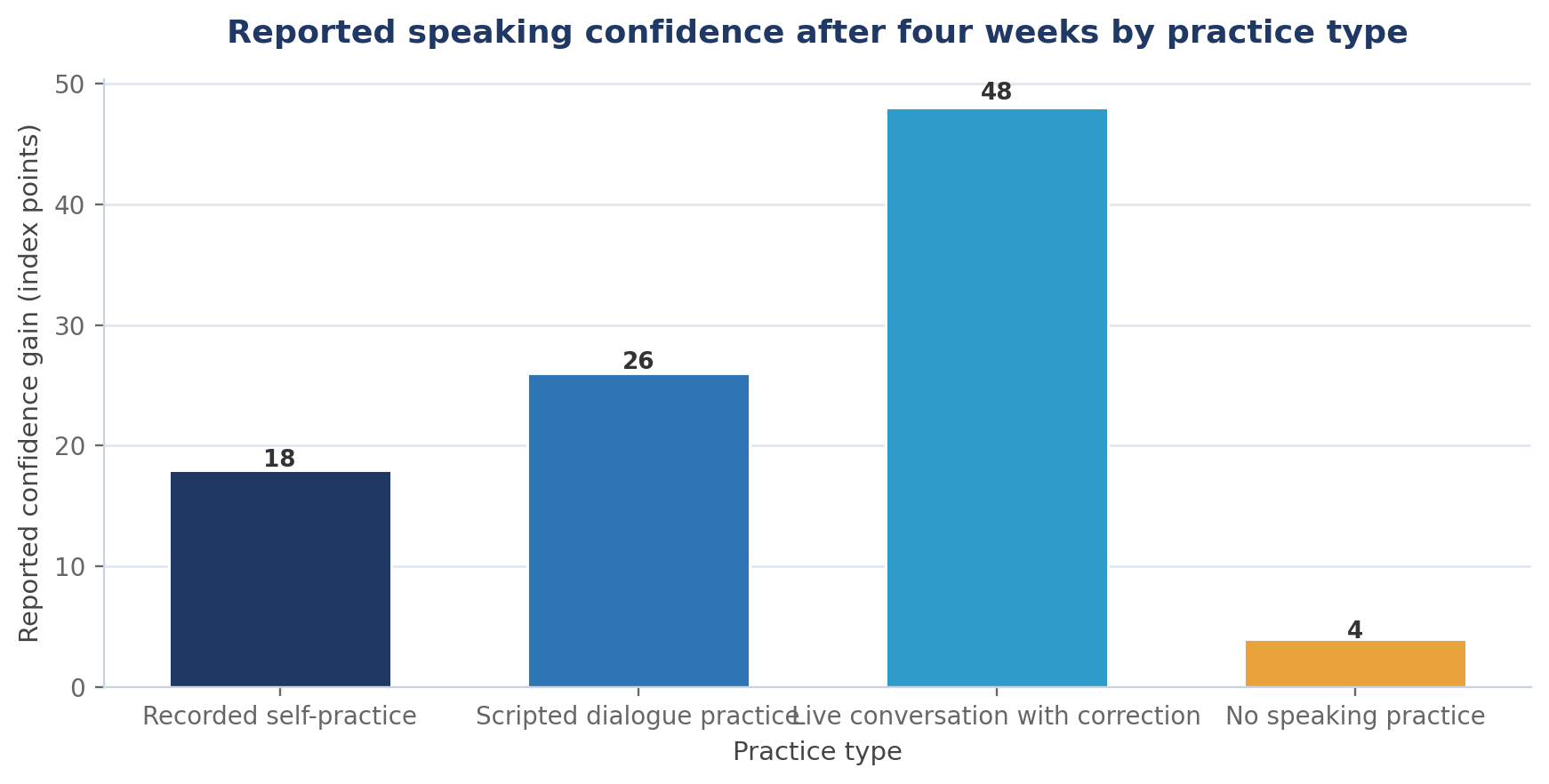
The middle of that table matters most. Prepared sentences are rehearsal; improvisation is the skill. And you can only improvise with someone who might answer in ways you did not expect.
A note on making mistakes
Japanese culture is famously courteous, and that courtesy extends to learners. In practice, the reactions you fear — eye-rolling, impatience, switching to English — are far rarer than the internet suggests.
What you will actually get: slowed speech, simplified vocabulary, and often visible encouragement. The risk is dramatically lower than your anxiety estimates.
Ready to turn reading into real Japanese? Start your self-paced course today.
Start the Japanese course →Create a free accountTake the first step with no one watching
Create a free languageskills.net account to take a speaking-level check at your own pace, then start your first low-pressure guided lesson with your AI voice tutor when you are ready.
Button: Create your free account →
Frequently Asked Questions
Why do I freeze when speaking Japanese? Stress consumes the working memory you need for recall. The words are still there — they become temporarily inaccessible under threat, which is why they return minutes later.
How long does it take to stop fearing speaking Japanese? With regular exposure, most learners notice a significant drop in anxiety within four to six weeks. Avoidance, by contrast, makes it worse over time.
Should I wait until I am more advanced to start speaking? No. Speaking practice is what builds the skill. Waiting makes the first attempt harder, not easier.
Is speaking to myself actually useful? Yes, as a first stage. Self-recording builds the physical habit before an audience is involved, which is exactly the sequence the four-week plan uses.
References & Further Reading
- Japan Foundation — Japanese-language education and learner research
- NHK World — Easy Japanese, graded audio and speaking practice
- JLPT — Official Japanese-Language Proficiency Test levels
- JASSO — Study in Japan and daily-life guidance
- Council of Europe — CEFR levels and spoken-production descriptors