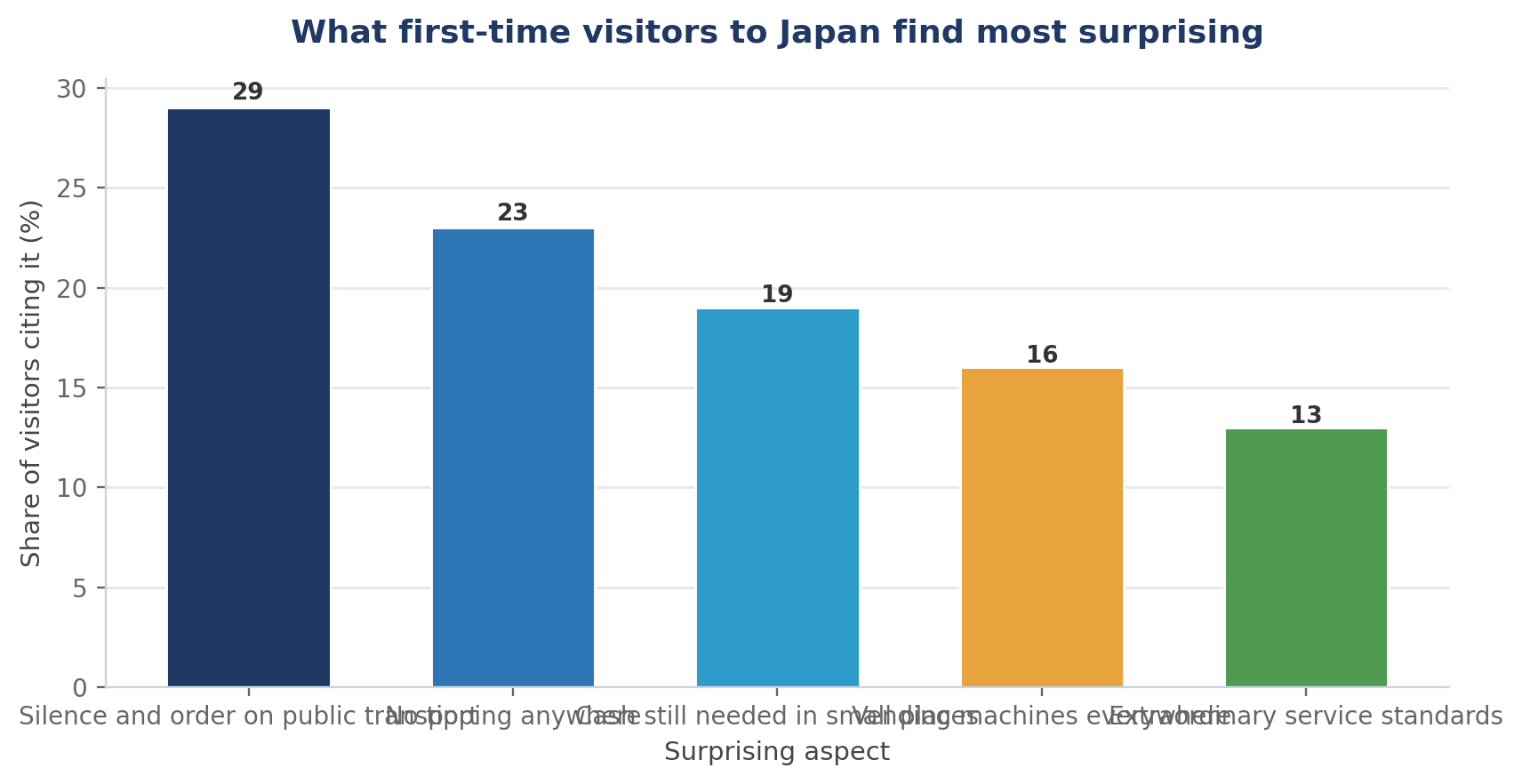
Japan is the most visitor-friendly country in the world for anyone willing to learn three things: how to walk, how to queue, and how to say thank you properly. Get those right and the country opens up in a way that guidebooks never quite explain.
The tips below are the ones that actually change how a trip feels. Not the folklore, not the tea ceremony theory — the practical things that prevent small awkward moments and produce unexpectedly warm ones.
The five-minute version
- Learn five phrases before you land — they carry enormous goodwill
- Never tip; it genuinely confuses people
- Be quiet on trains; talk on the platform
- Queue precisely, board in order, do not block the aisle
- Carry cash for small restaurants and shrines
Five phrases that transform your trip
You do not need Japanese. You need five sentences said with genuine intent.
すみません does three jobs at once — excuse me, sorry, and thanks-for-the-trouble. You will use it thirty times a day. Say it with a slight bow, and staff will treat you noticeably better than a tourist who says nothing.
Trains: the rules that matter most
Japanese public transport is world-class, and it works because everyone follows the same unwritten contract.
The one that catches visitors most: taking a phone call on a train. Step onto the platform, call, and re-board. It takes twenty seconds and avoids every pair of eyes in the carriage.
Money, tipping and paying
Here is the single most useful money rule: do not tip. Not at restaurants, not in taxis, not at hotels. Staff may chase you down the street to return the money, baffled rather than pleased.
Cards are now widely accepted in cities, but small restaurants, shrines and rural shops remain cash-friendly. Carry a few thousand yen and you will never be caught out.
Temples, shrines and quiet places
The offerings box at a shrine is not a transaction. Five yen is traditional — goen, a pun on "good connection" — and nobody is counting. The gesture is what matters.
Eating, drinking and social customs
Most dining etiquette is common sense once you know two rules.
Outside of those, relax. Nobody minds which hand holds your bowl, and the elaborate fear about chopstick etiquette is generally far more intimidating on the internet than in reality.
Ready to turn reading into real Japanese? Start your self-paced course today.
Start the Japanese course →Create a free accountLearn the phrases before you land
Twenty words of Japanese change a trip completely — temple staff explaining a ritual, a shopkeeper recommending the better option, a stranger walking you to the right platform. A personal AI voice tutor gets you there faster than an app, at your own pace.
Button: Explore the Japanese Course Pass →
Gifts, gratitude and small gestures
Japan has a deep gift-giving culture, and travellers can participate easily.
Souvenir culture is real: colleagues, hosts and teachers often bring back small regional food gifts, beautifully wrapped, from any trip. If you want to delight a host, bringing something from your home country — small, wrapped, presentable — works every time.
Practical habits that make the trip smoother
The rubbish rule is the one visitors notice first: there are almost no public bins, and yet the streets are spotless. Carry your rubbish, dispose of it at your hotel or a convenience store, and you are participating in the system rather than fighting it.
Everything in Japan runs on small courtesies performed without expectation of reward. Do the same and you will be treated remarkably well.
Ready to turn reading into real Japanese? Start your self-paced course today.
Start the Japanese course →Create a free accountPractise the phrases before you fly
Create a free languageskills.net account and work through a starter travel-Japanese module — greetings, directions, ordering and asking for help.
Button: Create your free account →
Frequently Asked Questions
Do I need to speak Japanese to visit Japan? No, but five polite phrases transform your experience. すみません and ありがとうございます alone will carry you remarkably far.
Should I tip in Japan? No. Tipping is not customary and can cause confusion. Excellent service is standard, not a bid for a gratuity.
Is Japan expensive for tourists? It can be very reasonable. Convenience-store meals, trains and regional travel are excellent value; the cost climbs mainly with fine dining and city hotels.
When is the best time to visit? Spring for cherry blossom and autumn for foliage are the classic windows. Both are busy, so book transport and accommodation early.
References & Further Reading
- Japan National Tourism Organization — Practical travel and regional guides
- Japan Foundation — Japanese language and cultural programmes
- NHK World — Easy Japanese and Japanese life programming
- JASSO — Study in Japan and daily-life guidance
- Council of Europe — CEFR levels and intercultural competence