A1 gets an unfair reputation as the level where nothing happens. Learners rush through it to reach the "real" Italian, and in doing so skip the two things A1 exists to install: the sound system and the sentence skeleton.
Those two things are unusually load-bearing in Italian. Get the vowels and double consonants right at A1 and you sound competent forever. Miss them and you spend years being understood but never quite sounding Italian. Equally, the A1 sentence patterns — present tense, articles, basic questions — are not a beginner's detour; they are the frame that everything else hangs on.
Here is exactly what A1 contains, what it costs in hours, and how to get through it without building habits that need repairing later.
What A1 Actually Means
A1 is defined by what you can do, not by what you have seen. The official descriptors are modest and precise.
Notice the phrase "if the other person helps". That is the honest boundary of A1: you can survive a conversation, not run one.
The A1 Vocabulary and Grammar Inventory
That is the whole of A1, and it is fewer items than most learners expect. The work is not the quantity; it is making them automatic.
The Units You Will Cover
By unit eight you can handle a day in Italy without English. That is the practical definition of finishing A1.
How Long It Takes
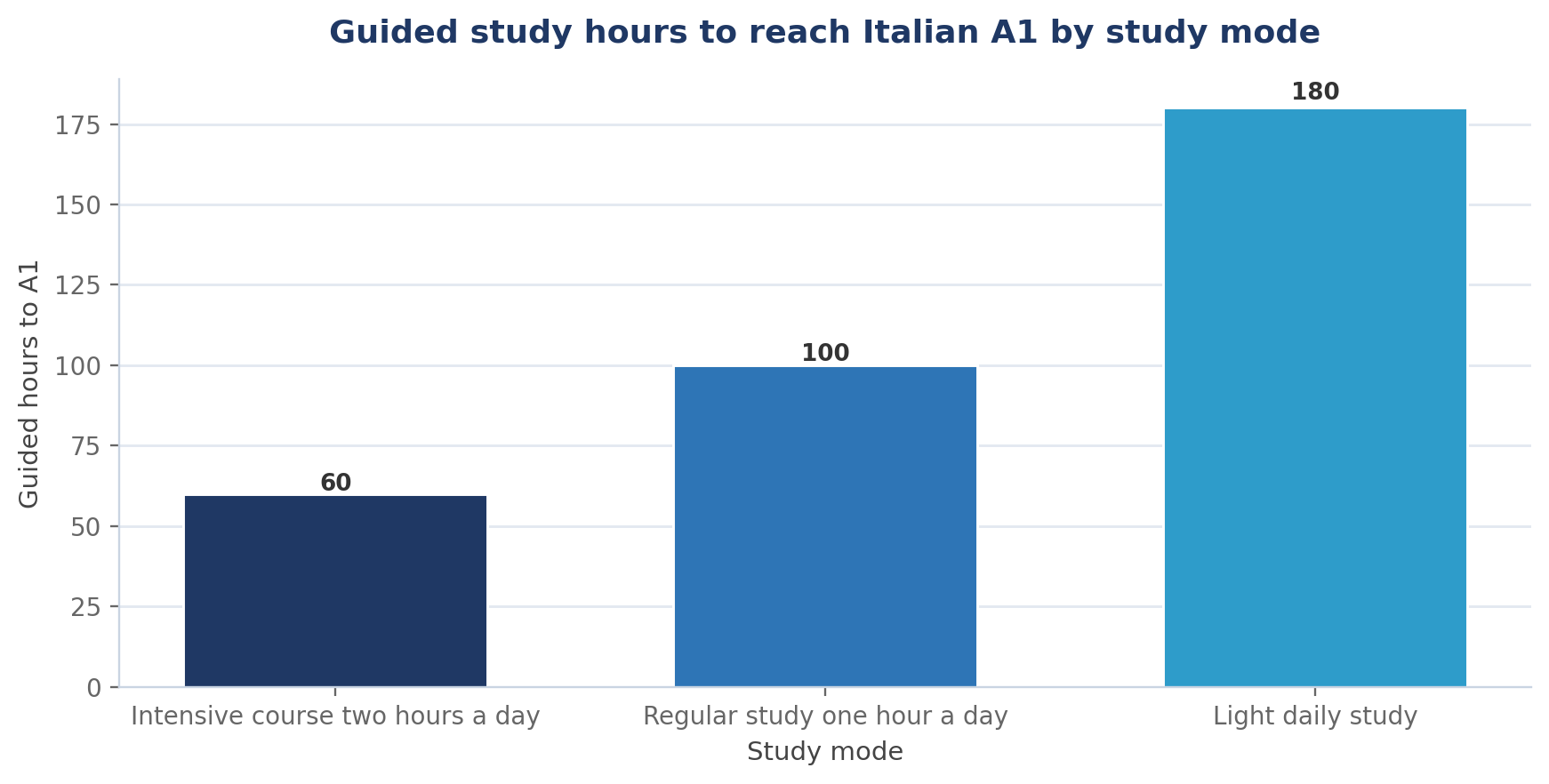
The range is wide because A1 is small but needs repetition. The fastest route is intensive, because daily exposure creates automaticity quickly; the slowest is short daily study, which works but stretches the timeline. Both reach the same place.
The Two Things Worth Extra Care
A1 is where habits form, and two habits are expensive to fix later.
Pronunciation in week one is the single highest-return investment in the entire language. Ten minutes a day on vowels and double consonants for the first month prevents an accent problem that would otherwise take years to undo — and it costs nothing, because you are already learning those words.
Start A1 with an AI voice tutor on your sounds
The habits you build in your first month follow you for years. Our Italian Course Pass pairs A1 lessons with a personal AI voice tutor that gives you speaking practice and feedback on your pronunciation from the very first lesson. Explore the Italian Course Pass →
Start the Italian course →Create a free accountA Realistic A1 Plan in Twelve Weeks
At one hour a day, this is achievable. Notice that the plan produces something spoken every single week — that is deliberate, because A1 learners most often spend their time reading and arrive at the end unable to say the things they can recognise.
What Comes After A1
A2 is where Italian becomes genuinely useful for travel, and it is a shorter jump than most learners expect — provided A1 was built properly rather than skimmed.
Build A1 properly, then A2 comes quickly
Foundation work pays off at every level above it. Our Italian Course Pass takes you through A1 and A2 with a personal AI voice tutor, structured units and printable study materials at each stage. Start your Italian Course Pass →
Start the Italian course →Create a free accountFrequently Asked Questions
What is A1 Italian? A1 is the first CEFR level: you can introduce yourself, ask and answer simple personal questions, and handle short exchanges when the other person speaks slowly and helps.
How long does it take to reach A1 in Italian? Around 80 to 100 guided hours in a structured course, or six weeks of intensive study. Short daily self-study takes closer to a year.
How many words do I need for Italian A1? Roughly 500 words of everyday vocabulary, plus about thirty core verbs in the present tense and the full article system.
Is A1 enough to travel in Italy? It is enough to order, shop and ask simple questions. A2 is the level where a trip stops needing English at all.