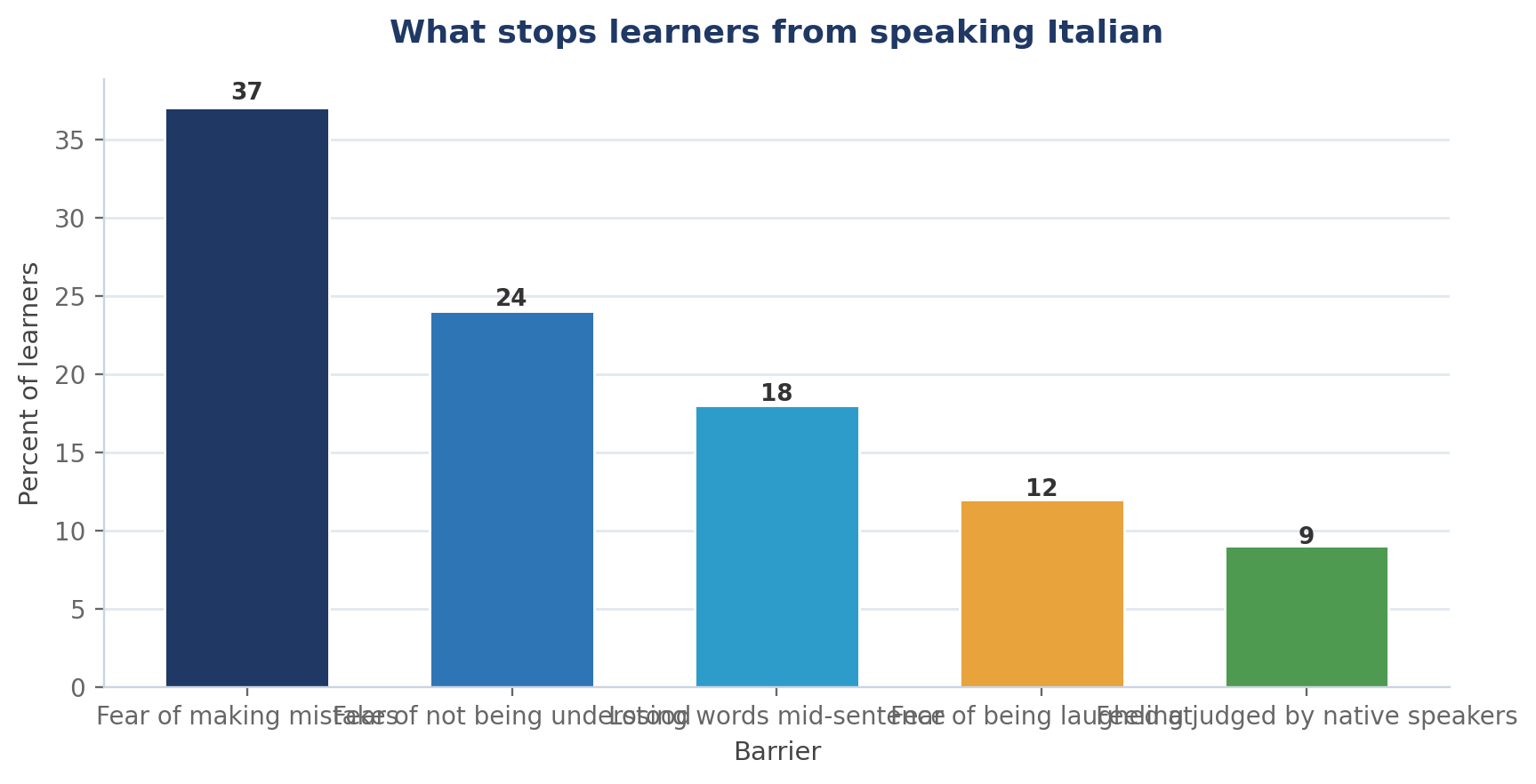
You can read Italian. You can follow a podcast. You understand the waiter perfectly. And then he asks you a question, and your mind goes completely blank.
This is the most common experience in language learning and the least talked about, because it is embarrassing to admit. It is also entirely solvable, and it is not solved by studying more grammar. The fear of speaking is a separate problem from knowing the language, and it needs a separate fix.
Here is what is actually happening in that moment, and the specific techniques that reduce it.
Why the Freeze Happens
The blank mind is not a knowledge failure. It is a performance failure, and the mechanism is well understood.
That first row matters more than people realise. In a classroom exercise you have one goal. In a real conversation you are simultaneously choosing words, applying grammar, managing pronunciation, listening to the reply, and monitoring how you look. Working memory has limits, and that is five tasks.
The practical consequence: fear of speaking is reduced by lowering the number of simultaneous tasks, not by adding more knowledge.
Reframe One: Italians Are Not Grading You
Learners consistently overestimate how much native speakers notice and care about errors. The evidence from actual interactions is reassuring.
There is a cultural point worth knowing. Italy is a high-contact, expressive speaking culture, and an attempt at Italian is treated as an invitation, not an audition. Small errors are not just tolerated — they are often the beginning of a friendly exchange about where you are from.
Reframe Two: Learn Recovery, Not Perfection
This is the single most effective change you can make. Instead of trying to speak without errors, learn the sentences that handle errors gracefully. Then an error is no longer a dead end.
Non mi viene la parola is worth memorising first. It does two things at once: it buys time, and it tells the other person that you know the gap is vocabulary rather than comprehension — which usually prompts them to offer the word instead of switching to English.
Reframe Three: Script the Openings
Fluency anxiety is worst at the start of an interaction, when you have no momentum. Script the first three sentences of every common situation and the rest tends to follow.
That last one is a power move. Announcing your level up front resets the other person's expectations and almost always earns patience instead of impatience.
The Exposure Ladder
Anxiety reduces through graded exposure, not through willpower. Climb one rung at a time, and only move up when the current rung feels merely uncomfortable rather than frightening.
Start at rung five, with someone trained to help
The jump from talking to yourself to talking to a stranger is where learners stall. Our Italian Course Pass gives you a patient AI voice tutor that expects errors and knows how to move you past them. Book a speaking assessment →
Start the Italian course →Create a free accountDaily Practices That Reduce Anxiety Fast
Shadowing deserves special mention. Because you are repeating rather than composing, it removes the decision-making load entirely and lets your mouth learn the rhythm of Italian without any social risk at all. Ten minutes a day for two weeks produces a noticeable change in confidence.
What Not to Do
The third row is counter-intuitive and important. Learners who try never to make mistakes speak less, get corrected less, and improve more slowly than learners who speak freely and get corrected constantly.
Speak from week one, with someone on your side
Fear fades with repetition and a patient listener. Our Italian Course Pass pairs you with an AI voice tutor that builds your confidence conversation by conversation. Start your Italian Course Pass →
Start the Italian course →Create a free accountFrequently Asked Questions
Why do I freeze when I try to speak Italian? Because speaking requires several tasks at once — word choice, grammar, pronunciation and self-monitoring — and working memory has limits. Reducing the number of simultaneous demands is the fastest fix.
How long does it take to stop being afraid of speaking? Most learners notice a clear change after five to ten short conversations. The first three are the hardest; after that the pattern becomes familiar and the fear drops sharply.
Should I wait until my Italian is better before speaking? No. Speaking is what makes Italian better, and delaying practice simply postpones the discomfort without removing it. Speak badly, early, and often.
What if the other person switches to English? Continue in Italian, and say posso provare in italiano? politely. Most people will switch back, especially if you signal that practice is what you want.