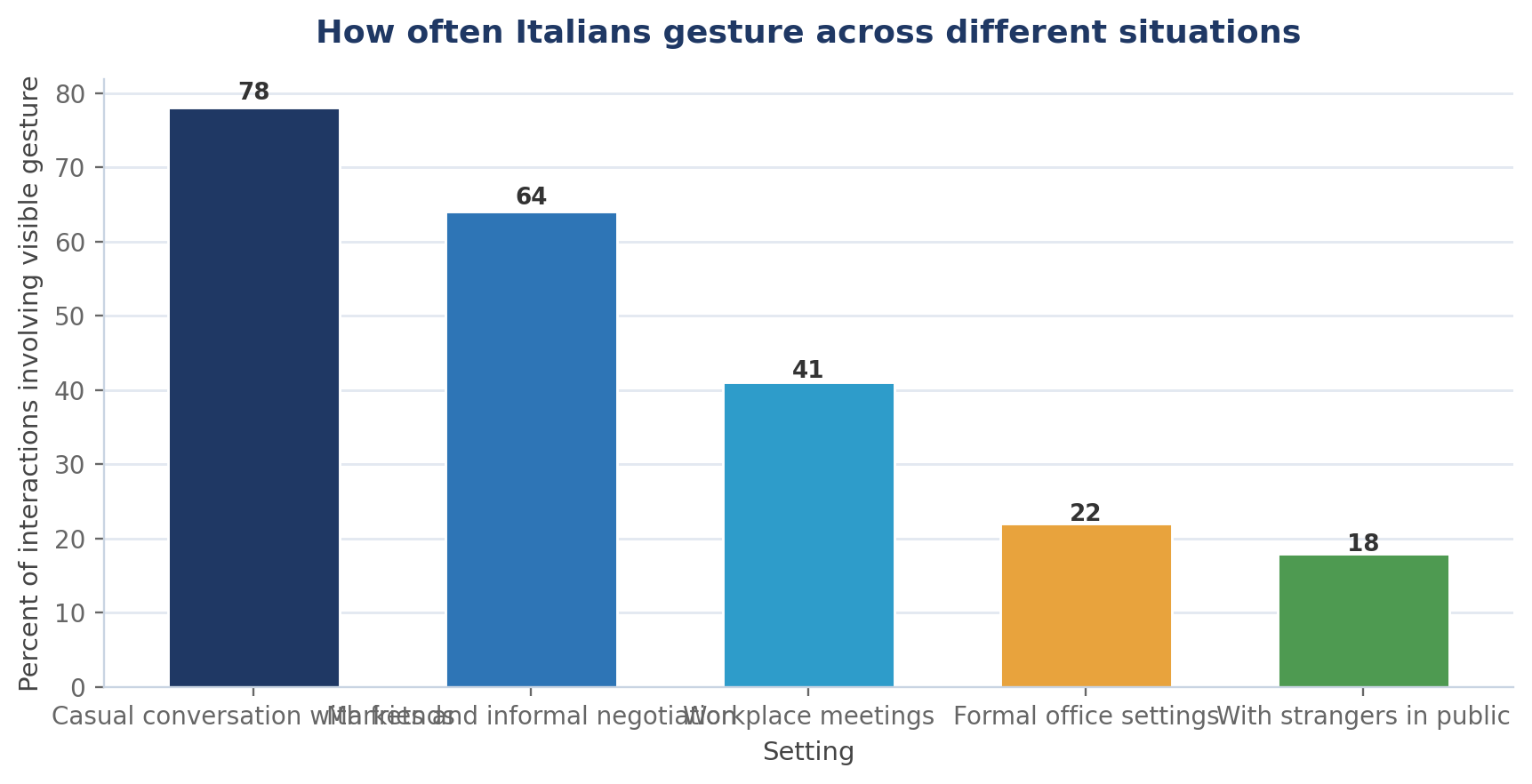
Italians talk with their hands. Everyone knows this before they arrive, and almost nobody is prepared for how true it is. A conversation between two friends can include a dozen distinct gestures in a minute, some of them carrying entire sentences, and a visitor who only listens to the words is missing half the language.
That is the good news and the warning at once. The gestures are learnable, they are friendly, and they are genuinely part of comprehension. What is harder is the layer underneath: personal space, physical contact, dress, punctuality and volume — the everyday habits that decide whether you read as a visitor or a guest.
Here is the practical guide to both.
Why Gestures Are Not Decoration
In Italy, hand gestures do grammatical and emotional work. They emphasise, negate, question, express impatience and signal shared understanding, and they often appear where the words are deliberately ambiguous.
The pattern is consistent with the culture: gestures rise with familiarity and drop with formality. If you are in a formal meeting and the gestures are minimal, that is not coldness — it is register.
The Gestures You Will Actually See
Two warnings. The temple tap and the horns gesture both carry insulting or superstitious meanings and are best learned for recognition, never for use. And any gesture is safer as a response than as an initiation — mirroring what you see is always more reliable than deploying something you read about.
Personal Space and Touch
Italy is a high-contact culture, and the distances are smaller than most visitors expect.
The stepping-back reaction is worth mentioning because it is so common and so counterproductive. Visitors from lower-contact cultures instinctively increase distance in conversation, which reads as coldness or discomfort. If you can hold your ground and stay relaxed, the interaction usually warms quickly.
Greetings, Titles and Formality
Titles matter in Italy. Dottore and dottoressa are used far more broadly than their English equivalents — often for any university graduate, not only physicians — and professore is used for teachers and academics. Starting formal and following the other person's lead is always safe.
Learn the words that go with the gestures
Understanding the hands is half of an Italian conversation, and the vocabulary is the other half. Our Italian Course Pass gives you a personal AI voice tutor who explains both as you study at your own pace. Explore the Italian Course Pass →
Start the Italian course →Create a free accountDress and Appearance
Italians read appearance quickly, and there is a simple, low-effort version of the local style that never goes wrong.
The rule is not formality; it is effort. Italians dress as though the day matters, and a clean, simple outfit reads as respect. Shorts and trainers at dinner in a town centre is the one combination that will mark you out immediately.
Volume, Punctuality and Everyday Habits
The punctuality split is the one that confuses visitors most, and it makes sense once you separate the contexts. Trains, meetings and appointments run on the clock. A dinner invitation for eight means eight-thirty, and arriving at eight is not early — it is inconvenient.
Five Habits That Mark You as a Visitor
None of these will cause offence. All of them change how you are treated, and changing them costs nothing.
Read the room in Italian, not just the words
Gestures, tone and register carry meaning that textbooks skip. Our Course Pass pairs you with a personal AI voice tutor who makes all three explicit from the first lesson. Start your Italian Course Pass →
Start the Italian course →Create a free accountFrequently Asked Questions
Do Italians really talk with their hands? Yes, extensively, though mostly in casual conversation. Gestures drop sharply in formal settings, so a quiet meeting is a matter of register rather than coldness.
How much personal space do Italians need? Less than northern European or North American norms. Expect closer standing distance and more casual touch, and avoid stepping backwards during conversation.
Should I learn Italian hand gestures? Learn to recognise the common ones, especially the pinched fingers and chin flick. Use them sparingly, and mirror what you see rather than initiating.
How should I dress in Italy? Neat, simple and slightly formal compared with tourist wear. Covered shoulders and knees for churches, closed shoes for restaurants, and avoid beachwear away from the beach.