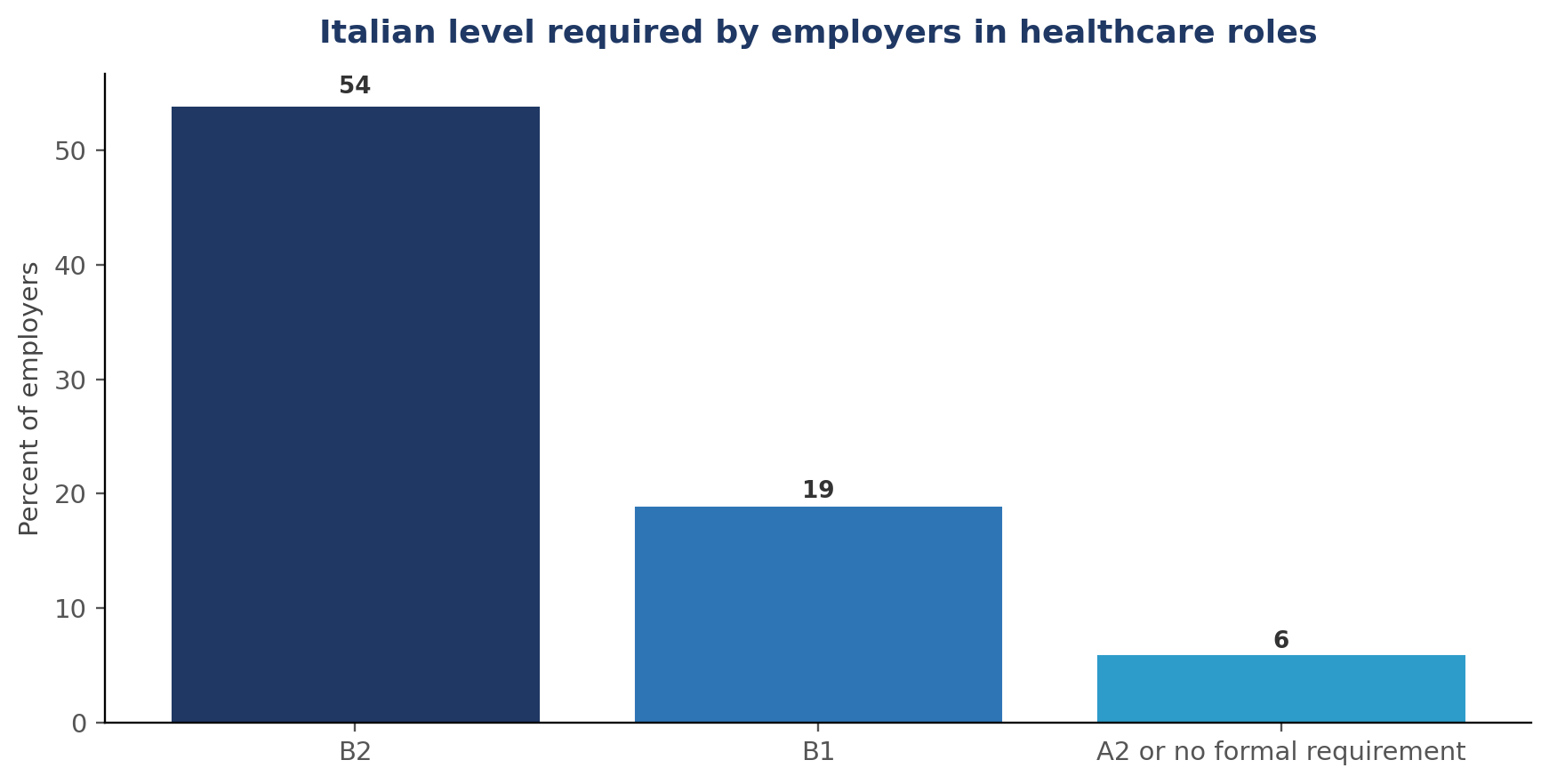
Healthcare is one of the most portable professions in the world, and Italy is short of clinicians. That combination makes Italian a career investment rather than a hobby — and it makes the language requirement unusually specific.
Nurses and doctors who move to Italy do not need literary Italian. They need a precise, narrow, high-stakes register: patient history, symptoms, instructions, consent, documentation, and the ability to understand a frightened person speaking quickly at two in the morning. That is a learnable target, and it is well defined.
This guide covers the level each role requires, the vocabulary that matters clinically, and the pathway from first lesson to practising licence.
The Level Each Role Requires
Requirements vary by region and employer, but the pattern across Italian healthcare is consistent.
The pattern behind that table is worth naming: the more you explain, instruct and reassure, the higher the requirement. Clinical knowledge transfers between countries. Explanation does not.
The Vocabulary That Actually Gets Used
Medical Italian divides into two layers. The technical layer is often Latin-based and half-familiar to anyone trained in medicine. The everyday layer — how patients describe pain — is the one that trips up foreign clinicians.
That third column is the one to drill. A patient who says mi sento stanco does not mean they are tired; they may mean they cannot get out of bed. Learning the colloquial layer alongside the clinical term is the difference between a correct assessment and a missed one.
Body, Symptoms and Pain
The standard pain construction is mi fa male plus the body part with a definite article, or ho mal di plus the area. Learn these as shapes rather than translating from English — mi fa male literally means "it makes bad to me", and trying to parse it slows you down when speed matters.
Patient Dialogue: The Phrases You Will Repeat
Non si preoccupi — don't worry — is a clinical instrument, not a courtesy. Anxiety raises heart rate, complicates history-taking and reduces comprehension, and a calm patient gives better information.
Documentation and Handover
The handover, la consegna, is where language pressure peaks. It is fast, spoken, unpaused, and it carries information that matters for the next twelve hours. It is also the single best reason to arrive at B2 rather than B1 — B1 clinicians understand most of a handover, which is not the same as understanding all of it.
Build the Italian your licence depends on
Our Italian Course Pass includes clinical vocabulary and patient-dialogue practice with a personal AI voice tutor, so you can rehearse the consultations you will actually run at your own pace. Explore the Italian Course Pass →
Start the Italian course →Create a free accountThe Pathway to Practising in Italy
Language is one requirement among several. Knowing the whole sequence prevents months of wasted effort.
Non-EU qualifications usually need a formal recognition procedure, which involves submitting documents in Italian and, frequently, an interview. That interview is a language test in practice, whatever it is called on the form.
A Realistic Study Plan
Eight to twelve months is realistic for a clinician starting near A2 or B1, with regular self-paced practice. The most efficient version pairs general Italian with clinical Italian from month four, rather than treating them as consecutive projects — because the register you need in a consultation is not the register you need in a supermarket, and it deserves its own time rather than being left until last.
From A2 to clinical confidence
Eight to twelve months of focused work can put you in a ward, working in Italian. Our Course Pass gives you a personal AI voice tutor who builds both the general and the clinical register with you, at your own pace. Start your Italian Course Pass →
Start the Italian course →Create a free accountFrequently Asked Questions
What level of Italian do nurses need in Italy? B2 is the standard requirement for nursing roles, because ward work involves constant patient dialogue, handover and documentation in real time.
Do doctors need B2 to work in Italy? Many hospital posts ask for B2 as a minimum, because consultations, consent discussions and case presentations demand precision and nuance.
Is medical Italian hard to learn? The technical vocabulary is often recognisable through Latin and Greek roots. The harder part is the colloquial language patients use to describe symptoms, which is not taught in clinical textbooks.
How long does it take to reach B2 in Italian? Around 600 guided hours from zero, or roughly 200 from B1. Clinicians typically take eight to twelve months while also completing qualification recognition.