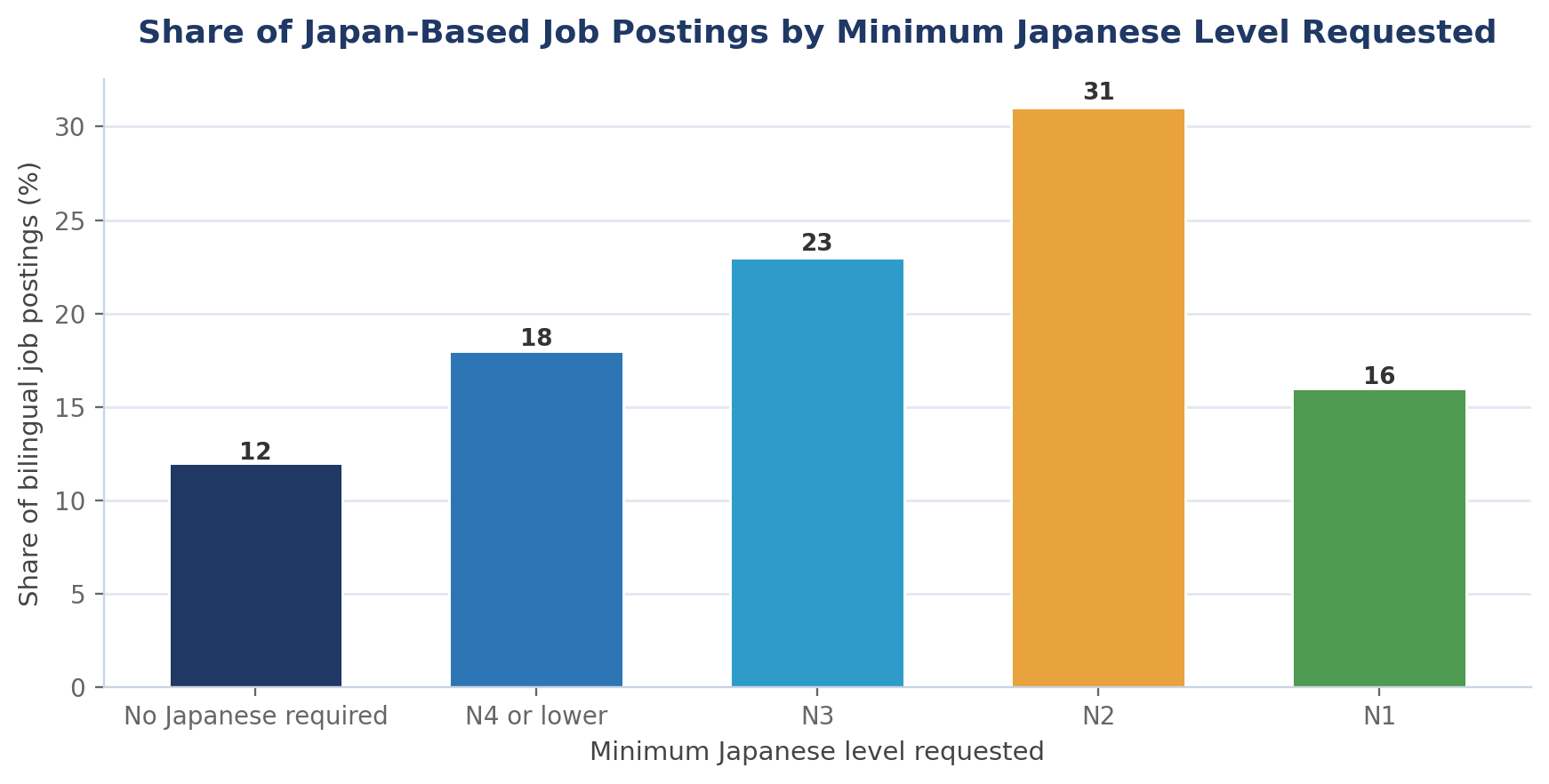
You have seen the job ads. "Japanese N2 required." "English-only workplace, no Japanese needed." "Business-level Japanese essential." So which one is true? All of them — and that is exactly why this question drives so many smart people in circles.
Here is the honest answer up front: the amount of Japanese you need depends far more on your job type than on the country itself. An engineer at a foreign-owned tech firm in Tokyo might genuinely survive on polite survival Japanese. A sales rep at a domestic trading company will sink without near-native business fluency.
Let's break it down so you can stop guessing and start planning.
The Fast Reality Check: Job Type Decides Everything
Japanese language requirements in Japan are not one number. They are a spectrum, and your industry picks your point on it. International companies with English as their working language hire people with almost no Japanese every single day. Domestic companies serving Japanese customers demand far more, because the customer conversation is the job.
Notice the pattern? The further you sit from a Japanese-speaking customer, the lower the bar. The closer you sit, the higher it climbs.
The Visa Layer Nobody Explains Properly
A Japan work visa does not usually test your Japanese. It tests your qualifications, your employer, and the category you qualify under. That single fact surprises almost everyone, and it reshapes how you should prepare.
So if you are heading in on an Engineer/Specialist visa, the JLPT is not a legal gate — it is a hiring gate. Employers use it as a cheap, reliable filter, and that filter is real.
What Employers Actually Test in the Interview
Here is a secret that saves people months: companies rarely care about your certificate alone. They care whether you can function in a meeting, write a clear email, and not create awkward friction with colleagues.
That last row is underrated. A huge part of working happily in Japan is being able to laugh at lunch, not just file a report.
The Level-by-Level Translation
Let's translate JLPT numbers into lived experience, because "N2" means nothing until it means something.
If you are aiming at domestic employment, N2 is the widely quoted practical floor. N1 opens doors that N2 merely knocks on.
Does "English-Only Workplace" Save You?
Sometimes. Foreign-owned tech companies, some startups, and international research teams genuinely operate in English. But there is a catch worth hearing clearly.
The office may run in English while life runs in Japanese. Your landlord, your city hall, your dentist, and your neighborhood association will not switch for you. People who ignore this often report culture shock far more intense than the job itself. Even in English-friendly workplaces, N4–N3 makes daily life dramatically smoother and signals respect to your colleagues.
Business Japanese: The Small Skills That Move Careers
Business Japanese is a distinct discipline, and it is where careers accelerate or stall. Three things matter most:
Keigo (honorific language). You do not need flawless mastery, but you need the polite register: いらっしゃいます, お世話になっております, 恐れ入ります. These phrases are the handshake of corporate Japan.
Reading the air (空気を読む). Indirect communication is normal. Learning to read a soft "that might be difficult" as a firm no is a genuine professional skill.
Writing clearly. Emails follow templates. Learn the templates and you sound competent immediately, no matter your accent.
Build job-ready Japanese, not textbook Japanese
Our Japanese Course Pass trains the exact keigo, email patterns, and meeting language employers actually test.
Start your Japanese Course Pass →Create a free accountA Realistic Timeline for Tech and Engineering
For engineering and IT roles, where the bar sits around N3–N2, timelines are shorter than people fear.
Consistency beats intensity. Ninety focused minutes daily will outrun heroic weekend cramming every time.
Common Myths, Quickly Busted
Myth: "You need N1 to work in Japan." Only for certain client-facing and management roles. Plenty of engineers work at N3.
Myth: "No Japanese means no job." False. Foreign firms and English-teaching roles hire constantly. Japanese simply expands your options enormously.
Myth: "I'll learn it once I arrive." You can — but arriving with N4 or N3 transforms your first six months from survival mode into genuine integration.
How to Actually Prepare
Start with the level your target job demands, then work backward. Build daily habits around listening, because real Japanese is fast, casual, and full of contractions that textbooks hide. Practice speaking out loud, even alone, because recognition and production are different skills. And most importantly, make a plan with a finish line — a test date, a job application deadline, a relocation date. Deadlines create fluency.
Your fastest route from zero to workplace-ready
Join the learners turning scattered study into structured, employer-relevant Japanese — create your free account and get moving today.
Unlock the Japanese Course Pass →Create a free accountFrequently Asked Questions
Do I need JLPT certification to get a Japanese work visa? For most professional visas, no formal Japanese test is required — only the Specified Skilled Worker route explicitly tests language via JFT-Basic or JLPT N4. Employers, however, frequently ask for JLPT as a hiring filter.
What JLPT level do most companies ask for? Domestic companies commonly request N2, with N1 preferred for client-facing, sales, and management roles. International firms with English working languages often accept N3 or lower.
Can I get a job in Japan with zero Japanese? Yes, especially in engineering at foreign-owned firms, English teaching, and some international startups. Your daily life will be harder without at least N4, so early study pays off fast.
How long does it take to reach N2? It varies widely by starting point and study hours. Many dedicated learners report roughly 1,500–2,000 study hours to reach N2, which often translates to about two years of consistent daily practice.