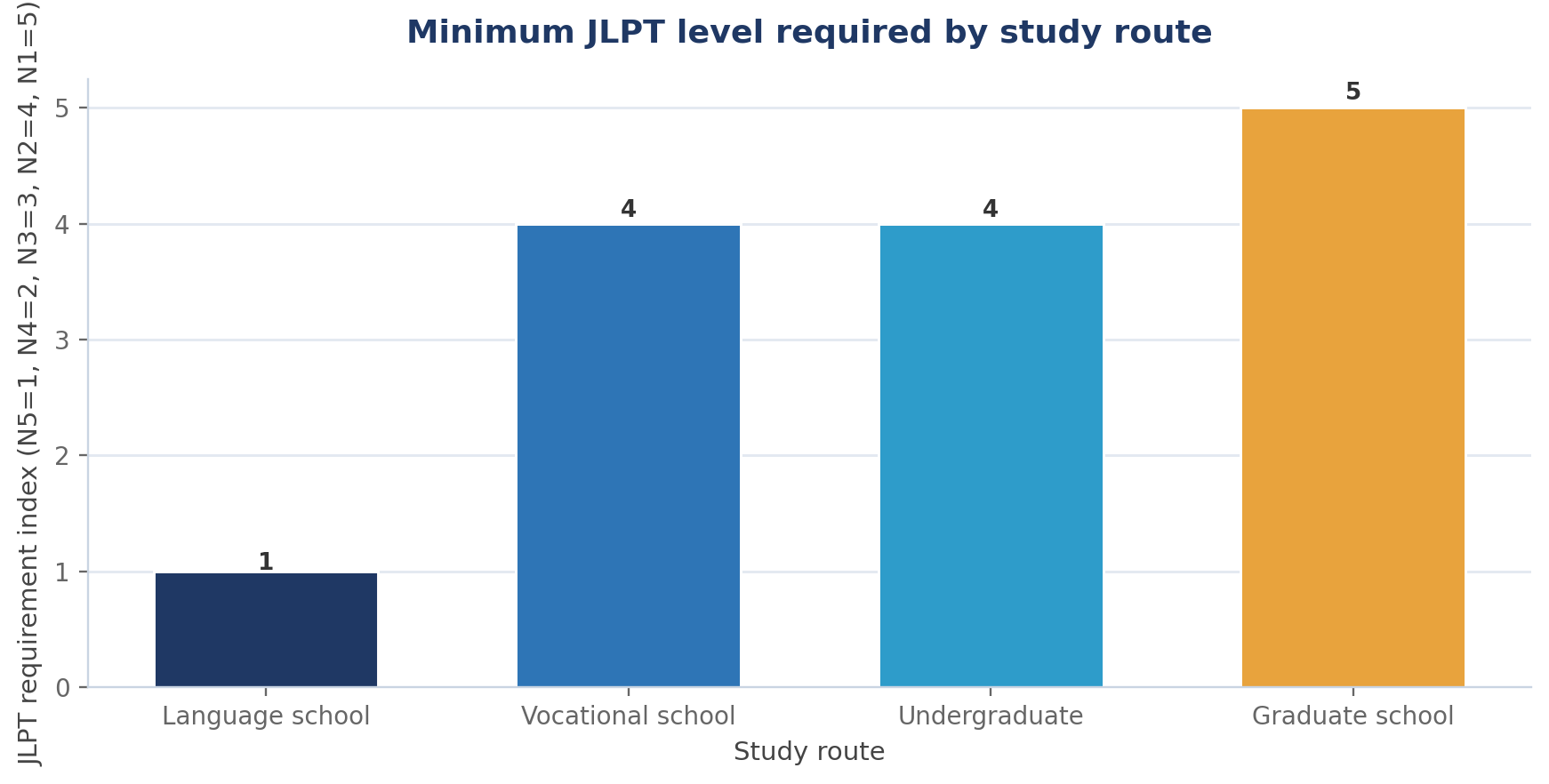
The single biggest reason study plans in Japan collapse is not tuition, paperwork or visas. It is language level. Applicants discover too late that the programme they wanted expects N2, and they arrive with N4.
This guide sets out what each route actually requires, how the JLPT maps onto those requirements, and how to sequence language study with your application so the two do not collide.
What you will get from this guide
- The Japanese level required by each study route
- How the JLPT levels map to real ability
- The pathway most students actually take
- A realistic preparation timeline
What each route requires
The single most useful fact on that table: language school is the standard on-ramp. Most international students enter a Japanese language school first, reach N2 over one to two years, then apply to a university or vocational programme.
JLPT levels, honestly described
Those hours are cumulative estimates, not rules. They assume guided study with listening practice; learners who study only for the test often need longer in real conversation.
Reach the level your programme actually asks for
A personal AI voice tutor delivers structured, self-paced lessons targeting real ability, not just test technique — the reading, listening and speaking you will need in a Japanese classroom.
Prepare Japanese for study →Create a free accountThe pathway most students take
The EJU — Examination for Japanese University Admission for International Students — tests Japanese as a Foreign Language along with subject areas. Many universities use it as their main measure, alongside or instead of the JLPT. Check each university's requirements carefully, because they genuinely differ.
What the language test does not tell you
Note the gap: the JLPT does not test speaking. Students who pass N2 sometimes arrive unable to hold a seminar conversation. Build speaking practice alongside test preparation, not after it.
Documents and deadlines
Deadlines cluster around intake periods, typically April and October. Missing one usually costs a full year, which is why the language timeline has to start long before the admissions paperwork.
Cost and the language-school year
Many students work part-time, which doubles as free listening practice — provided it does not eat the study time that got them there.
Arrive already able to follow the class
The students who thrive in Japan are the ones who built Japanese before the pressure started. Self-paced, level-matched AI voice-tutor lessons get you there faster.
Start your Japan study plan →Create a free accountFrequently Asked Questions
Do I need to speak Japanese to study in Japan? Not for English-taught programmes. For Japanese-taught programmes, N2 is the usual minimum, and language school is the standard way to reach it.
What JLPT level do Japanese universities require? Most require N2, with N1 preferred for competitive faculties and graduate research. Requirements vary by institution, so always check directly.
How long does it take to reach N2? From zero, typically around two years of consistent study, or one to two years in a language school with daily immersion.
Is the EJU required? Many universities require the EJU for undergraduate admission, especially for Japanese as a Foreign Language. Others accept JLPT results. Confirm with each university.
References & Further Reading
- Japan Student Services Organization (JASSO) — Study in Japan: official guidance
- Japan Foundation — JLPT: Japanese-Language Proficiency Test
- JASSO — Examination for Japanese University Admission (EJU)
- Japan Foundation — Japanese-language learning resources
- Ministry of Foreign Affairs of Japan — Visa and Certificate of Eligibility information