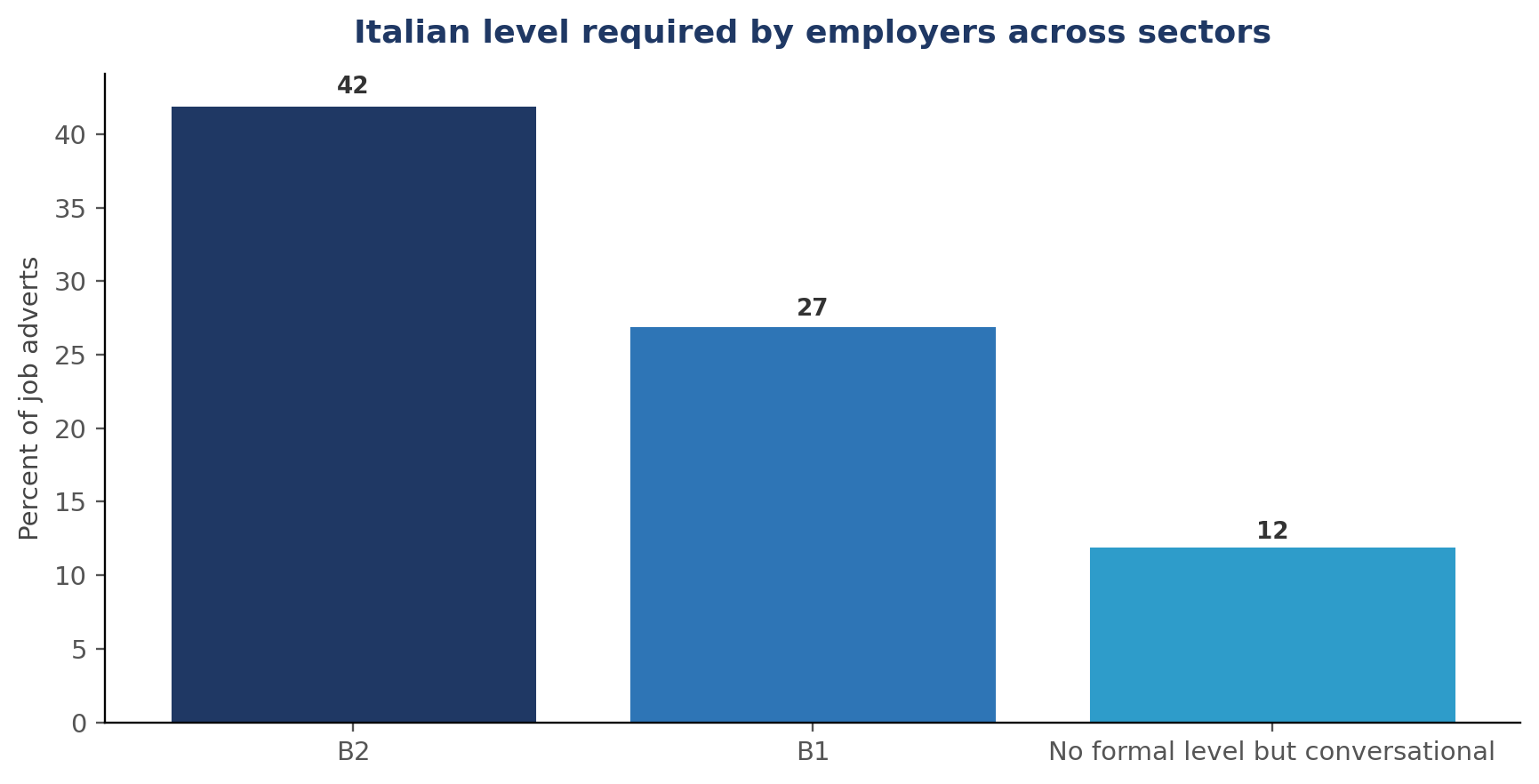
Job adverts in Italy are unspecific about language. They ask for "buona conoscenza dell'italiano" — good knowledge of Italian — and leave you to guess whether that means B1 or near-native. The guess matters, because the gap between those two levels is several hundred hours.
The useful answer is that the requirement is set by the job's language exposure, not by its seniority. A warehouse role with daily team communication needs more Italian than a senior technical role performed mostly in English. Sector and interaction type decide the level, and the pattern across the Italian labour market is consistent enough to plan around.
Here is the sector-by-sector breakdown, plus the interview and CV language that determines whether you actually convert a B2 into a contract.
What Employers Mean by a Level
The Level by Sector
The consistent logic: the more you explain, negotiate or write, the higher the level. The more you do in English or through systems, the lower it can be — though the social side of a workplace almost always demands B1 regardless.
The Level by Role Distance From the Customer
Learners often assume a senior role means a higher requirement. In practice a senior engineer in an English-speaking team may need less Italian than a hotel receptionist, because the job's language exposure is lower. Check the interaction pattern, not the title.
The Interview Is the Real Test
Italian interviews include a stage that surprises foreign candidates: questions about motivation, suitability and cultural fit, asked conversationally. Once the conversation moves away from your CV, your fluency is being assessed.
The last two rows are where candidates lose offers. Not having questions reads as low interest, and a nervous answer about salary expectations reads as uncertainty about your own value.
Business Register: What Changes at Work
Workplace Italian is more formal than the Italian you learn on a course, and the differences are systematic.
Two habits carry most of the weight. First, default to Lei with anyone you have not been explicitly invited to address with tu. Second, soften refusals — purtroppo and mi dispiace are not decoration, they are how disagreement is expressed without friction.
Build the Italian that gets you hired
Our Italian Course Pass includes interview practice, business register and CV support with a personal AI voice tutor that teaches structured lessons at your own pace. Explore the Italian Course Pass →
Start the Italian course →Create a free accountCV and Application Vocabulary
That last row catches foreign candidates regularly. Italian salaries are quoted lordo — gross — and the difference to netto is substantial, so a figure that sounds generous can be ordinary in the hand.
A Realistic Language Plan for Job Seekers
Twenty weeks is a realistic runway from a solid B1 to a confident B2 with interview practice included. The efficient approach front-loads the interview, because interview language is narrow, predictable and highly reusable — which means you get a large return for a small vocabulary investment.
Twenty weeks from B1 to hired
Interviews reward preparation far more than general fluency. Our Course Pass combines guided lessons, speaking practice with AI feedback and business vocabulary so you arrive ready for the conversation that decides it. Start your Italian Course Pass →
Start the Italian course →Create a free accountFrequently Asked Questions
What level of Italian do I need to work in Italy? B1 is the practical minimum in most workplaces, and B2 is what most customer-facing and professional roles ask for.
Is English enough to get a job in Italy? In some international companies and technical teams, yes. Even there, a B1 level of Italian changes how colleagues treat you and how quickly you settle in.
Do Italian employers ask for language certificates? Often not at B1 and B2 level; the interview does the testing. Regulated professions and public-sector roles usually do require a formal certificate.
How do I prepare for a job interview in Italian? Learn the six standard question types, script your answers, and rehearse out loud with the AI voice tutor, which gives feedback on your speaking.