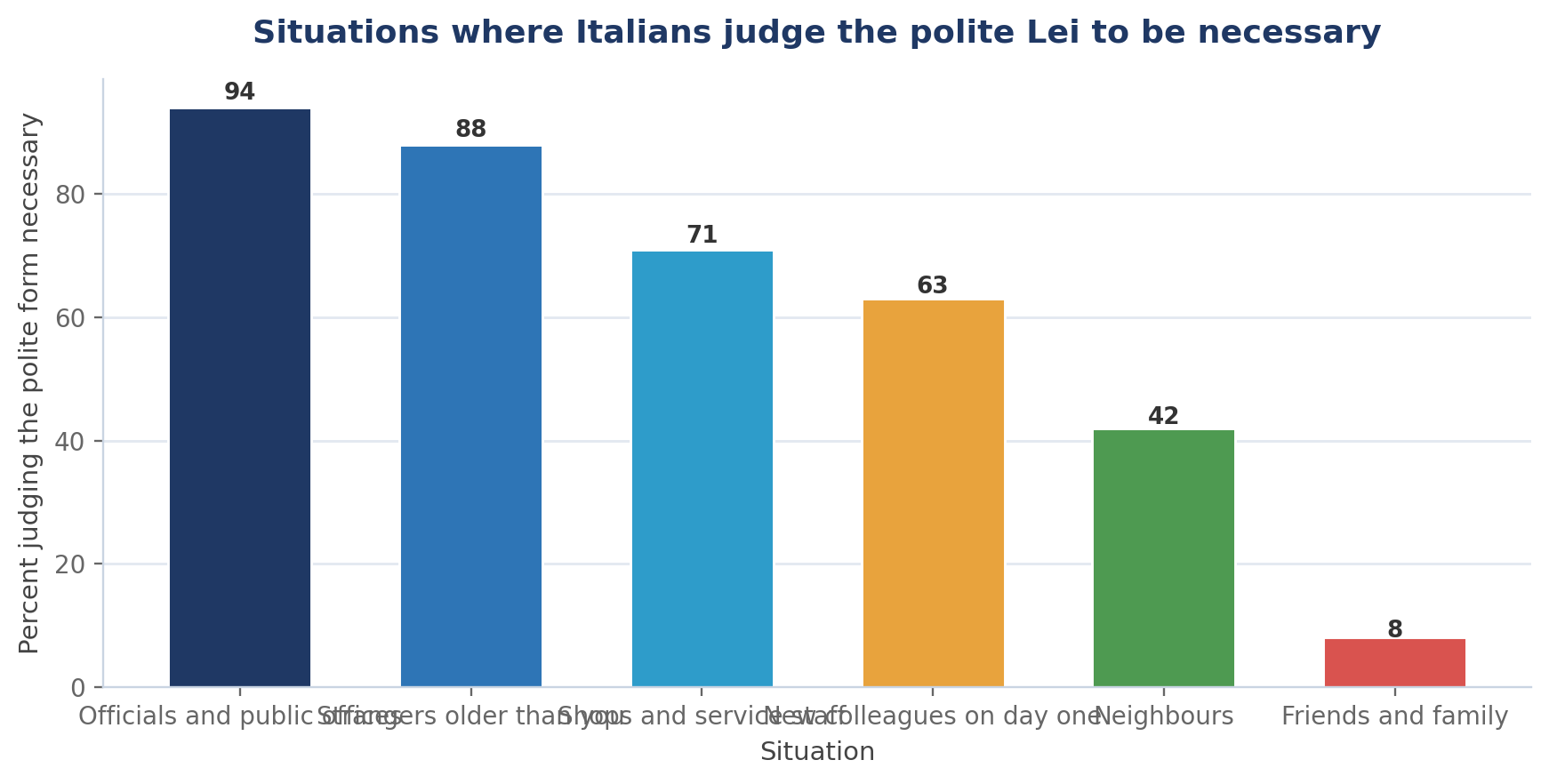
Italian has one social rule that learners meet within thirty seconds of their first real conversation, and get wrong more often than any grammar point: the choice between tu and Lei.
Get it right and you are treated as a polite guest. Get it wrong in one direction and you sound stiff and distant. Get it wrong in the other and you can cause genuine offence — particularly with older people, officials and anyone in a professional role. The grammar is easy. The judgement is what needs practice.
Here is the whole system, and the practical shortcuts for the situations you will actually meet.
The Two Registers at a Glance
The formal form is the reason Italian feels strange at first. To be polite, you do not use a special word for "you" — you address the person using the third person, as if talking about them rather than to them. It is the Italian equivalent of addressing someone as "sir" or "ma'am" in every sentence.
Note the capitalisation: in writing, Lei is often capitalised to distinguish it from lei meaning "she".
The Same Sentence in Both Registers
The contrast is clearest in the verbs, because the endings change completely.
Look at the third row: Parla inglese? is identical in both registers, because the third person singular and the formal form coincide for most regular verbs. Two rows are worth memorising as whole units — Come si chiama? and Mi dica — because they are the polite versions you will use most often with strangers.
When the Polite Form Is Expected
The boundary between tu and Lei is not about age alone. It is about distance, formality and role, and Italians apply it instinctively.
That last row is the exit door from formality, and it has a name. Diamoci del tu literally means "let's give each other the tu". When someone says it, switch immediately and permanently — continuing with Lei after the invitation sounds cold.
How to Switch Register Gracefully
Switching is a social act, and there are standard ways to do it in both directions.
In practice, who offers matters. The older or more senior person usually extends the tu, and the younger or more junior person accepts rather than proposes. Offering the switch upward is not rude, but it is bolder than learners often intend.
The Small Words That Change With Register
Register is not only about verbs. A whole layer of words shifts.
The greeting pair is the one to master first: Ciao is only for people you would use tu with. Saying Ciao to a police officer or a university professor is a genuine mistake, and Buongiorno works in almost every formal situation from morning until mid-afternoon.
Learn the register by using it, not by reading about it
Which form to use depends on the moment, and only practice builds that instinct. Our Italian Course Pass gives you a personal AI voice tutor that corrects your register as naturally as your grammar, in structured self-paced lessons you can study any time. Explore the Italian Course Pass →
Start the Italian course →Create a free accountFive Mistakes Learners Make
The fourth row is the most common error at intermediate level. Learners get the Lei verb right and then attach a tu possessive — Come sta la tua famiglia? instead of Come sta la Sua famiglia? Consistency matters more than anything else here; a single wrong pronoun undoes the impression the verb form created.
Practical Shortcuts for Travellers and Newcomers
If you remember only one rule from this article, make it this one: when in doubt, use Lei and Buongiorno. Over-formality is read as respectful effort; over-familiarity is read as a mistake. The asymmetry is almost total.
Never worry about which form to use again
Register is learned in conversation. Our Italian Course Pass gives you a personal AI voice tutor that models tu and Lei naturally, so the right choice becomes automatic. Start your Italian Course Pass →
Start the Italian course →Create a free accountFrequently Asked Questions
What is the difference between tu and Lei in Italian? Tu is the informal singular "you", used with friends, family, peers and children. Lei is the polite form, used with strangers, older people, officials and professionals, and it takes third-person singular verbs.
When should I use Lei instead of tu? Use Lei with anyone you do not know well, with older people, and in offices, shops and professional settings. Switch to tu when invited — usually with diamoci del tu.
Is it rude to use tu with an older person in Italy? It can be, particularly with someone significantly older or in a formal role. Many people would not be offended, but some would, and the polite form is the safe choice.
How do I offer to switch to tu in Italian? Say Possiamo darci del tu? or Diamoci del tu. Either works, though the older or more senior person usually makes the offer first.