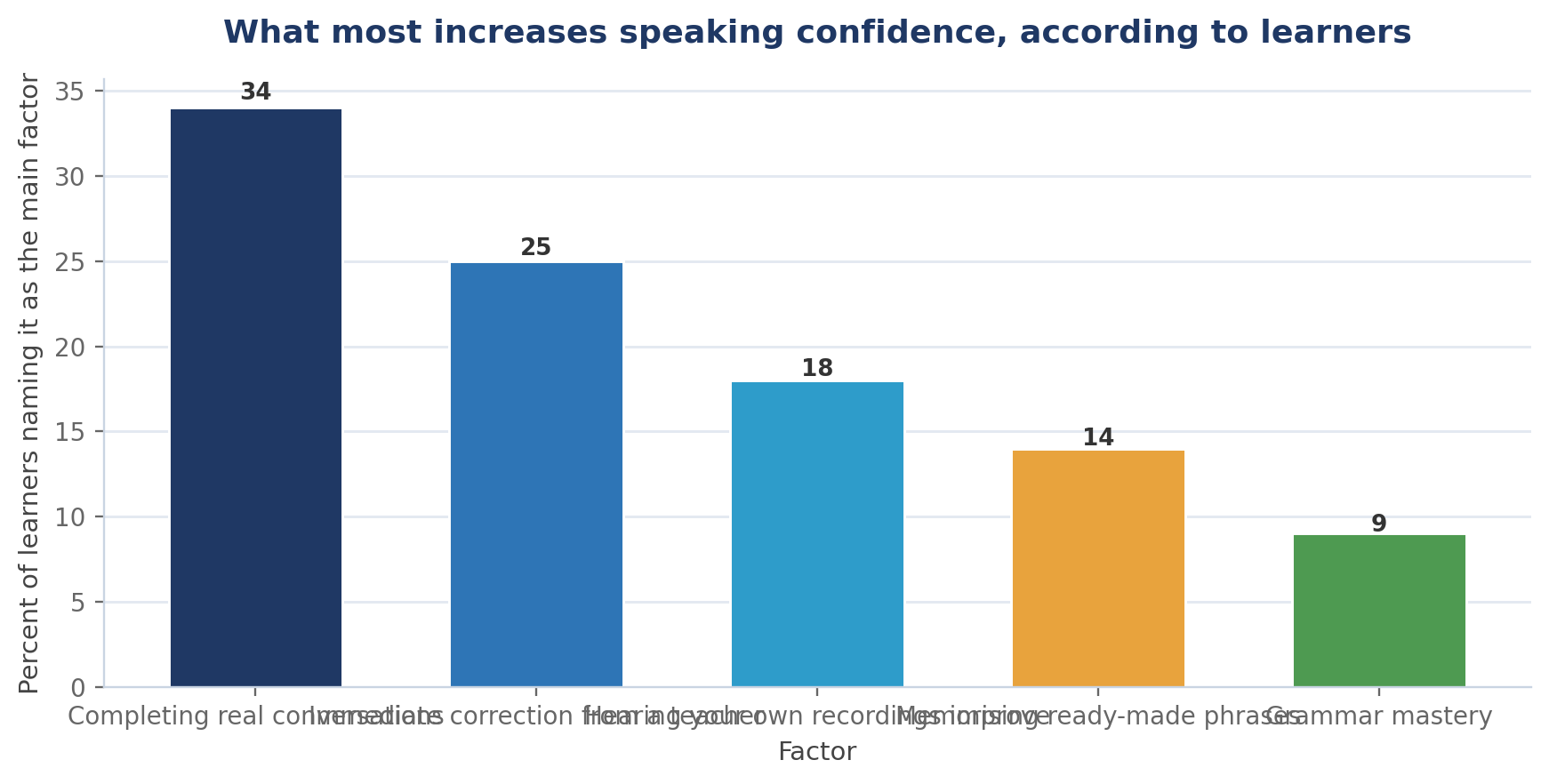
Confidence is not a personality trait, and it is not something you talk yourself into. It is the reasonable conclusion your brain reaches after a run of evidence — in this case, evidence that you can survive a conversation in Italian and come out the other side intact.
That reframing matters, because almost all advice on speaking confidence is encouragement: be brave, make mistakes, don't worry. Encouragement does not produce evidence. Structured practice does.
The method below is built entirely around generating evidence, fast, in small doses, and then noticing it. It works because it treats confidence as an output rather than an input.
Confidence Comes From Evidence
The mechanism is simple enough to state in a table, and it explains why so much well-meaning advice fails.
The last row is the one learners get wrong most often. Throwing yourself into a terrifying conversation every day does not build confidence — it produces avoidance. Repeating a manageable situation until it is boring, then adding one small difficulty, is what builds it.
The Confidence Ladder, in Order
Work up one rung at a time. Move on only when the current rung feels routine rather than brave.
Two things make this ladder work. First, every rung is measured in successful repetitions, not in feelings. Second, rungs 1 to 3 cost nothing and require no social risk, which means you can begin today.
Perfect Ten Phrases Before Anything Else
Fluency anxiety concentrates at the beginning of an interaction. If the first thirty seconds are automatic, the rest goes better. Ten fixed phrases cover most of those thirty seconds.
Learn this list until it is unconscious. Then the opening of every conversation is a rehearsed movement rather than a live calculation — and confidence has a place to stand.
Build a Confidence Log
Evidence decays if you do not record it. A confidence log takes two minutes a day and does more for motivation than any motivational technique.
That last row is not a setback. At week fourteen the difficulty rises because you have stopped choosing easy tasks — which is precisely the shape of real progress.
Recovery Beats Perfection
The fastest confidence gain available is learning to handle errors. An error that ends a conversation teaches your brain to fear errors; an error you recover from teaches it that errors are survivable.
Non mi viene la parola is the phrase that changes the most. It converts a freeze into a sentence, and in practice other speakers almost always supply the word you are missing — which turns a moment of failure into a moment of help.
Practise with a patient AI voice tutor
The safest place to make errors is a lesson. Our Italian Course Pass gives you a personal AI voice tutor that corrects gently, models natural speech and builds your confidence one conversation at a time. Book a speaking assessment →
Start the Italian course →Create a free accountThe Weekly Structure That Builds Confidence Fastest
That is roughly ninety minutes a week, and it contains the two ingredients confidence actually needs: manageable real interactions and a record of them.
Five Habits That Destroy Confidence
The fifth row is worth replacing with something concrete. "Hold a three-minute conversation about my weekend" is reachable in weeks and gives you a genuine win. "Become fluent" is reachable in years and gives you nothing to celebrate on a Tuesday.
Confidence is built conversation by conversation
Ninety minutes a week, with a patient AI voice tutor and a clear ladder, is enough. Our Italian Course Pass gives you a personal AI voice tutor, structured levels from A1 to B2 and a progress record you can see. Start your Italian Course Pass →
Start the Italian course →Create a free accountFrequently Asked Questions
How long does it take to feel confident speaking Italian? Most learners notice a clear shift after five to ten short conversations. Reaching the point where routine situations feel routine usually takes two to three months of regular practice.
Should I practise alone if I have no one to speak with? Yes, for two of the three skills. Recording monologues and shadowing audio build fluency and pronunciation. Only real interaction builds the social confidence that comes from being understood.
What if I make a mistake in the middle of a sentence? Use a recovery phrase and keep going. Ho sbagliato, ricomincio is a controlled restart, and native speakers respect it far more than silence.
Is it better to speak badly every day or well once a week? Badly every day. Frequency builds fluency, and errors are the raw material for correction — which is why a weekly AI tutor session plus daily speaking aloud works so well.