B1 is the level that opens doors. It is the German most employers ask for, the level most visa routes accept, and the first point at which you can genuinely live in the language rather than survive in it.
It is also the exam where competent speakers fail — because B1 tests four skills at once and most candidates have been training only two.
What you will get from this guide
- The full Goethe-Zertifikat B1 structure, timings and scoring
- What the exam actually rewards at B1
- Section-by-section strategy for all four modules
- An eight-week preparation plan with practice exercises
The Exam Structure
Goethe-Zertifikat B1 has four modules, each worth 25 points, for 100 in total. Modules are examined and certified separately, so a weak module can be retaken alone.
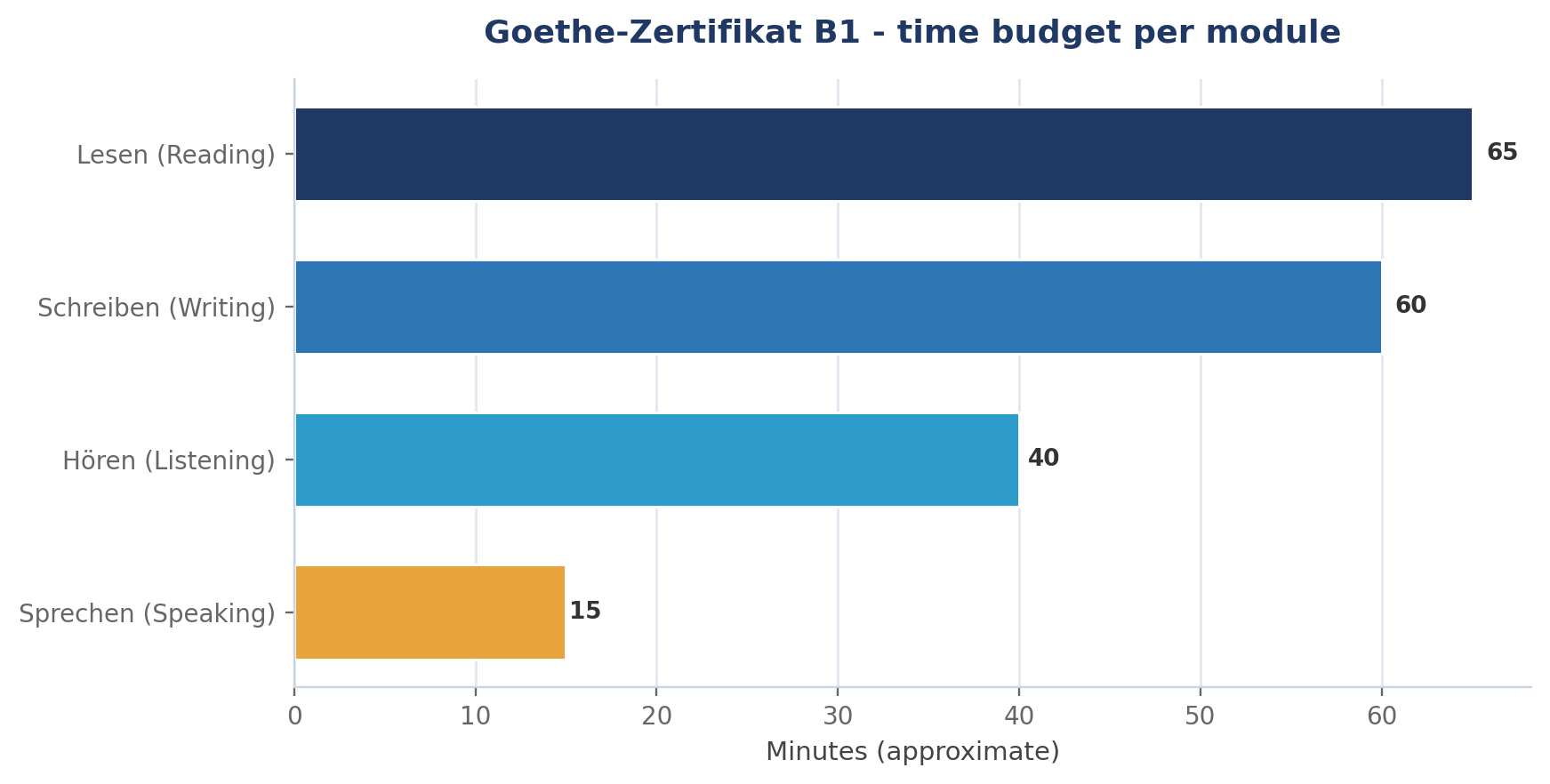
The mismatch is worth staring at. Reading and writing take over two hours between them; speaking takes fifteen minutes. Candidates routinely arrive having read novels in German and never once recorded themselves speaking for a quarter of an hour.
You need 60 out of 100 points to pass, with all four modules assessed.
What B1 Actually Tests
B1 rewards communication over sophistication. A simple, correct, well-organised answer beats an ambitious, tangled one every time.
Lesen: Five Parts, One Skill
Reading at B1 is a scanning and inference exercise under real time pressure. You get roughly one minute per item.
- Read the questions first, always. Then hunt the text for the answer.
- Expect distractors that appear in the passage but do not answer the question.
- Watch negation: nicht, kein, ohne. Negation flips meaning and is the top cause of careless errors.
- Do not translate. Translate and you will run out of time by part four.
- In the matching tasks, eliminate wrong options first — narrowing beats searching.
Hören: The Module That Decides Most Results
Listening plays twice in most parts. That is a strategy gift, not a safety net.
Practise with Deutsche Welle's Langsam gesprochene Nachrichten for structure, then at full native speed once a week so nothing on exam day is a shock.
Schreiben: Three Tasks, All Predictable
Structure your answers around a fixed shape: greeting, reason for writing, two or three supporting points, a question or request, and a close. Memorise one template per task type and adapt the content.
Note that task 3 is formal, which means Sie, Sehr geehrte, and Mit freundlichen Grüßen. Mixing registers between tasks is a frequent and entirely avoidable mark loss.
Get all three writing tasks corrected before the examiner reads them
Register errors and missing content points are invisible to the writer and obvious to a marker. On LanguageSkills.net, every B1 text you submit comes back annotated by your personal AI voice tutor, with speaking practice and printable study materials to reinforce the same skills.
See the German B1 course →Create a free accountSprechen: Three Parts You Can Rehearse
Three things move the mark more than vocabulary. Structure your presentation with Zuerst…, Dann…, Abschließend…. Respond to your partner — this is a dialogue, not two monologues. Keep going when you stumble; self-correction is fine, silence is not.
An Eight-Week Preparation Plan
Keep one notebook of every mistake and why it happened. By week eight you will see a pattern, and patterns can be fixed in days.
Walk in having already practised the format
Our B1 track includes guided lessons, speaking practice with AI feedback, listening practice and printable study materials, all at your own pace. Candidates who work through the full A1–B2 course systematically tend to feel far more prepared than those who study alone.
Book your Goethe B1 prep →Create a free accountWhy Prepared Candidates Still Fail
- Ignoring speaking until the final fortnight, then discovering they cannot sustain two minutes of monologue.
- Writing under the word limit. Task 1 and 2 require around 80 words; sitting at 45 loses content points.
- Mixing formal and informal register within one task.
- Freezing when a listening item is missed, and thereby losing the next three.
- Never sitting a full timed mock — so the exam is the first time they meet the format.
Frequently Asked Questions
What score do I need to pass Goethe B1? 60 out of 100 points, across all four modules. Individual modules can usually be retaken separately if needed.
How long does it take to prepare for Goethe B1? If you are already at a solid A2, eight to twelve weeks of focused preparation is realistic. Reaching B1 from scratch takes around 350–400 guided hours.
Is Goethe B1 difficult? The language is manageable; the format is demanding. Most failures come from unbalanced skills and unfamiliarity with the exam, not from insufficient grammar.
Does Goethe B1 expire? No. The certificate has no expiry date.
Is B1 enough to work in Germany? It is the level many employers and visa routes ask for, particularly in healthcare, care work and technical roles. Some regulated professions require B2.
References & Further Reading
- Goethe-Institut — Goethe-Zertifikat B1 examination regulations and Modellsatz: https://www.goethe.de
- Goethe-Institut — B1 Wortliste and grammar scope: https://www.goethe.de
- telc gGmbH — telc Deutsch B1 specifications for comparison: https://www.telc.net
- Deutsche Welle — Deutsch lernen B1 and Langsam gesprochene Nachrichten: https://learngerman.dw.com
- Council of Europe — CEFR Companion Volume, B1 descriptors: https://www.coe.int
- LanguageSkills.net — German A1–B2 courses: https://languageskills.net/german
The Takeaway
Goethe B1 is not a knowledge exam. It is a performance exam with a published format, four finite modules and a 60-point bar. Learn the format, train the two skills candidates neglect — writing and speaking — and sit at least two full timed mocks. That is the whole method.