Most people fail Goethe-Zertifikat A2 for one boring reason: they never practised the exam itself. They learned German. They did not learn this test.
The four modules are predictable. The timing is ruthless. The speaking exam is filmed, marked by two examiners, and lasts barely fifteen minutes. That is your battlefield — and every part of it can be rehearsed.
What you will get from this guide
- The exact structure of all four modules
- The scoring maths, so you know what "pass" actually means
- A twelve-week plan you can run while working
- The five mistakes that quietly cost candidates marks
What the Exam Actually Contains
Goethe-Zertifikat A2 has four modules. You can sit them together on one day or split them across separate dates — a detail many candidates miss, and a genuine lifeline if your speaking is weaker than your reading.
Each module is worth 100 points. The exam is passed per module at 60 points — so a strong reading score cannot rescue a failed listening score. Plan accordingly. Too many candidates pour hours into grammar and arrive at the listening paper untested.
The Score You Actually Need
You need 60 in each module. Write that number on your study wall.
Reading: Speed Beats Understanding
Thirty minutes, four tasks, and texts that are never as hard as they look. The trap is over-reading. You do not need to understand every word of a German notice about a cancelled bus — you need to find which day, which platform, and whether it affects you.
Train by timing yourself. Read, answer, move on. Candidates who finish with eight minutes spare get to check their answers; candidates who read slowly never do.
Listening: The Module That Fails People
Here is the cruel truth about A2 listening. The audio plays once. Some tasks repeat a key phrase, but you cannot rewind. If your brain is still translating sentence three when sentence six arrives, you lose the thread.
The fix is not more vocabulary. It is tolerance for speed. You need hours of German at natural tempo before exam day — podcasts, Deutsche Welle's slow-news programmes, and above all conversation with a real speaker who does not slow down for you.
Writing: Two Tasks, One Discipline
The writing paper is short and mechanical, which is good news.
Marks come from three places: did you complete the task, is the grammar clean enough, and is it readable. A simple, correct, slightly boring answer beats a creative one riddled with mistakes. Learn ten reusable sentence frames — Ich würde gerne…, Leider kann ich nicht…, Vielen Dank für deine Nachricht — and deploy them.
Exam-shaped German beats general German
Ready to turn reading into real German? Start your self-paced course today.
Start the German course →Create a free accountOur self-paced German course is built around the tasks the examiner actually marks. You write, you get AI feedback, you rewrite — with a personal AI voice tutor that follows the Goethe rubric and shows you exactly where you are leaking points. Button: Prepare for Goethe A2 →
Speaking: Fifteen Minutes, Three Tasks
Two examiners, one conducting, one observing. Task 3 is the one candidates butcher: you must negotiate, not just state your opinion. Das finde ich auch. Sollen wir vielleicht…? Ja, gute Idee, aber… Learn the art of agreeing and gently pushing back. It is a conversation, not a monologue.
Your Twelve-Week Plan
Logistics matter more than people admit. Register early — places fill months ahead. Bring valid photo ID matching your registration name exactly. Arrive early; latecomers are refused.
Five Mistakes That Cost Marks
First, ignoring the format. Learn the task types before exam week, not during it.
Second, writing too much. A 120-word answer where 50 was asked can lose you marks for relevance.
Third, talking over your speaking partner. Task 3 tests interaction; dominating the conversation is not a bonus.
Fourth, silent panic in listening. Miss a sentence, let it go, rejoin at the next task. Clinging to a lost answer destroys the ones after it.
Fifth, no timed practice. Untimed past papers feel reassuring and teach you almost nothing.
Practise the exam tasks with a personal AI voice tutor
Ready to turn reading into real German? Start your self-paced course today.
Start the German course →Create a free accountTwelve weeks is enough — if you practise the right things. Our AI voice tutor guides you through Goethe A2-style tasks, gives AI feedback on your writing, and lets you rehearse the speaking tasks until fifteen minutes in a small room feels routine. Button: Take a placement assessment →
Frequently Asked Questions
What score do I need to pass Goethe-Zertifikat A2? You need at least 60 out of 100 points in each of the four modules — Reading, Listening, Writing and Speaking. Each module is assessed separately, so a top reading score cannot compensate for a failed listening paper.
Can I take the modules separately? Yes. Candidates can sit all four modules on the same day or split them across different exam dates. Check with your local Goethe-Institut or licensed exam centre, since rules and fees vary by location.
How long does Goethe A2 take in total? About two hours of written papers (thirty minutes each for Reading, Listening and Writing) plus roughly fifteen minutes for the speaking exam. Plan for most of a day including registration, waiting and breaks.
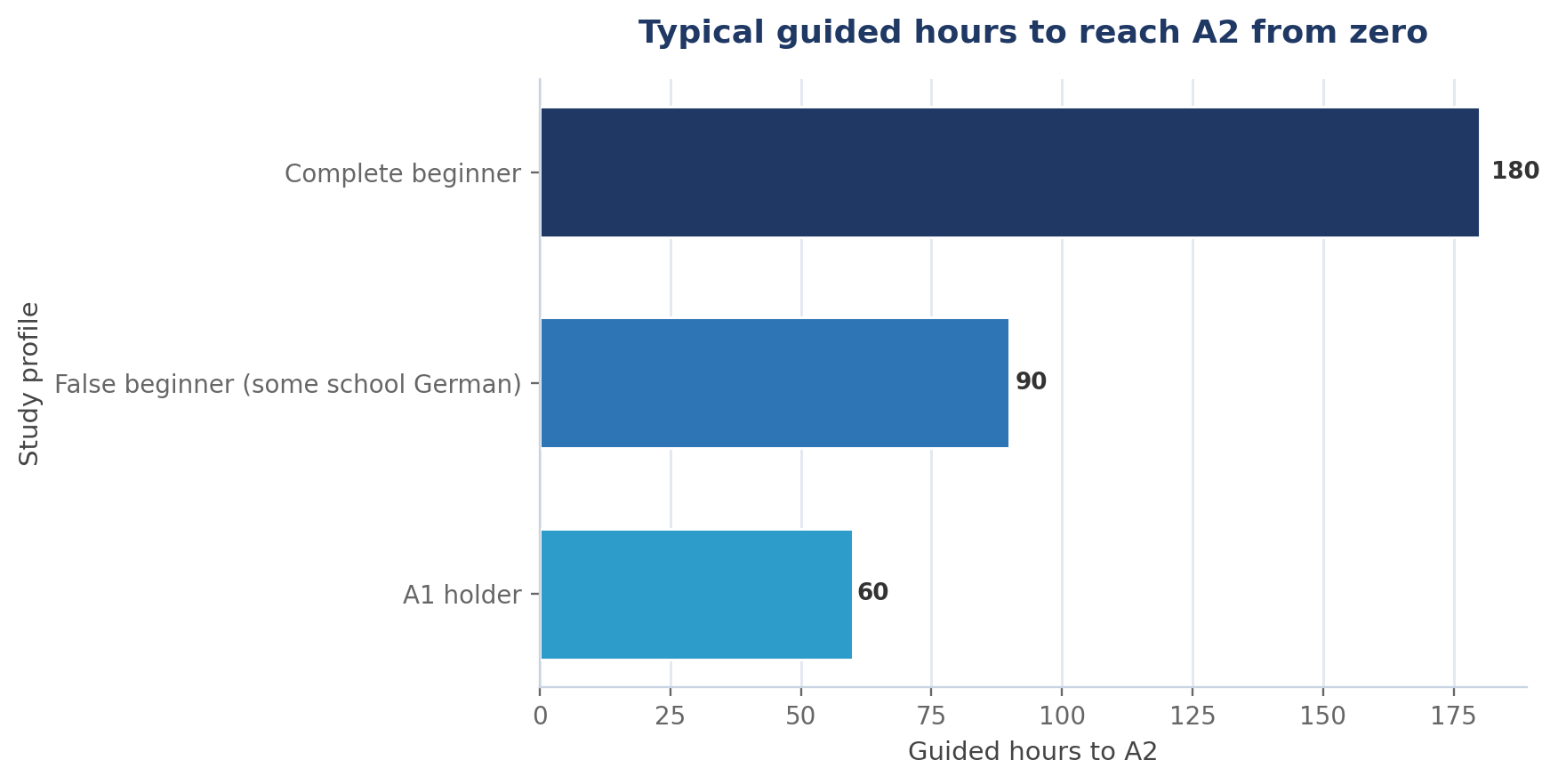
How much German do I need before booking A2? A2 assumes roughly 180 guided hours from complete beginner, according to the CEFR banding referenced in the Goethe-Institut's level descriptions. If you already hold A1, expect around 60 additional hours of focused preparation.