Nobody is coming to save you. No teacher will tap the desk, no class will start at nine. It is just you, a laptop and four cases that all mean something slightly different.
Good news: German is unusually self-study friendly. The rules are rigid, the resources are free, and the language does not reward improvisation. Follow the map and you will get there.
What you will get from this guide
- A realistic week-by-week structure from A1 to B2
- Which free resources are genuinely worth your hours
- The daily routine that survives a busy life
- The exact point where solo study stops working
The Three Pillars of Solo German Learning
Every self-taught learner who succeeds does the same three things. Every one who quits drops one of them.
Skip output and you become a person who understands documentaries but cannot order coffee. That is the classic self-study trap, and it is entirely avoidable.
Your Daily Routine: 55 Minutes That Compound
Structure beats duration. Fifty-five focused minutes a day beats a four-hour Sunday binge, every week.
Morning for memory, commute for ears, evening for production. If you only have thirty minutes, cut the commute slot and keep the other two.
A Phase-by-Phase Roadmap
Here is the whole journey, drawn honestly.
Those ranges assume roughly an hour a day. Half the time means roughly double the duration. There is no shortcut that is not also a lie.
The Free Resources Worth Your Hours
You do not need to spend money at A1 and A2. You do need to be ruthless about what you actually open.
One caution: collecting resources is not studying. Pick three, delete the rest, and put them where you will trip over them.
Grammar in Self-Study: What to Drill, What to Ignore
Grammar is where solo learners either win big or drown. Prioritise ruthlessly.
Learn the four cases as a system, not as a list of prepositions to memorise. Once you understand that the case marks the role a noun plays, half of German grammar collapses into one idea.
Grammar is the one thing solo study makes hard.
You can memorise a case table in an afternoon and still get it wrong under pressure, because nobody told you which one you just used. An AI voice tutor can catch the error in the sentence where it happens.
Start self-paced German →Create a free accountHow Long, Really? Honest Numbers
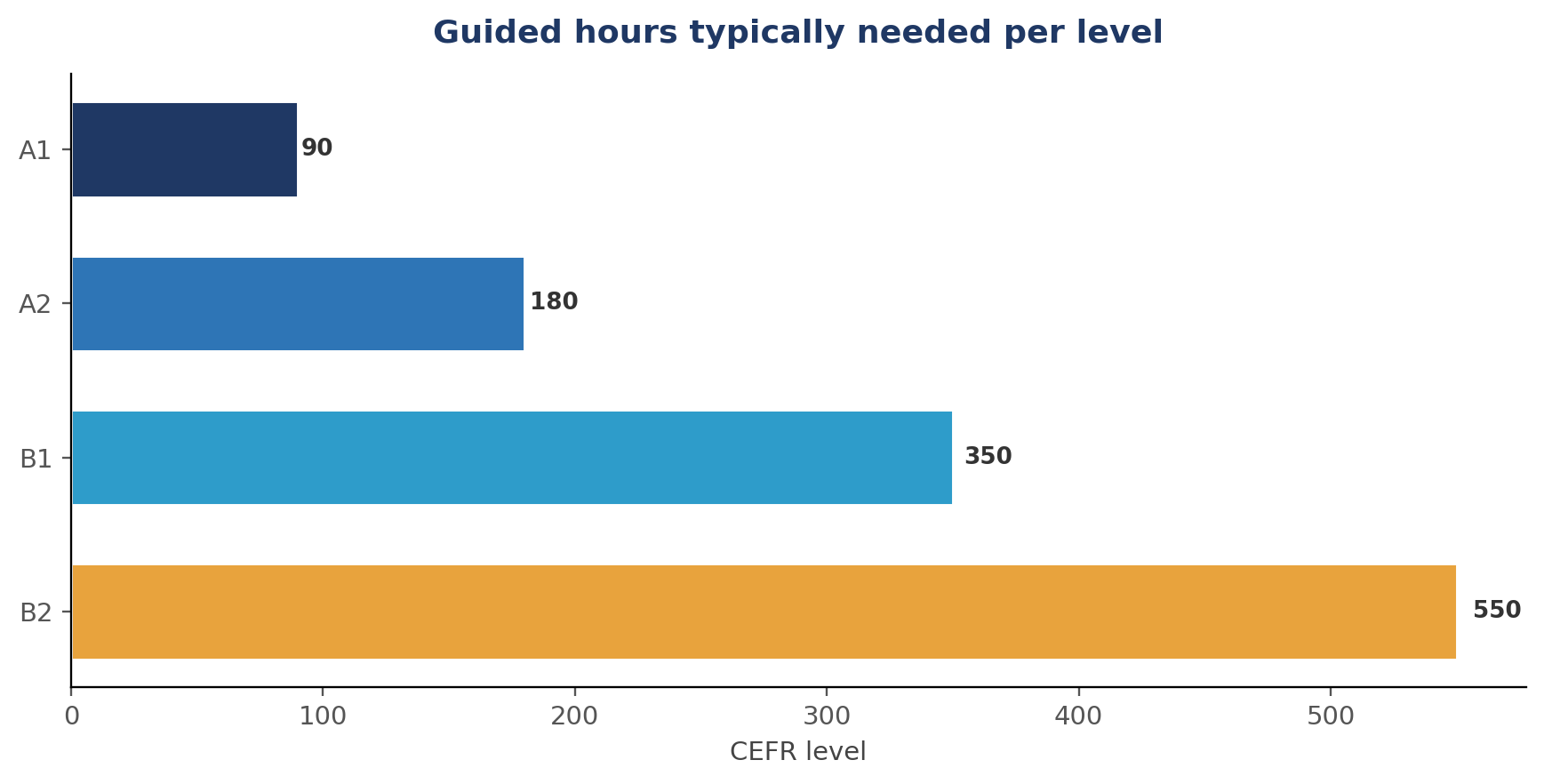
CEFR hour bands are estimates, and they assume guided instruction. Self-study usually takes longer because feedback is slower.
Read it like this: A1 to B2 is roughly 460 guided hours. Self-taught, budget 600 to 800 — the extra time is you correcting yourself.
Staying Alive Past Month Three
Motivation dies in the middle, not at the start. Plan for it now.
Log three numbers weekly: minutes studied, new words learned, minutes spoken aloud. Numbers are cold comfort, and cold comfort is exactly what keeps you going when enthusiasm has left the building. Add a monthly self-test — record a two-minute monologue about your month. Compare it to last month's recording. Progress you can hear is progress you will continue.
Where Solo Study Stops Working
Around B1, three walls appear at once. Your listening plateaus at fast native speech. Your pronunciation fossilises into habits nobody corrected. And your writing has errors you cannot see, because they feel correct.
That is the honest ceiling. Self-study gets you to B1. Fluency past it usually needs a human.
You built the habit alone. Now get the feedback.
Most self-taught learners arrive at B1 with excellent vocabulary and one stubborn problem: nobody has ever corrected their output. Our self-paced AI voice tutor exists for exactly that gap — structured lessons, speaking practice with AI feedback, and immediate correction.
Start German at languageSkills →Create a free accountFrequently Asked Questions
Can you really learn German by yourself? Yes, to around B1. That is enough for travel, reading and everyday conversation. B2 and beyond usually requires feedback from a fluent speaker.
How many hours a day should I study German alone? Forty-five to sixty focused minutes daily beats weekend marathons. Consistency is the variable that predicts success.
What should I learn first in German? Pronunciation and the present tense. Then the four cases as a single system. Vocabulary grows alongside all of it.
What is the biggest mistake self-taught German learners make? Never speaking. They read and listen for a year, arrive at an intermediate level, and discover they cannot produce a sentence under pressure.
References & Further Reading
- Deutsche Welle Nicos Weg — free CEFR-aligned video course from A1 to B1.
- Goethe-Institut — free practice materials and official CEFR descriptors.
- Duden — the standard reference for German grammar, spelling and usage.
- Council of Europe, CEFR Companion Volume — the scale behind every level claim.
- Anki — spaced repetition software used widely for vocabulary retention.
Open your laptop. Write five sentences about your day. The roadmap starts there.