The poster promises B1 in twelve weeks. The poster is selling hope, not hours. The number that actually decides your exam date is this one: roughly 350 guided study hours from zero to Goethe-Zertifikat B1 — and how you slice those hours across your week matters more than how clever you are.
What you will get from this guide
- Realistic goethe-zertifikat b1 study hours by starting level
- A weekly time budget that maps to a real exam date
- The 12-week countdown most working learners should follow
- The four time-wasters that quietly steal 40+ hours
The Honest Hour Bands
Start with arithmetic, not motivation. The Goethe-Institut publishes exam formats and model sets but no fixed hour quota; the CEFR guided-learning-hours model is what most course planners use. From a true zero, B1 sits near 350 hours. From a solid A2, you need far fewer.
Read column two slowly. The gap between beginner and A2 is bigger than the gap between A2 and B1. That is why learners who rush A1 in three weeks pay for it later, with interest.
Where Those Hours Actually Go
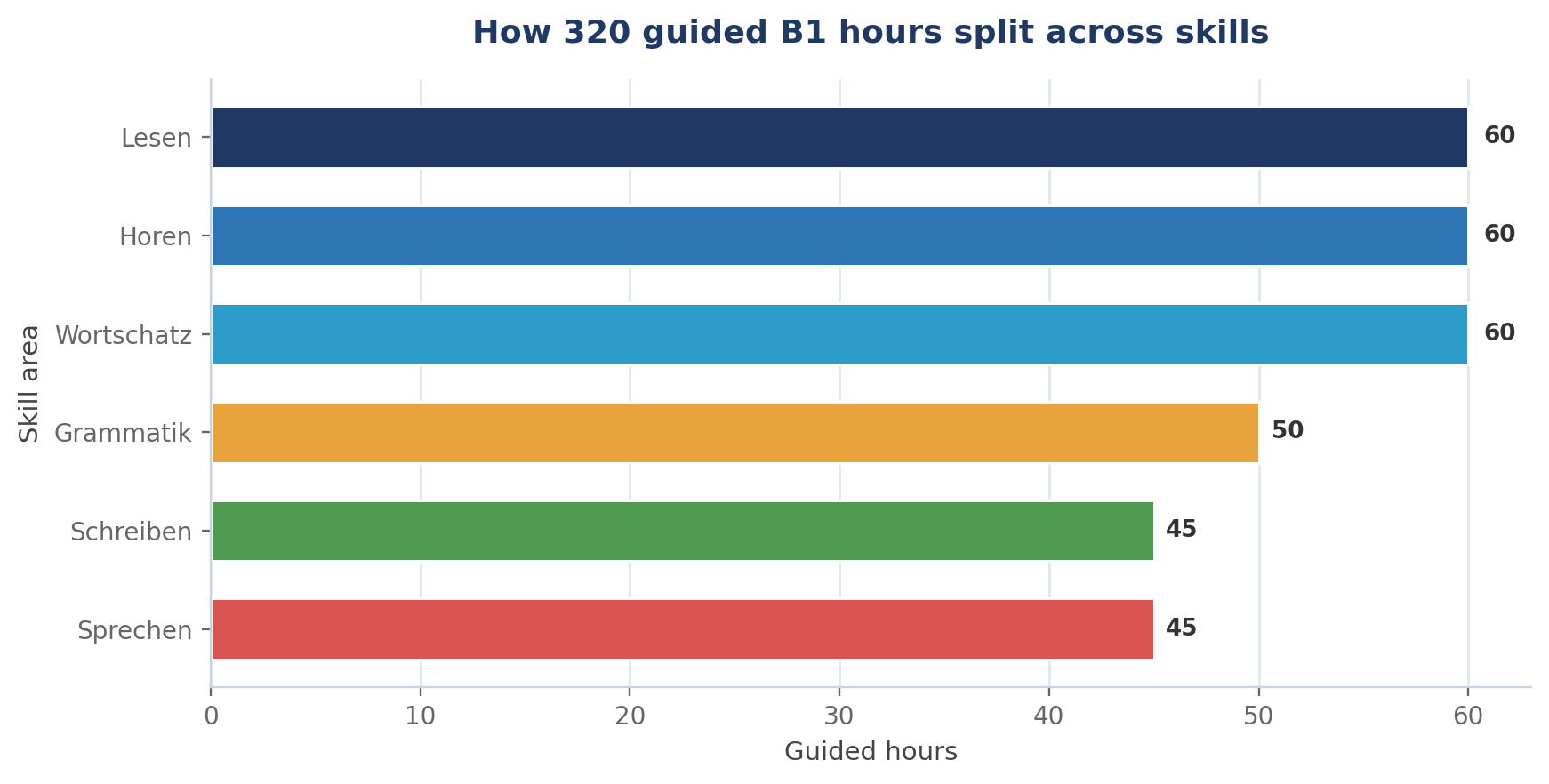
B1 is four skills and four exams, and they do not cost the same to prepare. Most candidates overspend on reading and underspend on speaking, then wonder why the oral pair exam feels like a cliff.
Notice that vocabulary and grammar — the shared engine — take 110 hours combined. Feed that engine daily and the four exams get cheaper. Starve it and every skill gets more expensive.
Time Budgeting: The Weekly Math
Total hours are useless without a weekly rhythm. Here is the honest conversion table for someone sitting at solid A2 needing about 200 hours.
Two warnings. First, frequency beats volume: six 40-minute sessions outperform one four-hour Sunday, because memory consolidates between sessions. Second, the 20-hour row is a part-time job. It works with consistent guided feedback, and it collapses in unfocused solo study.
A 12-Week Countdown From Strong A2
Assume 8 hours a week, about 96 hours total, and a B1 target date. This is the plan that fits a working adult.
Your hours deserve a tutor, not a guess
A plan table cannot hear your dative errors or stop you rehearsing the same wrong sentence for six weeks. A personal AI voice tutor gives you speaking practice with instant feedback, so every one of your 200 hours counts double.
Build my B1 study plan →Create a free accountThe Four Time Wasters
Most learners lose more hours to habit than to difficulty. Audit yourself against this table before you buy another workbook.
The last row is the silent killer. Learners who restart feel productive for months and arrive at the exam with no B1 practice at all.
When Your Calendar Is Hostile
Shift work, small children, two jobs — some weeks give you three hours, not eight. Budget accordingly: protect two 45-minute slots that are non-negotiable, and treat everything else as bonus. Then extend your exam date instead of lying to yourself. A B1 pass in nine months beats a fail in five.
Book the exam roughly two months before you feel ready. Deadlines manufacture focus, and Goethe exam places fill quickly in big cities. Confirm dates on the official Goethe-Zertifikat B1 pages, then work backwards through the tables above. If you want the shortcut past all this maths, a guided path removes the guesswork entirely — see how the course is structured and compare it with your own weekly budget.
Stop guessing your exam date
Tell us your weekly hours and your target month. A personal AI voice tutor turns that into a structured self-paced plan, gives you speaking practice with instant feedback, and provides printable study materials to guide your writing.
Start my German course →Create a free accountFrequently Asked Questions
Is 200 hours really enough for Goethe-Zertifikat B1? Yes, if you already hold solid A2. The 200 hours includes homework, not just class time. If your A2 is shaky, add 40–60 hours of consolidation first.
Should I count class hours and self-study hours the same? No. One hour of guided practice with feedback is worth roughly two hours alone. The tables above assume a mix of about 60% guided and 40% solo work.
How long before the exam should I start timed practice? Ten weeks out. Start with one skill at a time, then switch to full Modellsätze at four weeks. Timed practice is where knowledge becomes a score.
Can I pass B1 with only three hours a week? You can, in about fifteen months. If that timeline fits your life, take it. Consistency at three hours beats a heroic month followed by silence.
References & Further Reading
- Goethe-Institut: Goethe-Zertifikat B1 exam page, formats and model sets
- Council of Europe: Common European Framework of Reference for Languages, guided learning hours and level descriptors
- Goethe-Institut: Übungsmaterialien and official Modellsätze for B1
- Deutsche Welle: free structured German courses from A1 to B1 at dw.com/learn-german
- Duden: standard reference for German grammar, spelling and usage rules