Ask ten learners how long A2 takes and you get ten different numbers — 80 hours, 400 hours, "it depends". The truth is less mysterious than the folklore. Goethe-Zertifikat A2 study hours follow a predictable band, and once you know your starting line, you can plan the finish.
What you will get from this guide
- The real hour band for A2, split by starting level
- Weekly plans for 90-minute and 3-hour schedules
- What the exam actually tests — and where people lose points
- Honest answers on vocabulary, speaking nerves, and retakes
What Goethe-Zertifikat A2 Actually Certifies
A2 is the second rung of the Common European Framework of Reference. It says you can handle routine exchanges: shopping, travel, work small talk, short written messages. You are not fluent. You are functional.
The Goethe-Institut exam has four parts, each worth 25 points. You need 60 out of 100 to pass, and you cannot fail a single skill in isolation — the four sections combine into one score.
The Honest Hour Bands
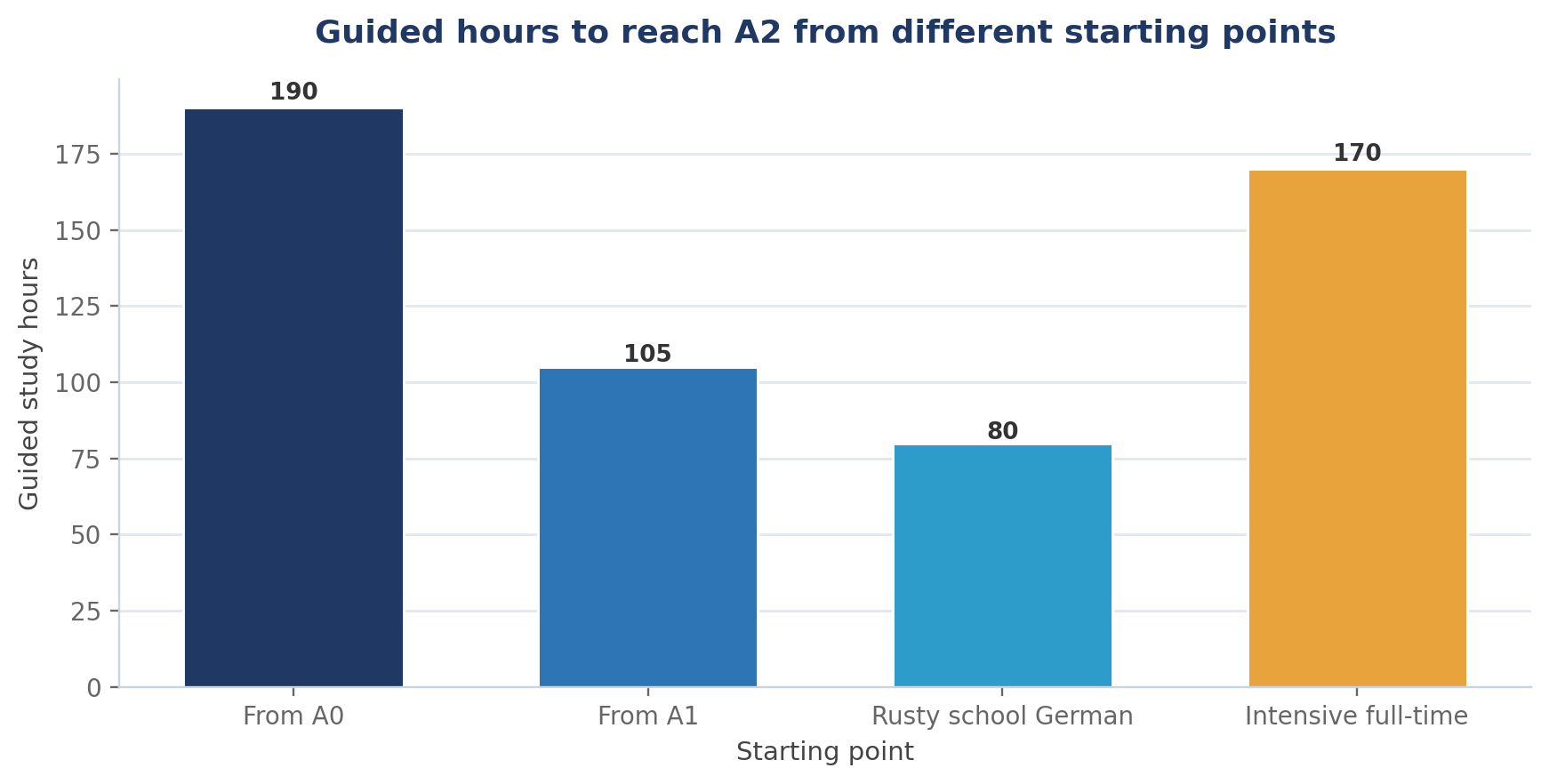
The Goethe-Institut and CEFR-aligned planning both place A2 at roughly 180–200 guided hours from zero, and around 90–120 hours if you already finished A1. Those are classroom hours; self-study usually needs more because you lose the live feedback loop.
Notice the shape of that chart. The distance from zero to A2 is the big climb. The distance from A1 to A2 is a staircase. If you have any German behind you, you are not starting at the bottom.
What Eats the Hours
Vocabulary is the quiet tax. A2 sits around 1,300 words of active vocabulary on top of A1's roughly 650 — call it 2,000 words of recognition. Learning a word properly takes about 5–10 minutes of spaced contact, so 650 new words alone is 55–100 hours of exposure spread across months.
A Weekly Plan That Fits a Real Life
Most people cannot study three hours a day. You do not need to. You need consistency and one honest long session per week.
That is seven and a half hours a week. Over twenty weeks it is 150 hours, which lands squarely inside the A2 band.
Stop guessing whether you are ready
An AI voice tutor hears the mistakes you cannot hear yourself, and corrects them instantly. Our German course pass gives you structured A2 preparation with speaking practice and AI feedback built in.
Start your German A2 plan →Create a free accountWhere Candidates Actually Lose Points
The exam is not hard. Preparation is sloppy. Three failure patterns repeat year after year.
Writing loses points on register. You write Hallo Anna in a formal note to a landlord and the examiner marks it down instantly. Learn the two registers cold.
Listening loses points on speed, not vocabulary. Learners know the words but cannot parse them at natural tempo. Practise at 1.0x, never slow the audio down for comfort.
Speaking loses points on hesitation. A short, confident answer beats a long, broken one. Rehearse the self-introduction until it is muscle memory.
How Long Until You Are Ready?
A useful test: take a practice exercises under timed conditions. Score above 70 and book the date. Score 55–70 and give yourself four more weeks. Below 55 and you are still building, not polishing.
Book the exam date before you feel ready. A dated deadline turns scattered study into a plan. LanguageSkills.net has a German course pass with an AI voice tutor that works to that date with you.
Your exam date is a plan, not a dare
Tell us when you sit the Goethe-Zertifikat A2 and we build the weeks backwards from there — vocabulary, speaking drills, corrections.
Book your German placement →Create a free accountFrequently Asked Questions
Can I pass Goethe-Zertifikat A2 in three months? Yes, if you already have A1 and can study six to eight hours a week. From absolute zero, three months is unrealistic unless you study full-time — expect eight months instead.
Is 200 hours really enough for A2? It is the standard band for guided hours with a teacher. Silent self-study often needs 250–300 hours because you lose correction, which slows everything down.
Do I need to know 2,000 words? Roughly 1,300 active words on top of A1's vocabulary, so about 2,000 words you can recognise and use. Quality beats raw count — a word you can use in a sentence beats five you only nod at.
What is the pass mark? 60 out of 100 points across the four sections. Sections are not failed individually, so a strong listening score can carry a weaker writing score.
References & Further Reading
- Goethe-Institut — Goethe-Zertifikat A2 exam overview and model sets: https://www.goethe.de/en/spr/kup/prf/prf/gzsd2.html
- Council of Europe — Common European Framework of Reference for Languages, level descriptors: https://www.coe.int/en/web/common-european-framework-reference-languages
- Deutsche Welle — free A2 German course Nico's Weg: https://learngerman.dw.com/en/overview
- Goethe-Institut — practice materials and exam training portal: https://www.goethe.de/en/spr/kup/prf/ub.html
- LanguageSkills.net — German course pass and tutor-led A2 preparation: https://languageskills.net/german