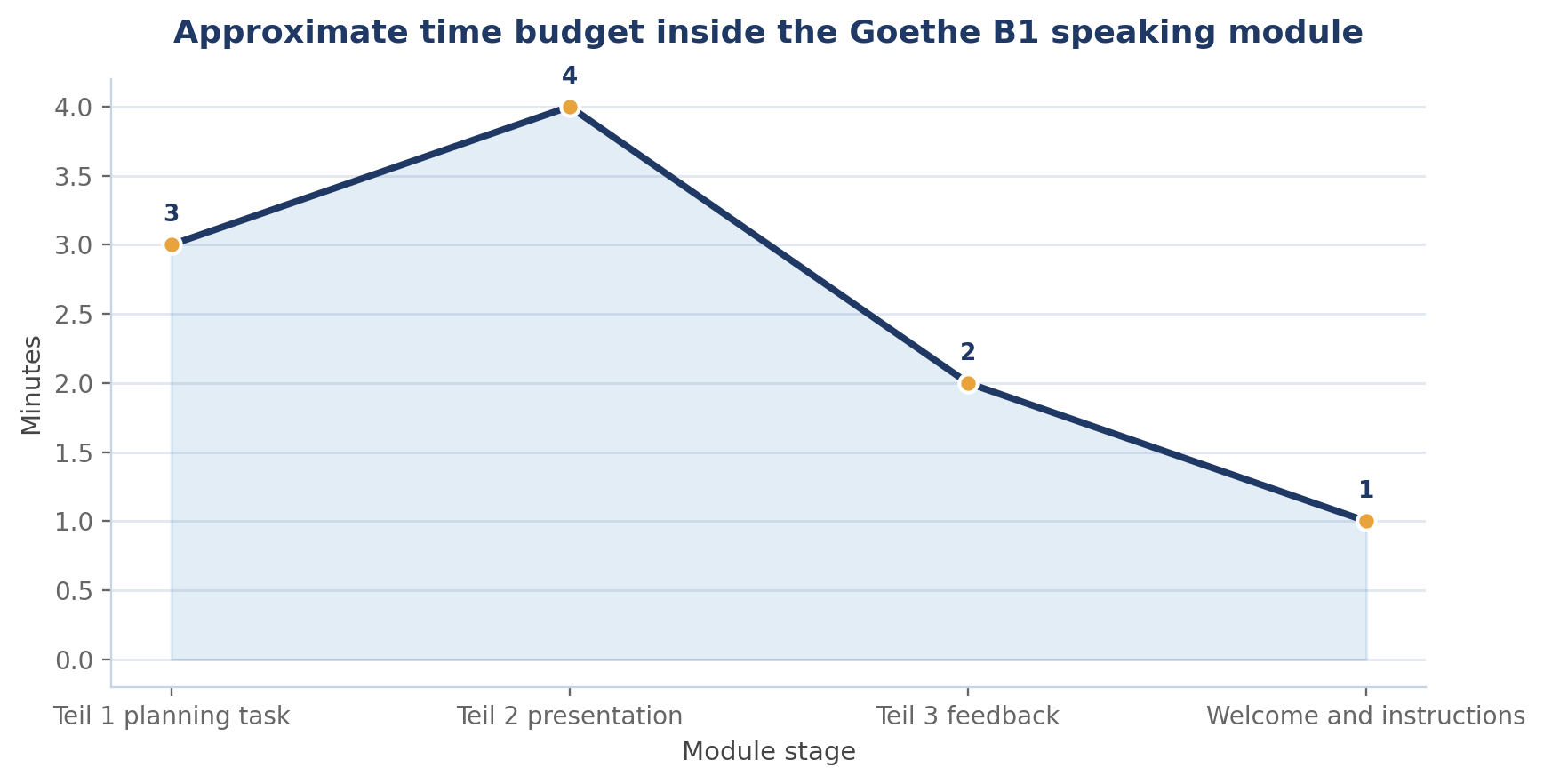
Fifteen minutes. Two examiners, one partner, and a clock that suddenly moves at double speed. The Goethe-Zertifikat B1 Sprechen module is where prepared candidates look fluent and fluent candidates look lost.
Good news: it is the most predictable exam on the German circuit. These goethe-zertifikat b1 speaking tips turn that predictability into points.
What you will get from this guide
- What each of the three speaking parts actually demands
- Sample answers in real B1 German
- A phrase bank you can deploy without thinking
- The four mistakes that quietly cost you points
The Format in Sixty Seconds
Three parts, built around one partner, assessed independently of that partner's performance.
You plan something together, you present a topic alone, then you react to your partner's presentation and answer a question about your own. Roughly ten minutes of speech in total, spread across two candidates.
Teil 1: Planning Together Without Hijacking
You and your partner must arrange something — a party, a trip, a farewell gift. There is no winner. The examiner is listening for negotiation.
Use the pattern: suggest, react, adjust, confirm.
Notice the tone. German examiners reward Wie wäre es mit… and Vielleicht könnten wir… far more than flat statements. Politeness structures are grammar in disguise.
That last row is free points. End with a summary sentence: Also, wir machen das so.
Teil 2: The Presentation That Scores
You pick one of two topics and present four points: what, where, how, and your opinion. Then your partner asks a question.
Structure it out loud. Examiners are trained to look for signposting.
The cheapest points in the whole exam are the opening and closing lines, because nearly everyone forgets them under stress. Say them anyway, calmly, and you already sound organised.
Rehearse with an AI voice tutor that gives instant feedback
Guided speaking practice with AI feedback and phrase drills until the opening lines come out automatically. That is how B1 speaking stops being a gamble.
Prepare for the Goethe B1 →Create a free accountTeil 3: Reaction Time
You give feedback on your partner's presentation and answer one question about your own. Short, structured, polite.
That bought second is legal and useful. A short, honest sentence beats twenty seconds of silence.
What the Examiner Is Marking
Goethe uses four criteria, and only one is about vocabulary.
Interactive learners pass. Solo performers do not. So say your partner's name, or at least du, and build on what they said.
Four Mistakes That Cost Real Points
Watch for these in your own practice exercises.
Describing a missing word is a B1 skill in itself, and examiners reward the attempt.
A Four-Week Preparation Plan
Focused preparation beats a month of anxious PDFs.
Record yourself. You will hear the hedging, the swallowed endings, the silence you thought lasted one second and lasted six.
Fifteen minutes decides the module. Train for it.
Bring your exam date, your nerves and your questions to a self-paced German course built around Goethe format tasks — and walk in already knowing how it feels.
Start your exam prep →Create a free accountFrequently Asked Questions
How long is the Goethe-Zertifikat B1 speaking exam? Around fifteen minutes for a pair of candidates, with two examiners present. You will typically receive instructions beforehand and may have short preparation time before Teil 2.
Do I have to do the exam with a partner? Usually yes. Candidates are examined in pairs, and occasionally in a group of three when numbers are uneven. Interaction is assessed, so practise with a real human.
Can I pass B1 if I fail speaking? The Goethe B1 exam is modular: each part is scored separately. A weak result in Sprechen is not saved by a strong Lesen score, so treat every module as its own battle.
Should I use Sie or du with the examiners? The examiners keep it formal, so Sie is the safe default with them. With a partner of similar age, du is normally fine — but ask first if you are unsure.
References & Further Reading
- Goethe-Institut — Goethe-Zertifikat B1: Prüfungsziele, Testbeschreibung and official Modellsatz materials
- Goethe-Institut — B1 Sprechen module documentation and Bewertungskriterien
- Goethe-Institut — Übungsmaterialien for integrated exam training
- Association of Language Testers in Europe (ALTE) — material on CEFR-aligned speaking assessment
- Council of Europe — Common European Framework of Reference for Languages, B1 spoken interaction descriptors
Want the exam-day confidence that only rehearsal gives? Train the format with a personal AI voice tutor at languageskills.net/german.