Four modules. Three hours. One number that decides it: sixty. That is the Goethe-Zertifikat B1 format in a sentence — and every detail below is what stands between you and the certificate.
What you will get from this guide
- Every module with its real timing and task count
- How 30 test items become a score out of 100
- The grade bands, spelled out
- What happens when you pass three modules and fail one
The shape of the exam
The Goethe-Zertifikat B1 tests four skills separately: Lesen, Hören, Schreiben, Sprechen. Each is a self-contained module with its own score. You sit them on the same day in most centres, and you can also book a single module on its own if you only need to retake one.
Two examiners assess the speaking. At least one is usually not the person who taught you, which is exactly the point.
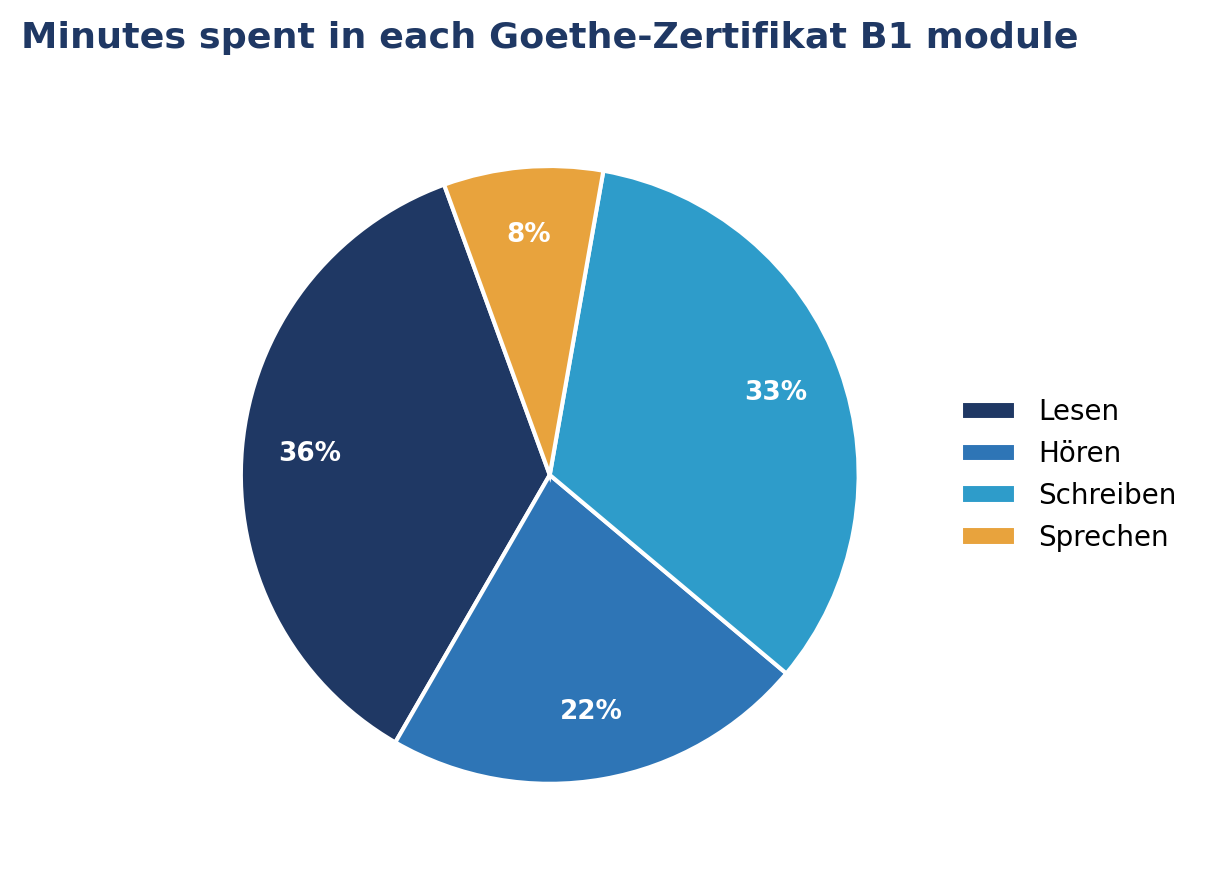
The chart below shows where the clock actually goes. Speaking looks short on paper and feels like a heartbeat in the room.
Lesen: five tasks, thirty items
Reading is the longest single block. You get 65 minutes for five tasks, and the texts get steadily harder — short notices first, then a longer article, then opinion-based texts where two writers disagree.
The trap is time, not difficulty. Candidates who read every word line by line run out of minutes by Teil 4. Read the questions first, then hunt.
Hören: four parts, played once
Listening is where nerves cost marks. Thirty items, and in parts of the module the audio is played a single time.
The whole module runs around 40 minutes including the pauses built into the recording. There is no rewinding in Teil 1 to 3. One missed sentence is gone.
Train your ear before exam day
Listening is the module people fail by a whisker. Our self-paced German course includes listening practice with an AI voice tutor that gives instant feedback on what you missed, sentence by sentence.
Prepare for B1 with a tutor →Create a free accountSchreiben: three texts in sixty minutes
Sixty minutes, three tasks, and a hard word count you must respect. Writing too little loses points. Writing far too much wastes the minutes you need for Teil 3.
Examiners look at four things: whether you fulfilled the task, how coherent the text is, how wide your vocabulary is, and how accurate your grammar is. Structure beats flourish. A clean three-part email with Anrede, body and closing outscored a clever paragraph that does not answer the prompt.
Sprechen: fifteen minutes, two candidates
The speaking module usually pairs you with another candidate. You plan something together, then each of you presents.
The presentation has a fixed skeleton: topic, why you chose it, what you know, advantages and disadvantages, your own opinion, thanks. Learn the skeleton and any topic becomes speakable.
Scoring: 30 items become 100 points
Here is the part that confuses most candidates. Each module is scored out of 100, and the pass mark is 60 points — a straight 60 percent. The items you answer are worth a portion of that total.
The grade on the certificate follows a fixed band.
Sixty is sixty. There is no rounding up and no discretionary generosity.
If you fail one module
This is the design feature that saves people. The four modules are independent. Pass three and fail one, and you retake only the failed module — typically paid per module. Your other results stay valid, and the centre issues the full certificate once all four are passed.
Practical consequences:
Frequently Asked Questions
How long is the whole Goethe-Zertifikat B1 exam? Around three hours of modules in one day, plus a short break between the written and oral parts. Most centres publish arrival times an hour before the first module.
Do I have to take all four modules at once? No. You can register for the full exam or for individual modules. Taking them one at a time is common for people working full time.
What score do I need to pass? Sixty points out of 100 in every module. That is 60 percent, with no compensation between modules — a strong Lesen does not rescue a weak Hören.
How long is the certificate valid? Goethe-Zertifikate do not carry a formal expiry date, but some employers and universities ask for a recent result. Check with whoever requested it.
Walk in knowing exactly what happens
Format knowledge removes half the fear. Real preparation removes the other half — self-paced guided lessons, speaking practice with AI feedback, and printable study materials.
Book your B1 preparation course →Create a free accountReferences & Further Reading
- Goethe-Institut, Goethe-Zertifikat B1 — Übungsmaterialien and official exam regulations: goethe.de
- Goethe-Institut, Prüfungsordnung — the rules covering modules, scoring and retakes.
- telc and ÖSD B1 materials, useful for cross-checking format differences between exam boards.
- CEFR level descriptors, Council of Europe — what B1 actually means: coe.int
- Deutsche Welle, DW Learn German — free B1-level listening material for exam-style practice.