Sixty points. That is the whole exam in one number — and knowing exactly where those sixty points live is worth more than another month of unfocused vocabulary grinding.
The Goethe-Zertifikat A2 proves you can handle everyday German: shopping, appointments, short messages, simple conversations. It is also one of the most predictable exams in Europe once you know its shape. Here is the Goethe-Zertifikat A2 format, module by module, with the scoring maths laid bare.
What you will get from this guide
- The four modules, their timings and their point weights
- How the 100-point scale converts into a pass, a grade and a retake decision
- What each reading, listening, writing and speaking task actually asks
- A realistic preparation timeline from your current level
The Exam at a Glance
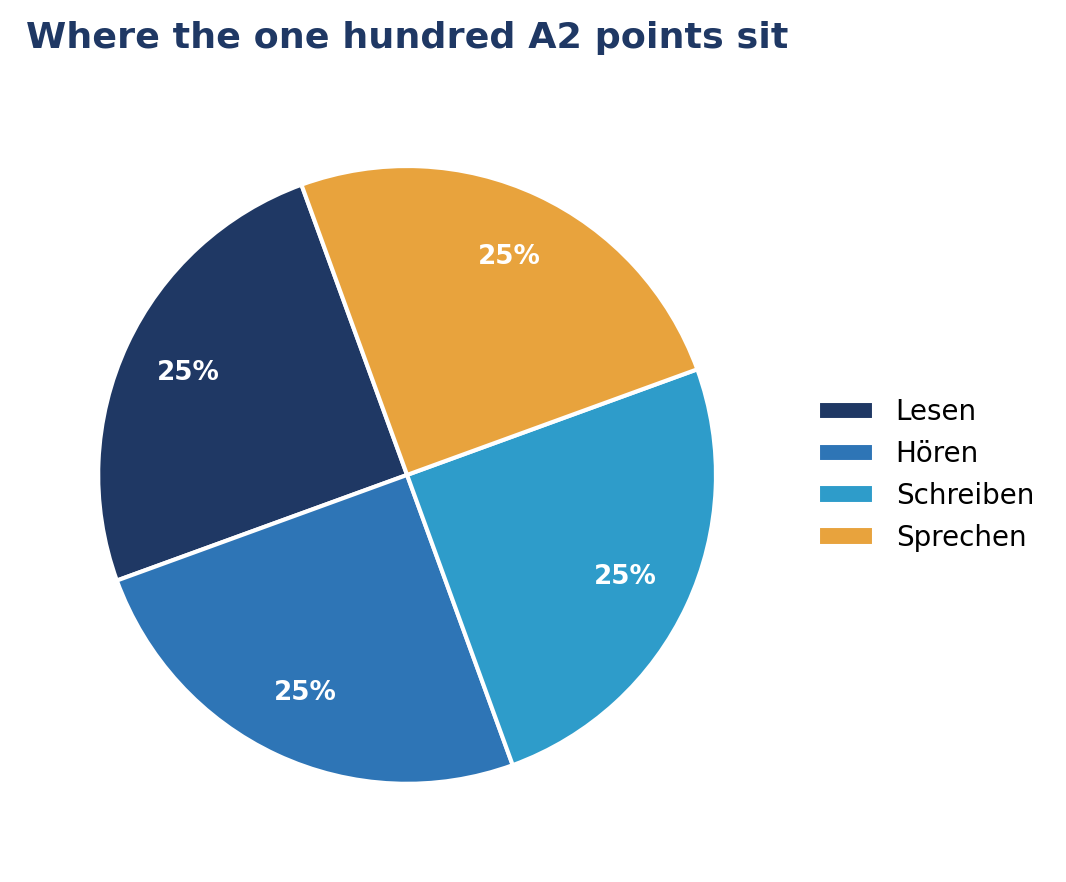
Four modules. Twenty-five points each. One hundred points total.
The written modules are typically taken together, with the speaking module sat separately or on the same day depending on the exam centre. Always confirm current timings on the official Goethe-Institut A2 page, because regulations can change between exam sessions.
Reading (Lesen): Speed Over Depth
Reading at A2 is not about literature. It is about signs, notices, emails, classified ads and short articles. You are hunting for specific information, not admiring prose.
The trap is perfectionism. You have roughly one and a half minutes per item. Skim the question first, then hunt for the keyword in the text. Do not read every word twice.
Listening (Hören): Trained Ears Win Points
Listening carries the same weight as reading, and it is the module where adult learners most often bleed points.
The audio plays in everyday contexts: announcements, phone messages, short conversations, radio-style snippets. You hear each item a limited number of times, so the skill being tested is first-pass comprehension, not endless replaying.
Build that skill by listening to real German at real speed. Deutsche Welle's Deutsch lernen library is free and graded by level — twenty minutes a day beats an hour once a week.
Writing (Schreiben): Two Tasks, Clear Rubric
Writing is short and formulaic, which is excellent news.
Marks come from task fulfilment, communicative design and language correctness. A clean, complete answer with three bullet points covered beats a long answer that ignores one of the prompts. Learn five reusable sentence frames and you can survive almost any prompt.
Your writing is marked against a rubric — so practise against the rubric.
Most learners lose writing points for missing content points, not for grammar. An AI voice tutor gives you structured writing practice with feedback, so you can check your texts against the rubric and see which of the three criteria is costing you points.
Prepare with a German course pass →Create a free accountSpeaking (Sprechen): Three Parts, One Partner
Speaking is usually assessed in pairs with two examiners present. The structure is predictable.
The most common failure is silence. An examiner cannot award points for a pause. Learn connector phrases — ich denke, dass…, vielleicht können wir…, was hältst du davon? — and keep the conversation moving even when your grammar wobbles.
How Scoring and Grading Actually Work
Each module is worth 25 points. Add your four module scores for a total out of 100. The pass mark is 60 points, and grades are awarded in bands.
Here is the arithmetic in practice, and why the modular system matters so much.
Notice scenario three: two weak modules, still a pass. The exam rewards balance. If reading and writing are already strong, sixty points is a much closer target than it looks.
Many Goethe exam centres also allow you to sit or retake individual modules, keeping the modules you have already passed. That makes a strategic retake far cheaper than repeating the whole exam — and it is exactly the reason to know your per-module numbers, not just your total.
Building a Twelve-Week Plan
Take one complete mock at the start. It hurts, but it tells you which module is your 12-point module — and that single module is usually where twenty hours of targeted work buys the most marks.
Sit the exam once and walk out smiling.
Self-paced guided lessons with an AI voice tutor turn vague study hours into module-specific gains — timed reading drills, writing practice with AI feedback, and speaking practice you can do any time at your own pace.
Start with a free placement check →Create a free accountFrequently Asked Questions
What is the pass mark for the Goethe-Zertifikat A2? Sixty points out of one hundred, which is 60 per cent. Each of the four modules contributes a maximum of 25 points.
Can I retake just one module? Many Goethe exam centres offer modular results and retakes, so you can keep passed modules and repeat only the ones you missed. Availability and rules vary by centre, so check with yours before booking.
How long is the whole exam? Roughly two hours of written modules plus the speaking module, which lasts around fifteen minutes for a pair. Expect to be at the centre for a morning or an afternoon.
Is A2 enough for a visa or a residence permit? A2 is often cited for family reunification applications, but requirements depend on the country and the authority. The Goethe-Zertifikat A2 is widely recognised; confirm the exact certificate your case needs before you book.
References & Further Reading
- Goethe-Institut — Goethe-Zertifikat A2 — official format, timings and registration.
- Goethe-Institut — German exams overview — how A2 fits between A1 and B1.
- Council of Europe — CEFR — the descriptors behind the A2 level.
- Deutsche Welle — Deutsch lernen — free graded listening for exam training.
- Goethe-Institut — practice materials — official mock papers and answer keys.