Most candidates who fail the Goethe-Zertifikat B1 do not fail because their German is weak. They fail because of three or four repeatable errors — a forgotten letter, a monologue that ignores the partner, a panic spiral after one missed number in listening. Fix those and the exam becomes a formality.
Here is where the marks actually leak, module by module.
What you will get from this guide
- The real structure and timing of each B1 module
- The specific mistakes that cost marks in writing and speaking
- A four-week revision plan built around the biggest losses
- A readiness checklist to run before you book the exam
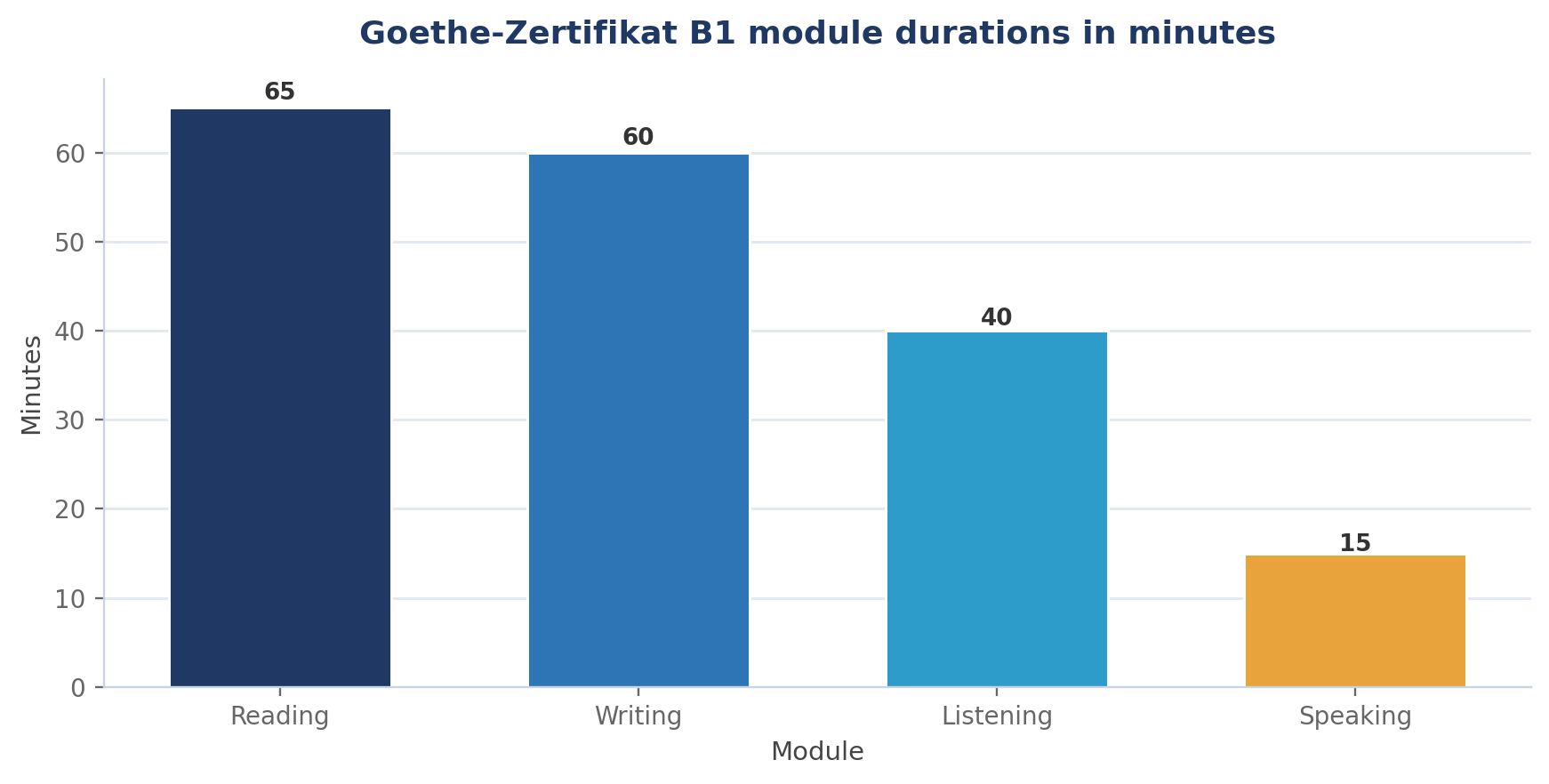
Know the machine you are fighting
The Goethe-Zertifikat B1 has four modules, taken together on exam day. You need at least 60% overall to pass. Confirm the current weighting and any per-module rules with your exam centre, because Goethe-Institut updates its Prüfungsordnung from time to time.
Mistake 1: treating the letter like an essay
The writing paper is not a chance to show off subordinate clauses. It is a task completion test. Examiners look for three things: did you cover every bullet point, did you use the right register, and did you hit the expected length.
The fix is mechanical. Before writing, underline each bullet in the task. After writing, tick each one off. Check the salutation and sign-off against the register the task demands. Then read once for verb position in subordinate clauses.
Mistake 2: rehearsing a speech instead of a conversation
The speaking module is a pair task. Candidates who memorise a monologue and recite it regardless of their partner lose interaction marks — and often sound robotic in the process.
Two minutes of natural back-and-forth beats five minutes of perfect German delivered alone.
Practise B1 speaking with an AI voice tutor, any time
Interaction is a skill, and it needs regular practice. Our AI voice tutor runs structured speaking tasks, gives you feedback on your responses and helps you push your register up towards exam level — all self-paced, whenever you study.
Book B1 exam practice →Create a free accountMistake 3: losing your nerve in listening
Listening is where anxiety does the most damage. The recording plays once in most parts, and one missed number can unravel a whole section.
Mistake 4: reading like a reader, not a hunter
In Lesen, you have roughly two minutes per item. Candidates who read the passage like a novel run out of time on the last section, which is usually the most straightforward.
Scan for the keyword in the question, match it to a paragraph, then read only that paragraph closely. If two options look identical in meaning, one of them is testing whether you noticed a single negative word — nicht, kein, nur.
A four-week revision plan that targets the leaks
The smartest investment in week two is a marked piece of writing. Self-marking hides your register errors, because they sound natural to you.
Get feedback on your B1 writing with a self-paced AI tutor
An AI voice tutor that has processed hundreds of B1 scripts spots a register slip in seconds and tells you exactly which bullet you under-developed. That feedback is worth more than three more practice papers.
Start B1 exam preparation →Create a free accountFrequently Asked Questions
What score do I need to pass the Goethe-Zertifikat B1? You need at least 60% overall across the four modules. Check the current Prüfungsordnung with your exam centre for exact scoring details.
How long should my B1 writing be? Follow the word count given in each task. Under-length answers lose content marks; heavily over-length answers waste time you need for checking.
How far in advance should I book the exam? Book once a full mock paper shows you within reach of 60%. Most candidates need eight to twelve weeks of focused preparation from a solid A2 base.
Can I retake only one module? Goethe-Institut allows candidates to repeat individual modules under conditions set by the exam centre. Confirm the rules when you register.
References & Further Reading
- Goethe-Institut — Goethe-Zertifikat B1: exam structure and sample papers
- Goethe-Institut — Prüfungsordnung and current exam regulations
- Council of Europe — CEFR B1 level descriptors
- Deutsche Welle — Free German courses aligned to CEFR levels
- telc — German B1 examination information for comparison