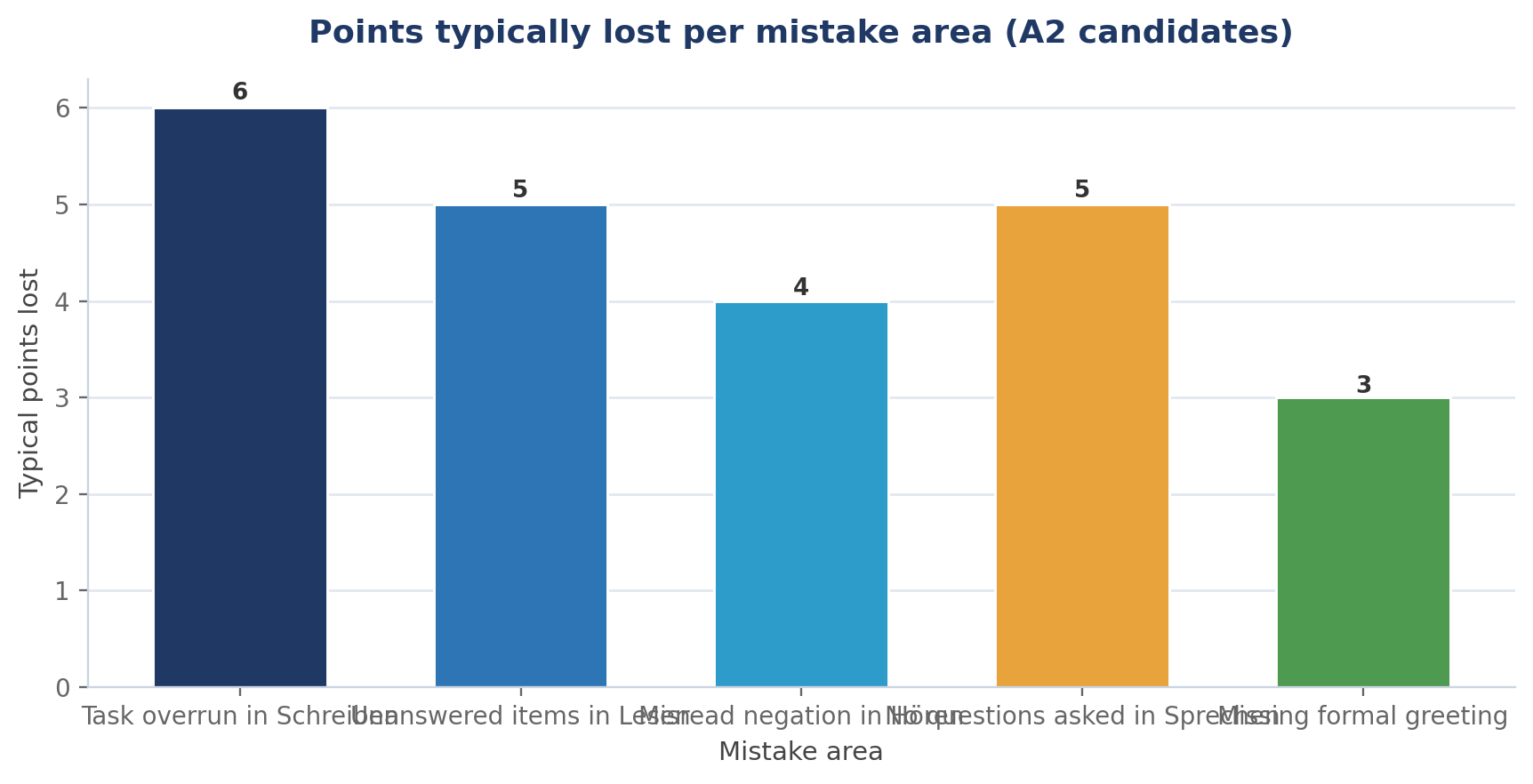
Nobody fails Goethe-Zertifikat A2 because German is too hard. They fail on the small stuff: two words over the limit in the writing task, a question paper abandoned halfway, a speaking partner they never once asked a question.
This guide is the list of goethe-zertifikat a2 mistakes I see again and again — and the fixes that take an afternoon to learn.
What you will get from this guide
- How the exam is scored, in plain numbers
- The mistake in each of the four modules
- What examiners actually reward in writing and speaking
- A four-week preparation plan
How Goethe-Zertifikat A2 Is Scored
Four modules. Twenty-five points each. One hundred in total.
You need 60 of 100 to pass. The current weightings and task counts are published by the Goethe-Institut, so always check the official page before you book — that is mistake number zero: preparing for an exam you never read the rules of.
Mistake 1: Writing Too Much in Schreiben
The task says Schreibe circa 30 Wörter. Candidates write 70. Every extra sentence is another chance to show a grammatical error, and examiners mark accuracy within the required task, not enthusiasm beyond it.
The fix is brutal and simple: count words in your practice. The first text needs roughly 30 words, the second roughly 40 — the situation and the three given points set the shape.
Never mix du and Sie. If the prompt says dein Freund, write du everywhere. If it says Ihre Nachbarin, write Sie. Switching mid-text is the single most visible slip in the whole writing module.
Mistake 2: Reading the Question After the Text
In Lesen, candidates read the whole passage first, fall in love with the details, then look at the question and discover it asked about something else entirely.
Read the question first. Then scan. A2 texts are short — notices, ads, appointment cards, emails — and the answer is almost always one specific line.
Mistake 3: Missing Negation in Hören
Audio runs once. Candidates hear Der Zug fährt nicht um acht and write eight o'clock. The nicht is the whole point of the question.
Train this specifically: take any A2 listening track and write down every negative word you hear — nicht, kein, nie, nichts, niemand. You will be amazed how often it decides the answer.
The ear is trainable. Start before exam day
Self-paced German lessons with a personal AI voice tutor, real audio and real speed — including every nicht you let slide. Structured practice, week by week.
See the German course →Create a free accountMistake 4: Saying Nothing in Sprechen
The speaking module runs in a small group, and it rewards interaction. Candidates prepare beautiful monologues about their family and hobbies, then sit mute while their partner speaks.
The examiners are listening for questions as much as answers. Ask something. React. Und du? is worth more than a perfect relative clause.
Mistake 5: Memorising Sentences Instead of Situations
A memorised paragraph collapses the moment the topic changes. Learn the shape instead: greeting, one reason, one detail, one question. That skeleton fits almost every A2 task, in writing and in speech.
A Four-Week Preparation Plan
Mock the whole thing in one sitting at least twice. Endurance is a skill, and the fourth module is the one where tired candidates drop marks.
The Exam-Day Checklist
Bring identification, arrive early, and read the instructions twice. Write in pen if instructed, answer every item on the answer sheet — guessing costs nothing in Lesen and Hören — and keep an eye on the clock in each module.
If you are still building the foundation, A2 vocabulary and grammar are the real preparation. A personal AI voice tutor that follows the Goethe format turns scattered study into a structured plan. You can start with a free account at languageskills.net/register.
Walk in knowing what is coming
Self-paced preparation built on the Goethe-Zertifikat A2 format: every module, every trap, every timed practice paper — with a personal AI voice tutor giving you feedback as you go.
Start your German course →Create a free accountFrequently Asked Questions
How many points do I need to pass Goethe-Zertifikat A2? You need 60 out of 100 points across the four modules combined. Confirm the current pass rules with the Goethe-Institut when you register.
Can I take the modules separately? Yes. Goethe-Institut offers modular and combined exam formats depending on the exam centre, so ask when booking.
How long should I prepare? From a solid A1, three to four months of structured work is typical. If your A1 is shaky, fix the basics first — A2 punishes gaps, not mistakes.
Is A2 enough for a visa or job in Germany? A2 is often the minimum for family reunification and some visa routes. For work and study, B1 or B2 is usually required. Check the official requirements for your case.
References & Further Reading
- Goethe-Institut — Goethe-Zertifikat A2 — official format, task types and scoring.
- Goethe-Institut — Practice materials — free sample papers and audio files.
- Goethe-Institut — A1/A2 word list (PDF) — the official vocabulary scope.
- Common European Framework of Reference (CEFR) — what A2 descriptors actually mean.
- Deutsche Welle — Learn German — free level-graded listening practice for the Hören module.