Every German learner meets the same villain. It is not the vocabulary. It is the moment a textbook writes der Mann in one sentence and den Mann in the next, and nobody explains why the word just changed clothes. Word order is where German stops feeling like English with funny spelling.
Here is the whole system, stripped to its bones.
What you will get from this guide
- The one rule that governs every German main clause
- How the sentence bracket (Satzklammer) traps your verb at the end
- Where to put time, cause, manner and place without sounding wrong
- The three word-order traps that mark out beginners instantly
The One Rule That Explains Everything
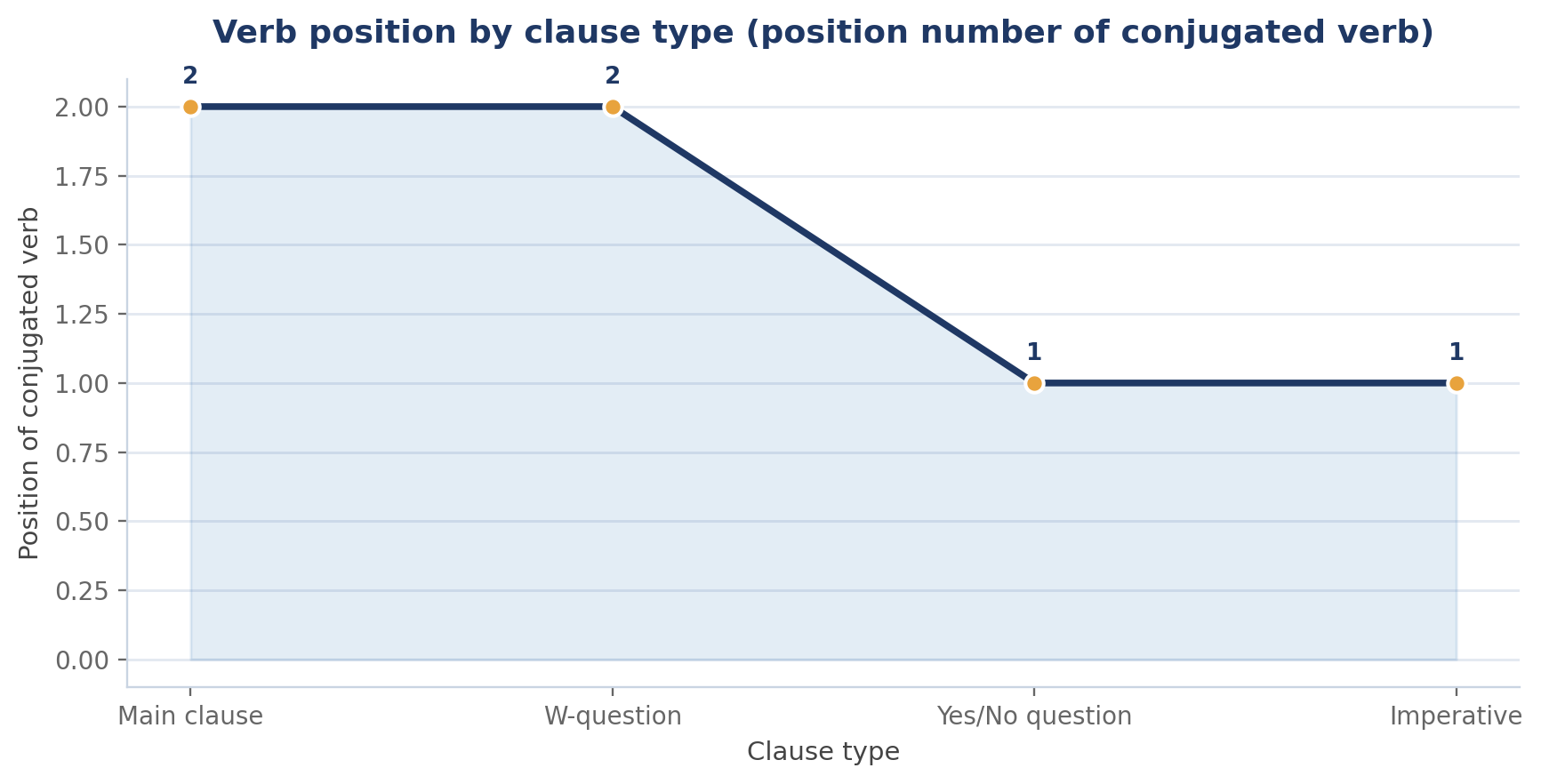
In a German main clause, the conjugated verb occupies position two. Not "second word" — second element. That element can be a single pronoun or a twelve-word noun phrase. Either way, the verb follows it immediately.
Shift anything to the front for emphasis — the verb still lands in slot two. Beginners who keep the subject first at all times sound robotic, but never wrong. Beginners who move the subject and forget the verb inversion sound distinctly foreign.
Inside the Sentence Bracket
Now the real architecture. German builds sentences as two halves clamped together: the conjugated verb opens the bracket, and the rest of the verb phrase closes it at the end. Everything else lives between the jaws.
That last row is the plot twist. In a subordinate clause the conjugated verb does not open the bracket — it slams it shut. Conjunctions such as weil, dass, obwohl, wenn, damit and sobald all send the verb to the very end.
TeKaMoLo: The Order Adverbials Love
When several adverbial phrases queue up, German arranges them in a fixed courtesy order: Temporal, Kausal, Modal, Lokal. Time, reason, manner, place.
So: Ich fahre heute wegen des Sturms mit dem Auto nach Hamburg. Manner before place — always. Swapping them is not fatal, but it flicks a switch in a native ear.
Three Traps That Out You Instantly
- Verb-second, not subject-second. Gestern ich ging is the classic slip. It must be Gestern ging ich.
- Time-manner-place word salad. English says "I go to Berlin tomorrow by train". German refuses. Reorder it: time, manner, place.
- Subordinate-clause amnesia. After weil, the auxiliary must migrate to the end. Weil ich habe keine Zeit is wrong; weil ich keine Zeit habe is right.
How to Drill It Without Boring Yourself to Tears
Grammar exercises convince you that you understand. Speaking convinces the grammar that you understand. Do both, but weight the second.
- Rewrite one paragraph of news a day, converting every main clause into a weil-clause and back.
- Read German aloud and tap the table when you hit the closing bracket verb. Physical rhythm builds the pattern faster than mental rules.
- Record yourself for 60 seconds on a random opinion, then replay and hunt for verb-first main clauses.
- Write five sentences starting with an adverbial, forcing inversion every time.
Rules you can recite are not rules you can use
Word order collapses under conversation pressure — unless you get instant feedback in the moment. A personal AI voice tutor does exactly that, with speaking practice and immediate AI feedback.
Practise with your AI voice tutor →Create a free accountWhere the Bracket Breaks Down
Two common exceptions deserve a flag. When a clause is short and the verb phrase simple, the bracket can feel invisible: Ich lese. No gap, no drama. And with wenn clauses that precede a main clause, the main clause verb comes immediately after the comma: Wenn es regnet, bleibe ich zu Hause.
Also note that prepositional phrases can sometimes go before the time phrase when they are being emphasised as the topic. German word order is rule-governed, not rule-frozen — the rules tell you what is possible, and the topic position tells you what is being highlighted.
Turn the sentence bracket into muscle memory
Reading about verb position changes nothing. Saying it a hundred times does. Start with a free placement check.
Get your placement check →Create a free accountFrequently Asked Questions
Is German word order really free? No. It is flexible, and the flexibility follows rules. Position two belongs to the conjugated verb; the end of a subordinate clause belongs to the conjugated verb. Adverbials shuffle within a strong preference order.
Why does German put the verb at the end? German is a verb-second language in main clauses and a verb-final language in subordinate clauses — a pattern shared with other Germanic languages historically. The clause type decides the position, not your mood.
What exactly is the Satzklammer? It is the "sentence bracket": the conjugated verb opens the clause, and any remaining verb parts (participles, infinitives, separable prefixes) close it at the end. Everything else nests inside.
Does word order matter for the Goethe exam? Yes. Writing and speaking assessments mark structure, and consistent verb-second errors cost points at every level from A1 upward.
References & Further Reading
- Duden — Die Grammatik (Duden Band 4), sentence structure and the Satzklammer: https://www.duden.de
- Goethe-Institut — German language courses and grammar resources: https://www.goethe.de
- Deutsche Welle — Deutsch lernen (Nicos Weg, grammar clips): https://learngerman.dw.com
- Council of Europe — CEFR level descriptors: https://www.coe.int/en/web/common-european-framework-reference-languages
- IDS Mannheim — Grammis, the grammatical information system of German: https://grammis.ids-mannheim.de