A table is female. A girl is neuter. A spoon is male. German grammar der, die or das is the first thing learners rage about, usually within the first week, usually while staring at das Mädchen.
What you will get from this guide
- The endings that predict gender with high accuracy
- The three semantic groups that always get a fixed gender
- How to remember the nouns with no rule at all
- What happens to der/die/das in the other three cases
What Gender Actually Is
Gender is not biology. It is a grammatical category — a filing system German keeps for nouns so its articles, adjectives and pronouns can agree with them. Nothing more. Die Sonne is not "feminine" in spirit; it simply lives in drawer two.
And yes, three drawers: masculine (der), feminine (die), neuter (das).
That last row is a gift. **All plurals take *die***. Whatever chaos a noun caused in the singular, the plural quietly unifies.
The Endings That Reveal Everything
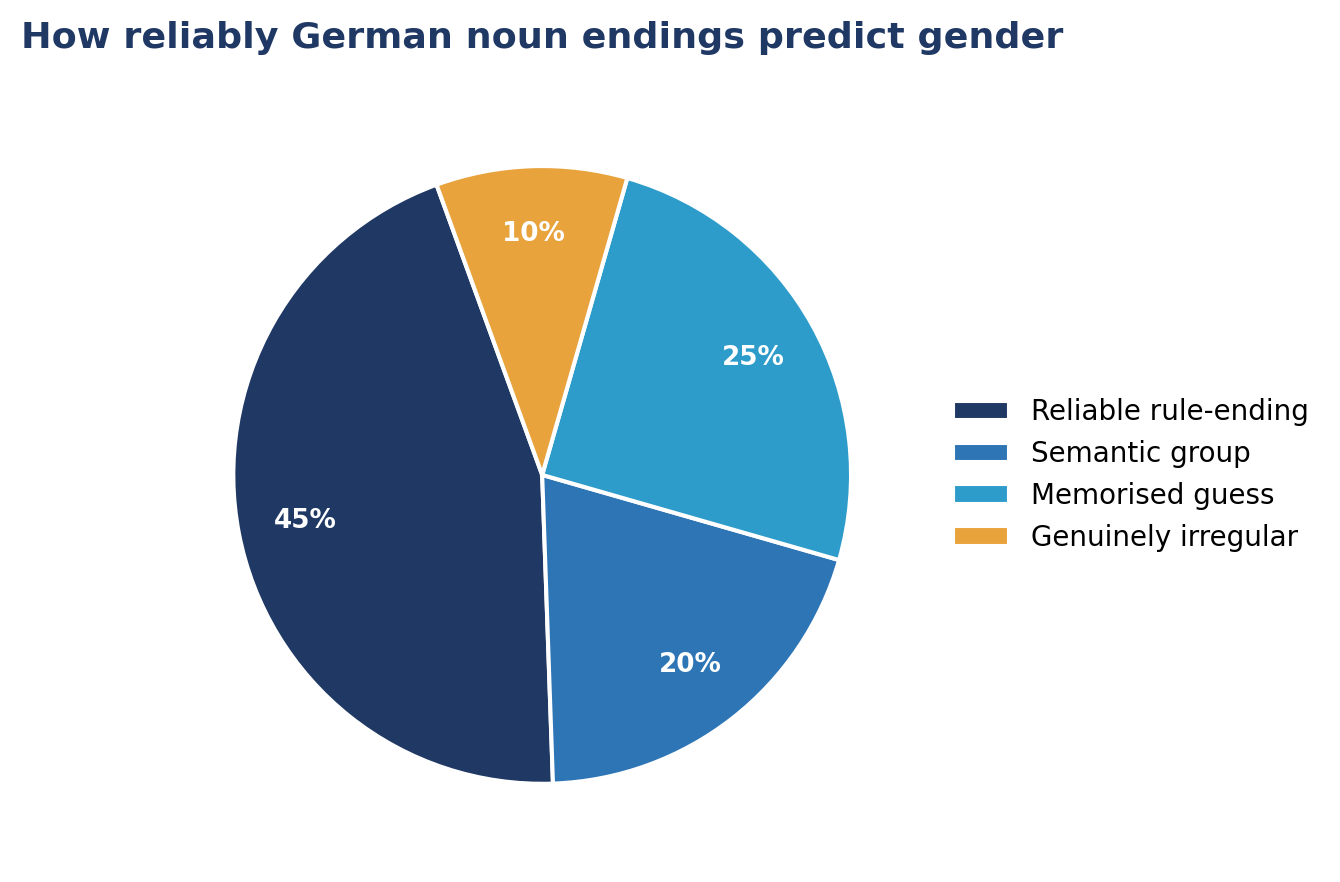
Here is your first real weapon. Noun endings predict gender, often with 90%+ reliability.
Note the -chen rule. It explains das Mädchen in one line: the diminutive suffix always forces neuter, overriding the meaning. German is not being cruel. It is being consistent about a suffix.
Semantic Groups With Fixed Gender
Some genders come from meaning, not spelling, and these are worth memorising as sets.
Two are near-absolute and worth trusting immediately: every verb turned into a noun is das, and every diminutive is das. Free wins.
The Roughly 25% With No Rule
Nobody enjoys this part. Some high-frequency nouns simply have to be learned. There is no shortcut, only a memory trick.
Chunk learning beats flashcards for long-term recall. Memorise im Zug sitzen or in die Stadt gehen, and the case form does the gender work for you. Your brain stores the whole phrase, then hands you the gender as a bonus.
Gender Changes With Case
This is where beginners panic, and where the real structure appears. Articles shift by case — but notice who barely moves.
Feminine only ever has two forms: die or der. Plural is similar. Only masculine changes shape in every case — that is why der gets all the attention. Learn the masculine pattern and you have learned most of German declension.
Rote learning is slow. Patterns make it fast.
German Course Pass gives you a personal AI voice tutor that drills gender endings until they become reflex, correcting your articles in speaking practice rather than on a worksheet.
Learn German with live instructors →Create a free accountA Practical Study Routine
Do this for four weeks and der/die/das stops being a coin flip.
Fifteen a day is 450 nouns a month. At that rate, the 2,000 most common German nouns — enough for roughly 80% of everyday conversation — take about four months. That is not a heroic commitment. That is ten minutes before breakfast.
Why It Matters More Than You Think
Wrong gender does not just sound off. It breaks agreement downstream.
One error propagates through a whole sentence. That is why teachers are strict about articles, and why the patience is worth it. Get die Möglichkeit right and six other decisions become automatic.
One error, six consequences — fix it at the source
Our AI voice tutor on the German Course Pass catches article errors the moment they happen, in speech, before they harden into habits.
Get your German Course Pass →Create a free accountFrequently Asked Questions
Is there a rule that covers all German noun genders? No, and anyone promising one is selling something. Endings and semantic groups cover roughly 75% of nouns reliably. The remaining quarter is genuine memorisation — but those are often the least frequent words.
Why is das Mädchen neuter if it means girl? Because the diminutive suffix -chen always makes a noun neuter, and it overrides meaning. The same applies to das Fräulein and every other -chen word.
Should I learn der, die and das with every new noun? Always. Never write a noun without its article. Learning Tisch alone wastes the effort, because you will need der Tisch in every single sentence you ever say.
Do Germans care if I use the wrong article? They will still understand you, and most will not correct you rudely. But wrong gender triggers wrong adjective and pronoun endings, so the whole sentence starts to wobble. It is worth the effort.
References & Further Reading
- Duden, Die Grammatik — the standard reference work on German noun gender and declension.
- Goethe-Institut, grammar resources for levels A1 to B2, including article and case practice.
- Deutsche Welle, Nicos Weg — grammar explanations embedded in an A1-A2 story course.
- Council of Europe, Common European Framework of Reference for Languages — level descriptors for grammatical accuracy.
- LanguageSkills.net German grammar courses — self-paced AI voice tutor correcting article and case errors in real time.