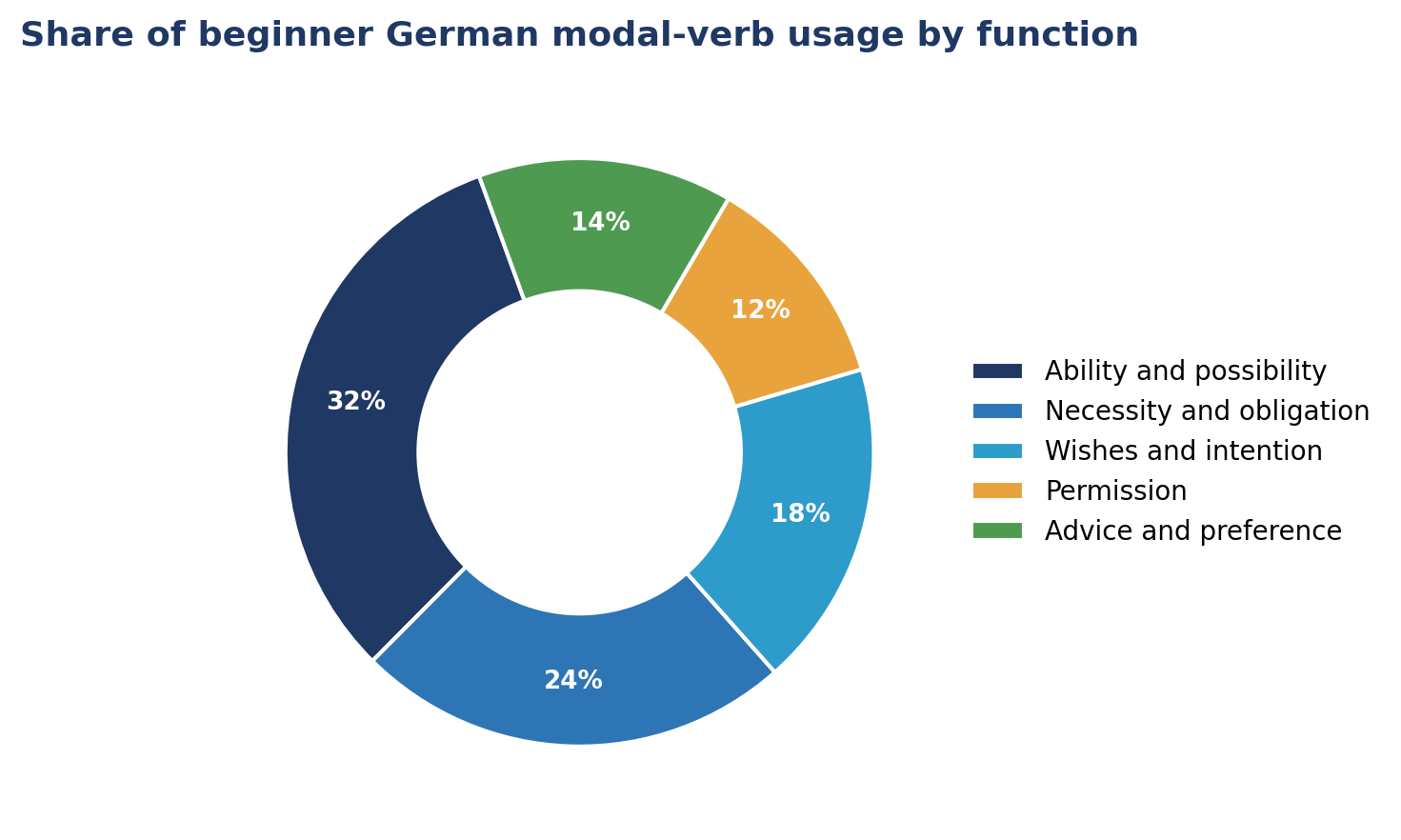
German modal verbs look innocent. Six little words — können, müssen, wollen, sollen, dürfen, mögen — and suddenly you can say what you can, must, want, should, may and like. Then you meet your first real sentence and the second verb slides to the end of the line like it owes someone money.
What you will get from this guide
- All six Modalverben, conjugated, without the noise
- The sentence-bracket rule explained in one picture
- müssen vs sollen, dürfen vs können — the pairs that confuse everyone
- The five mistakes that scream "beginner" and how to fix each
What a Modal Verb Actually Does
A modal verb does not carry the action. It changes the mood of an action someone else performs. In German the modal takes the position of the finite verb — second in a main clause — and the main verb, in its infinitive form, walks to the very end.
That is the whole trick. Modal in slot two, infinitive at the end. Once you internalise the frame, hundreds of German sentences stop being puzzles.
The Six Modal Verbs and Their Moods
Note the odd one out: möchten is technically the subjunctive form of mögen, but learners use it as a standalone modal for polite requests. Ordering with ich will sounds like a demand. Ich möchte sounds like a customer.
Conjugation Without the Headache
Here is the good news: modal verbs do not take the -t ending in the third person singular. Er kann, not er kannt. And the first and third person singular are identical, which is rare in German and very convenient.
Two patterns to remember: the singular vowels often change (können to kann, müssen to muss, dürfen to darf), and the plural forms look exactly like the infinitive. Learn the ich form and the du form, and the rest falls out.
The Sentence Bracket Rule
German builds a bracket around the middle of a sentence. The modal opens it, the infinitive closes it, and everything else lives inside.
Structure: Subject + modal + [middle field] + infinitive.
In a yes/no question, the modal jumps to position one and the infinitive stays at the end. In a subordinate clause with weil or dass, the modal itself moves to the end, after the infinitive. That last rule surprises people. Ich weiß, dass er kommen kann puts kann dead last.
Separable Verbs and the Modal Frame
Separable verbs keep the frame. The prefix does not split off when an infinitive sits at the end.
If you write Ich muss um sechs auf stehen, it is not wrong in a way that stops understanding — but it is wrong. The infinitive stays whole at the end.
The Confusing Pairs, Settled
That last pair deserves a permanent place in your memory. Du musst nicht and du darfst nicht sit one letter apart in English translation and one universe apart in meaning.
Grammar rules are easy; habits need practice
You now know the frame, the conjugations and the four pairs that trip up beginners — and you will still say ich will einen Kaffee in a Vienna café. A personal AI voice tutor exists precisely for that gap: structured speaking practice with instant feedback, at your own pace, until the right pattern becomes the automatic one.
Find a German course →Create a free accountThe Five Beginner Mistakes
Putting It to Work
Build sentences that are true about your own life. "Ich muss morgen früh aufstehen. Ich möchte am Wochenende reisen. Ich darf hier parken." Personal sentences stick because your brain keeps rehearsing them whether you asked it to or not.
Then stretch: add nicht and time expressions, then convert them into questions, then push them into weil clauses. Each transformation drills the bracket from a new angle. Ten minutes of this daily beats an hour of reading about grammar — because you are producing the structure, not recognising it.
Turn the bracket rule into reflex, one practice session at a time
Modal verbs are the fastest win in German grammar, and the fastest thing to get subtly wrong forever without feedback. A self-paced German course with an AI voice tutor gives you speaking practice with instant feedback on word order — the only way a rule becomes a habit.
Start a free account →Create a free accountFrequently Asked Questions
How many modal verbs does German have? Six core modals: können, müssen, wollen, sollen, dürfen and mögen. The related form möchten is used like a seventh and is the polite way to ask for something.
Why does the second verb go to the end of a German sentence? German is a verb-second language in main clauses, so the finite verb occupies position two. A modal takes that slot, which pushes the infinitive to the final position and creates the sentence bracket.
**Do modal verbs take zu before the infinitive?** No. Constructions like Ich muss gehen and Ich will lernen never insert zu. That is a feature of other verb types, not of modals.
**What is the difference between müssen and sollen?** müssen expresses necessity that you cannot avoid. sollen expresses an instruction or expectation coming from someone else — advice, orders, or what you have been told to do.
References & Further Reading
- Duden. Die Grammatik: Unentbehrlich für richtiges Deutsch, Dudenverlag.
- Goethe-Institut. A1–B1 grammar syllabus and course materials, goethe.de.
- Deutsche Welle. Nicos Weg grammar units on Modalverben, dw.com.
- Council of Europe. Common European Framework of Reference for Languages: Companion Volume, 2020.
- telc gGmbH. Level descriptions and grammar expectations for A1–B1, telc.net.