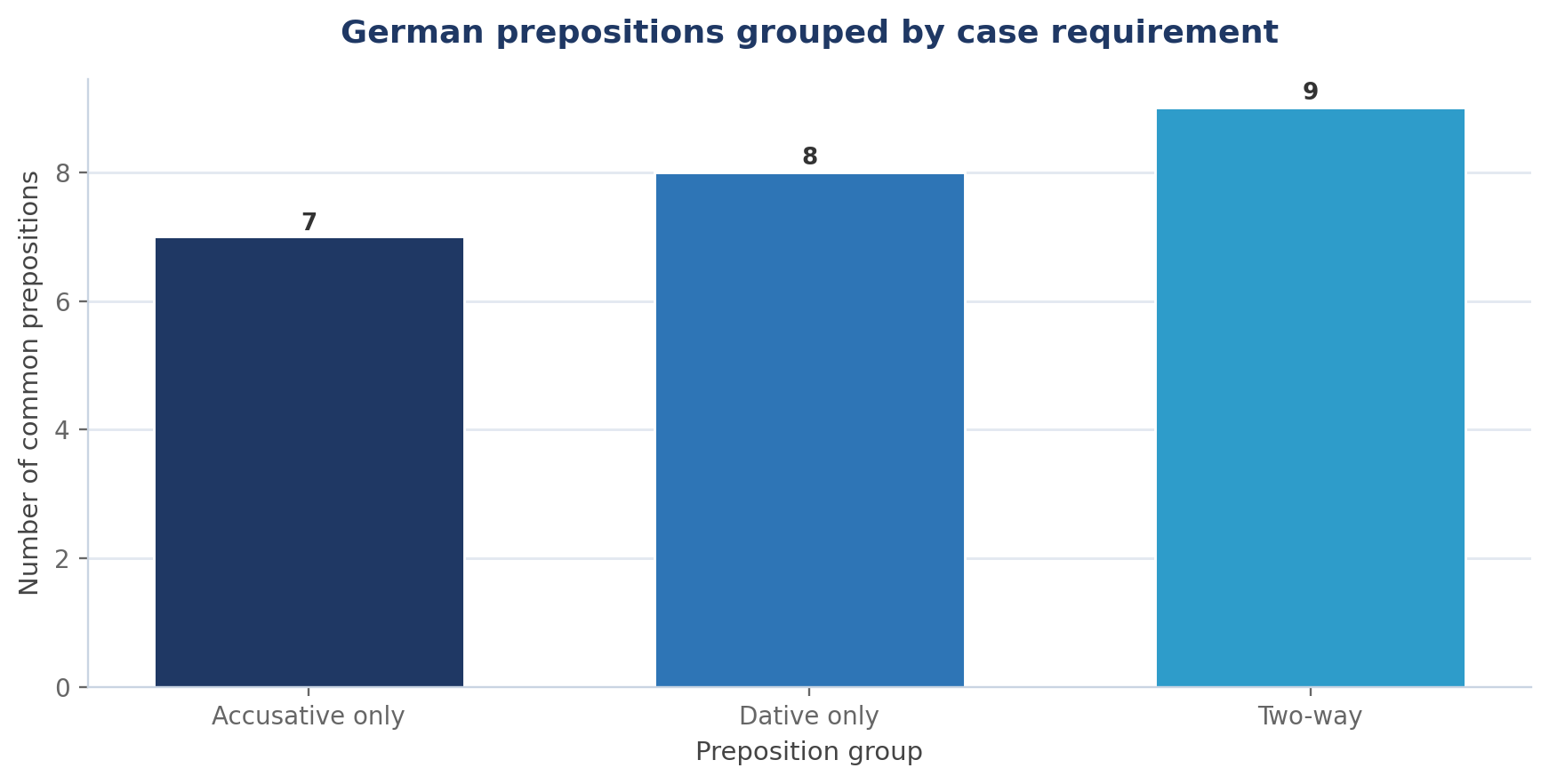
Nine German prepositions refuse to choose a side. In, an, auf, über, unter, vor, hinter, neben and zwischen can each take either the accusative or the dative, and the choice changes what your sentence means. Beginners hate them. Then they learn the one rule behind them and cannot understand why anyone ever found them difficult.
Here is the rule, the full list, the verb pairs that make it stick, and the mistakes that keep learners stuck.
What you will get from this guide
- The one rule that governs all nine two-way prepositions
- The full list, sorted by meaning
- The verb pairs that reveal movement versus position
- A mistake checklist and a practice routine
The one rule
Movement toward a target takes the accusative. Position in a place takes the dative.
That is it. No exceptions, no memorisation of individual cases per preposition.
The logic is almost beautiful once you see it. If you are moving and the destination is your goal, the destination is an object being acted upon — accusative. If you are simply describing where something already is, you are locating it — dative.
The nine two-way prepositions
Notice the contractions ins (in das) and im (in dem): German loves to squeeze these together, and they are a fast way to spot which case is in play.
The verb pairs that make it obvious
The cleanest way to feel the difference is through the classic verb pairs — one verb for placing, one for being.
*Ich lege das Buch auf den Tisch.* I am laying the book on the table — movement, accusative. *Das Buch liegt auf dem Tisch.* The book is lying on the table — position, dative.
The same preposition, one changed letter, two clear meanings. Learners who master these pairs stop guessing permanently.
Verbs that force the dative even without movement
Some two-way prepositions appear with verbs that always take the dative, regardless of logic.
These are not exceptions to the rule so much as idioms with their own fixed case. Learn them as phrases.
Stop guessing between den and dem — drill it with your AI voice tutor
Case decisions happen in milliseconds when you speak. Only repetition makes them automatic. Self-paced lessons with a personal AI voice tutor turn auf den Tisch from a rule you recall into a reflex you own.
Practise German prepositions →Create a free accountWhere learners go wrong
A two-second habit kills most errors: before writing or saying the preposition, ask wohin or wo. The answer picks the case for you.
A practice routine that works
Describing your own room is a surprisingly powerful exercise. You know the space, so your brain is free to focus on the case rather than on inventing content. Move an imaginary object around that room and narrate every move: Ich stelle die Lampe auf den Tisch. Jetzt steht sie auf dem Tisch.
Why this matters beyond grammar drills
Two-way prepositions appear constantly in real German: instructions, directions, recipes, news reports and everyday small talk. They are also a favourite of examiners at every level, because they reveal whether a learner truly controls case or is simply pattern-matching. Getting them right is one of the clearest signals that a learner has moved from studying German to using it.
Turn case rules into conversation habits
Self-paced speaking practice with your AI voice tutor gives you the repetition and instant feedback that make den and dem arrive automatically, without a mental table. Short, focused sessions beat another grammar chapter.
Explore German courses →Create a free accountFrequently Asked Questions
What are the nine two-way prepositions in German? In, an, auf, über, unter, vor, hinter, neben and zwischen. They are called Wechselpräpositionen because they switch between accusative and dative.
How do I decide between accusative and dative? Ask whether the sentence answers wohin (where to?) or wo (where?). Wohin takes the accusative; wo takes the dative.
**Do contractions like ins and im matter?** Yes, especially in speech. Ins Zimmer and im Zimmer are what natives say; in das Zimmer and in dem Zimmer usually sound formal or deliberate.
Are there exceptions to the movement rule? A few fixed expressions and verbs take the dative regardless, such as jdm. in die Augen sehen. Learn those as idiomatic phrases rather than as rules.
References & Further Reading
- Duden — Die Grammatik: prepositions and case government
- IDS Mannheim — Grammis: prepositions in German
- Goethe-Institut — German levels and grammar guidance
- Deutsche Welle — Learn German: grammar with audio exercises
- Council of Europe — CEFR descriptors for grammatical accuracy