Yesterday you walked to the shop. In German you say you have walked, and then the verb splits in two and one half runs to the end of the sentence. That is the Perfekt, and it is the tense Germans actually use to talk about the past. Master it and your German stops being a series of present-tense survival phrases.
What you will get from this guide
- The two-part structure of the Perfekt, stated once and clearly
- How to choose between haben and sein without guessing
- How to build the Partizip II for regular, irregular and separable verbs
- The word-order rule that trips up nearly every learner
The Shape of the Thing
Every Perfekt sentence has exactly two moving parts:
Helping verb in position 2 + Partizip II at the end.
Ich habe gestern einen Kuchen gebacken. I baked a cake yesterday.
The helping verb carries all the grammar — person, tense, agreement. The Partizip II carries the meaning. They are a couple forced to sit at opposite ends of the table, and the sentence is the table.
Haben or Sein? The Question That Haunts Everyone
Nearly all verbs take haben. A smaller group takes sein, and that group is learnable in about an hour.
Learn the sein list as a chant. Gehen, fahren, fliegen, kommen, aufwachen, einschlafen, sterben, wachsen, bleiben, sein, werden. Everything else is haben until proven otherwise.
Building the Partizip II
Three families of verbs, three patterns. Weak and mixed verbs follow rules; strong verbs must be memorised, and there is no way around it.
Two traps live in that table. Separable verbs shove the ge- into the middle like a filling in a sandwich: aufgemacht, not geaufmacht. And verbs beginning with an unstressed prefix — verstehen, bezahlen, erklären — refuse the ge- entirely.
Word Order: Where Everything Goes Wrong
In a main clause, the Partizip II goes to the very end. In a subordinate clause, the helping verb goes last, after the participle.
Read the last row twice. When a modal verb appears in the Perfekt, the participle becomes an infinitive and the modal takes the participle role at the end. Ich habe kommen müssen, not Ich habe gemusst kommen.
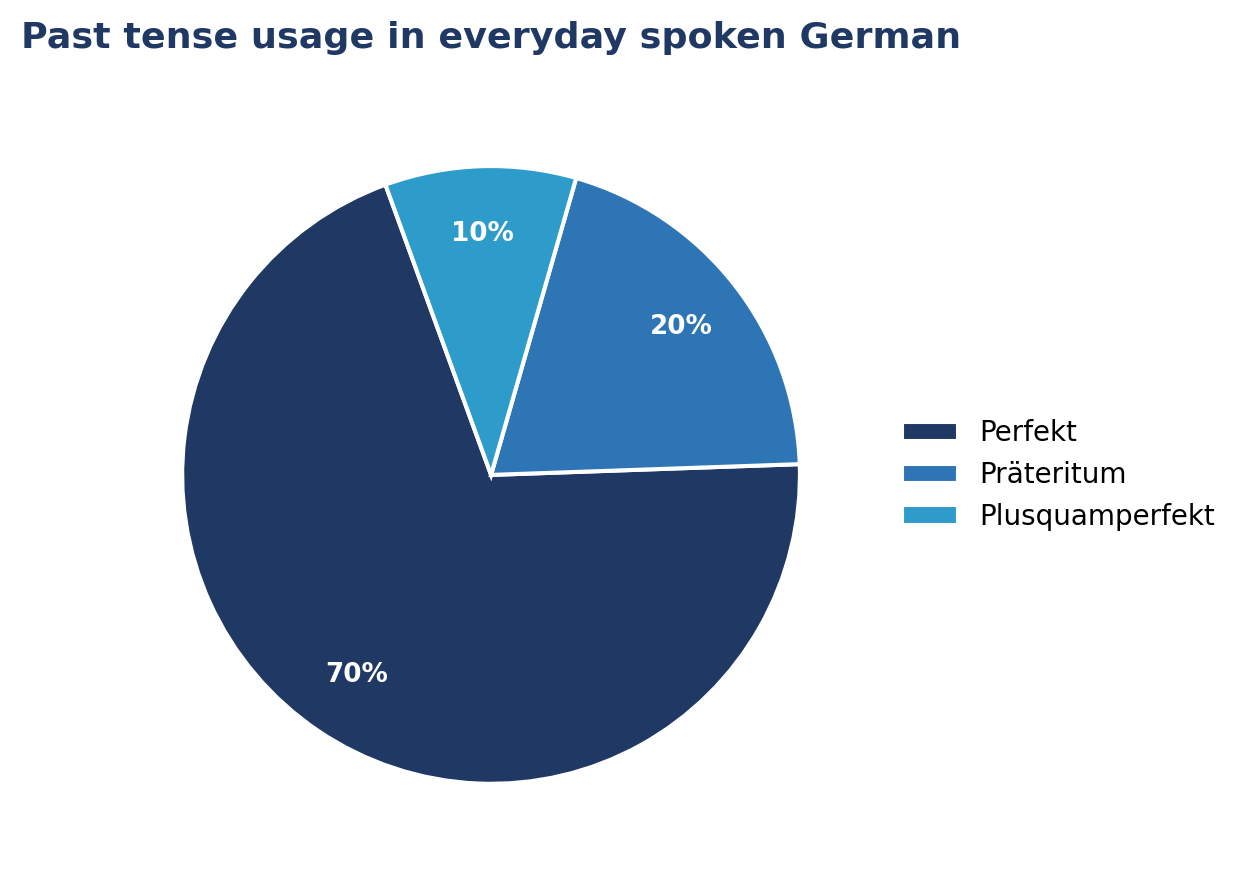
How German Past Tenses Actually Divide Up
The Perfekt dominates speech. The Präteritum lives mostly in writing and in a handful of high-frequency verbs — war, hatte, wurde, konnte, musste. The Plusquamperfekt handles "before that".
The practical takeaway: speak in the Perfekt, learn war and hatte as frozen words, and read Präteritum until it stops feeling foreign.
Rules are easy. Automatic is hard
You can read the haben/sein table in five minutes and still fumble it for a year. A personal AI voice tutor turns the rule into reflex, with instant feedback that catches the split-second errors you never hear yourself make.
Practise German grammar live →Create a free accountThe Five Mistakes Marking You as a Beginner
- Sein for everything. Ich bin gegessen sounds like you are a meal. Movement verbs take sein; eating is not movement.
- Participle in the middle. Ich habe gesehen den Film is English word order in German clothing.
- Extra ge- on -ieren. It is studiert, never gestudiert.
- Separation errors. Ich habe aufgemacht die Tür — the auf belongs inside the participle, the participle belongs at the end.
- Präteritum in casual speech. Ich ging zum Supermarkt is technically correct and sounds like a novel.
A Ten-Minute Drill That Works
Take one hour of your day and narrate it out loud in the Perfekt, past tense, in German. Ich habe Kaffee getrunken. Ich habe die Zeitung gelesen. Ich bin zur Arbeit gefahren. Ten minutes. Every day. You will say something absurd and wrong by Thursday, and noticing it is the whole point.
Add regular AI-tutor speaking practice and this compounds fast. Grammar you only read decays; grammar you say out loud sticks.
Say it wrong today, say it right forever
An AI voice tutor catches the errors your ear has stopped hearing. Bring your Perfekt sentences, get instant feedback, and stop guessing.
Start your German course →Create a free accountFrequently Asked Questions
Do Germans really use the Perfekt for everything past? In speech, mostly yes. Präteritum survives for war, hatte, wurde, konnte and in formal writing. Use the Perfekt when you talk, and learn those few Präteritum forms as vocabulary.
Is it "ich habe gestanden" or "ich bin gestanden"? Both exist but mean different things. Ich habe gestanden = I confessed. Ich bin gestanden = I stood. Context and helper decide the meaning.
What is the difference between Perfekt and Plusquamperfekt? Plusquamperfekt is the past of the past — the earlier of two events. Ich hatte gegessen, bevor ich ankam. You use it in storytelling, rarely in casual conversation.
Can I avoid learning the Partizip II forms? No, but you can learn them efficiently. Group strong verbs by their vowel pattern — sprechen/gesprochen, nehmen/genommen — and drill in batches of ten.
References & Further Reading
- Duden, Die Grammatik (9th edition), Dudenverlag — Perfekt formation and word order
- Deutsche Welle, Deutsch lernen grammar resources — dw.com/deutschlernen
- Goethe-Institut, level-based grammar syllabi for A1–B1 — goethe.de
- Council of Europe, Common European Framework of Reference for Languages (2020)
- Hammer, M. & Durrell, M., Hammer's German Grammar and Usage, Routledge