Every German learner meets the same villain. It is not the vocabulary. It is not even the word order. It is the moment a textbook writes der Mann in one sentence and den Mann in the next, and nobody explains why the word just changed clothes.
That is the four-case system, and here is the good news: the cases are not four separate topics to memorise. They are one idea applied four times. Understand the idea once and the tables stop being painful and start being obvious.
The One Idea Behind All Four Cases
German marks what role a noun plays in a sentence. English does this with word order. German does it with the article. That is the entire concept.
Read that table left to right and the whole system appears: same dog, four jobs, four different articles. German is telling you who does what, not just in what order.
The 20-minute version of this article
- Nominative = the doer. Accusative = the thing being done to. Dative = the one receiving. Genitive = the one owning.
- Only masculine articles visibly change in the accusative (der → den).
- Only the dative triggers plural -n on the noun.
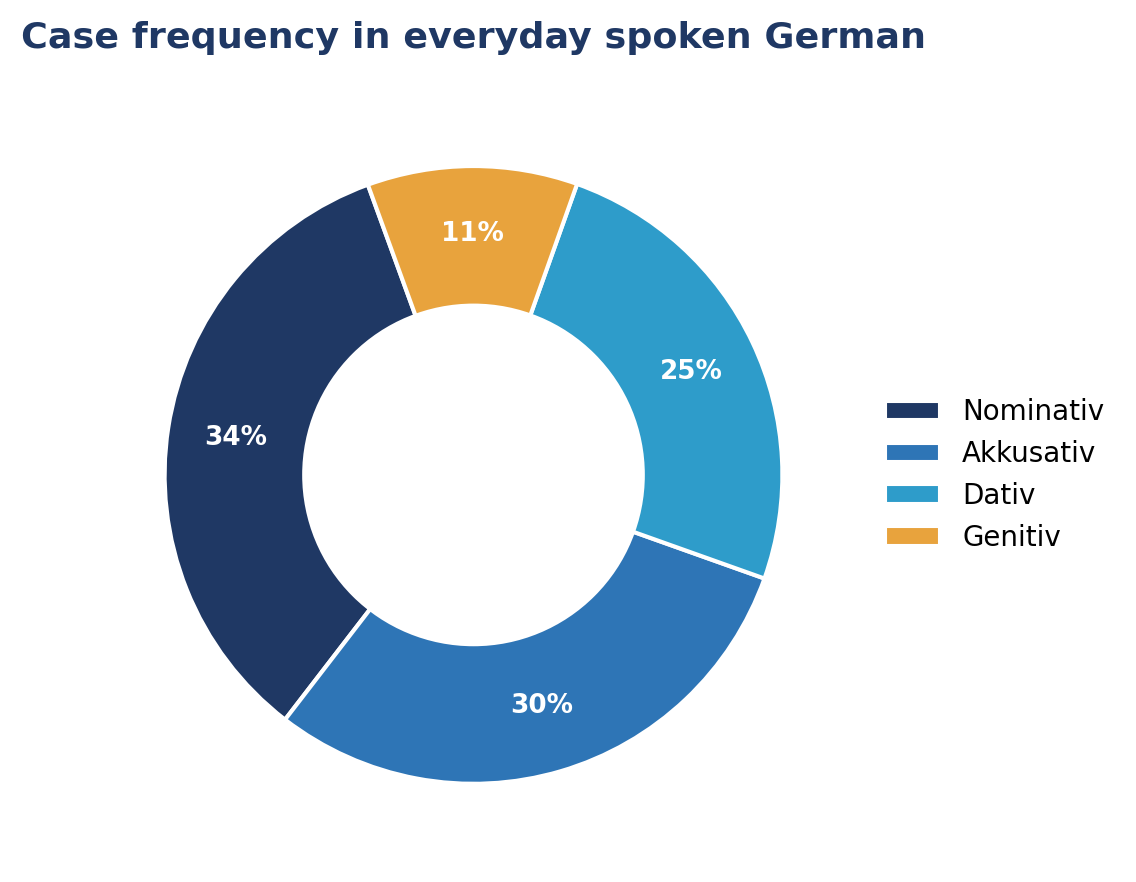
- Roughly 80% of everyday German uses only Nominative, Accusative and Dative.
How Often Do the Cases Actually Show Up?
Learners over-invest in Genitiv and under-invest in Dativ. The frequency data tells a different story.
Notice that Genitiv is the rarest and the most feared. In speech, Germans usually replace it with von + Dativ ("das Auto von meinem Bruder"). Learn it for reading and writing; do not build your identity around it.
The Master Declension Table (Learn This Once, Use It Forever)
This is the table every German course eventually hands you. The trick is to learn the pattern, not the rows.
Now spot the pattern instead of memorising 16 cells:
- Feminine barely moves. die → die → der → der. It only changes twice, and only in Dativ and Genitiv.
- Neuter barely moves either. das → das → dem → des. One change in the accusative family, two later.
- Masculine does all the dramatic work. der → den → dem → des. If you learn one row, learn this one.
- Plural gets a bonus rule. In the dative plural, the noun itself adds an -n: *mit den Kindern*, *in den Häusern*.
That is the whole table. Four real changes, not sixteen.
Nominative: The Doer Comes First
The nominative is the default case — the one you find in dictionaries and on flashcards. Use it for the subject of the sentence and for the complement after sein, werden and bleiben.
- Der Kaffee ist heiß. (The coffee is hot.)
- Meine Schwester wird Ärztin. (My sister is becoming a doctor.)
The nominative needs no strategy. Learn the gender of the noun and you have already mastered it.
Akkusativ: The Receiver, And The Verbs That Demand It
The accusative marks the direct object. In practice, that means you mostly change masculine words: der → den, ein → einen.
Verbs that almost always take the accusative: haben, sehen, kaufen, essen, trinken, lesen, brauchen, suchen, finden, nehmen, lieben, fragen.
- Ich kaufe einen neuen Laptop. (I'm buying a new laptop.)
- Siehst du den Mann dort? (Do you see the man there?)
Then come the accusative prepositions, and this is where you should spend real study time. Memorise them as a chant, because they will never change:
durch, für, gegen, ohne, um, bis, entlang — always accusative.
Every one of them. No exceptions, no "it depends". *Für den Job*, *ohne den Schlüssel*, *gegen die Regel*.
Dativ: The Receiver of the Received
The dative marks the indirect object — the person or thing something is given, sent, told or shown to.
Dative verbs: geben, helfen, danken, gefallen, gehören, glauben, folgen, passen, schmecken, antworten.
- Ich helfe dem Nachbarn. (I help the neighbour.)
- Das Buch gehört der Bibliothek. (The book belongs to the library.)
And here is the shortcut that pays for itself every single day — the dative prepositions:
aus, bei, mit, nach, seit, von, zu, gegenüber — always dative.
*Mit dem Auto*, *nach der Arbeit*, *zu meinem Freund*, *seit einem Jahr*. Learn this set in one sitting and you will produce correct German in a dozen everyday situations before you can explain why it is correct.
Genitiv: Ownership, And Why Germans Avoid It
The genitive shows possession: *das Auto des Vaters* (the father's car). Masculine and neuter nouns also pick up an -s or -es: *des Mannes*, *des Kindes*.
In conversation, Germans usually reach for von + Dativ instead. But the genitive is alive and well in writing, in formal German, in names of institutions and in a small set of fixed prepositions: wegen, trotz, während, statt, innerhalb, außerhalb.
- Wegen des Regens bleiben wir zu Hause. (Because of the rain, we stay home.)
- Während der Pause liest sie. (During the break, she reads.)
Two Shortcuts That Unlock Most of German Grammar
Textbooks bury these. Use them from day one.
**Shortcut 1 — The der → den reflex.** Whenever a masculine noun is the direct object of an action, or follows durch/für/gegen/ohne/um, it becomes den. Train this single reflex and you will fix a huge share of your case errors instantly.
**Shortcut 2 — The mit reflex.** Whenever you hear or say mit, zu, nach, bei, von, seit, aus, your article switches to dative. No thinking, no table: mit dem, zu der (contracted to zur), bei mir.
Reading the rules is free. Getting corrected is what makes them stick.
Cases are the one part of German where feedback beats information. With the LanguageSkills.net AI voice tutor, you get instant feedback on your sentences, it flags which case tripped you, and you can drill that specific pattern until it becomes reflex — at your own pace, any time.
Start learning German with your AI voice tutor →Create a free accountThe Three Case Errors That Cost Beginners the Most
Fix these three and your German will sound noticeably more competent within a fortnight.
A Four-Step Drill That Actually Rewires You
Step 1 — Parse before you translate (10 min). Take five German sentences and label every noun N, A, D or G. Do not translate. Just label. You are training your eye.
Step 2 — One verb, four cases (10 min). Write geben in four sentences where the nouns shift roles. You will feel the system click.
Step 3 — Preposition sprints (5 min). Write 15 phrases using only the dative prepositions, then 15 using only the accusative ones. Speed, not depth.
Step 4 — Produce and get corrected (15 min). Write six sentences about your own day and have a trainer mark the cases. This step is the one that converts knowledge into skill.
Learn German grammar with your AI voice tutor
Grammar is a skill, not trivia. Our German track pairs every case lesson with guided speaking practice, AI feedback on your writing, and progress tracking, so you can see the errors disappear week by week instead of guessing. Take the free level check and we'll start you at exactly the right point.
Start your free level check →Create a free accountFrequently Asked Questions
Do I need all four German cases to speak fluently? To speak well, you need Nominativ, Akkusativ and Dativ actively. Genitiv matters mainly for reading, writing and formal contexts — and it is a small, finite set of endings.
What is the easiest way to remember German cases? Attach a question word to each one: wer for nominative, wen/was for accusative, wem for dative, wessen for genitive. Then ask that question about the noun before you choose the article.
Why does only masculine change in the accusative? Because German preserves an old pattern where feminine and neuter forms were already similar in the nominative and accusative. It is not a rule someone designed — it is linguistic history, and it happens to save you a lot of memorising.
Are dative and accusative prepositions the same? No. durch, für, gegen, ohne, um, bis, entlang are always accusative. aus, bei, mit, nach, seit, von, zu, gegenüber are always dative. A separate group — in, an, auf, über, unter, vor, hinter, neben, zwischen — switches depending on movement or position.
At what level are German cases tested? They start at A1 and never stop being tested. A1 covers nominative, accusative and dative basics; B1 introduces the full genitive and the two-way prepositions in depth.
The Takeaway
The four German cases are one idea in four costumes: German marks roles with articles instead of with word order. Learn the doer, the receiver, the beneficiary and the owner. Then learn two shortlists — the accusative prepositions and the dative prepositions — and let daily practice handle the rest.
You will not master this from a table. You will master it from sentences somebody corrects.
Turn grammar theory into fluent sentences
Reading about den versus dem takes ten minutes. Producing it correctly under pressure takes practice — and that is precisely what a Course Pass is for. Guided lessons, speaking practice with AI feedback, listening practice and printable study materials from A1 to B2.
Get your German Course Pass →Create a free accountReferences & Further Reading
- Duden, Die Grammatik — Kassusystem und Deklination
- Goethe-Institut, A1–B1 grammar progression for German as a foreign language
- Council of Europe, CEFR Companion Volume — grammatical range descriptors
- Mannheim German Reference Corpus (DeReKo), Institut für Deutsche Sprache — case frequency data
- Deutsche Welle, Deutsch lernen grammar units on Kasus and Präpositionen
- Eisenberg, P., Grundriss der deutschen Grammatik