Every German learner meets the same villain. You want to say "I don't have a car" and two words elbow each other out of the way: nicht and kein. Pick wrong and the sentence survives, but it limps. Pick right and people stop noticing you are learning.
German grammar negation with nicht and kein is not a coin flip. It is one clean rule with a small tail of exceptions, and the rule fits in one sentence. Let's cut it open.
What you will get from this guide
- The single rule that decides nicht vs kein — no memorising word lists
- Exactly where nicht sits in a sentence, including with modal verbs
- Full kein declension tables for nominative, accusative and dative
- Common mistakes that make Germans smile politely, and their fixes
The One-Sentence Rule
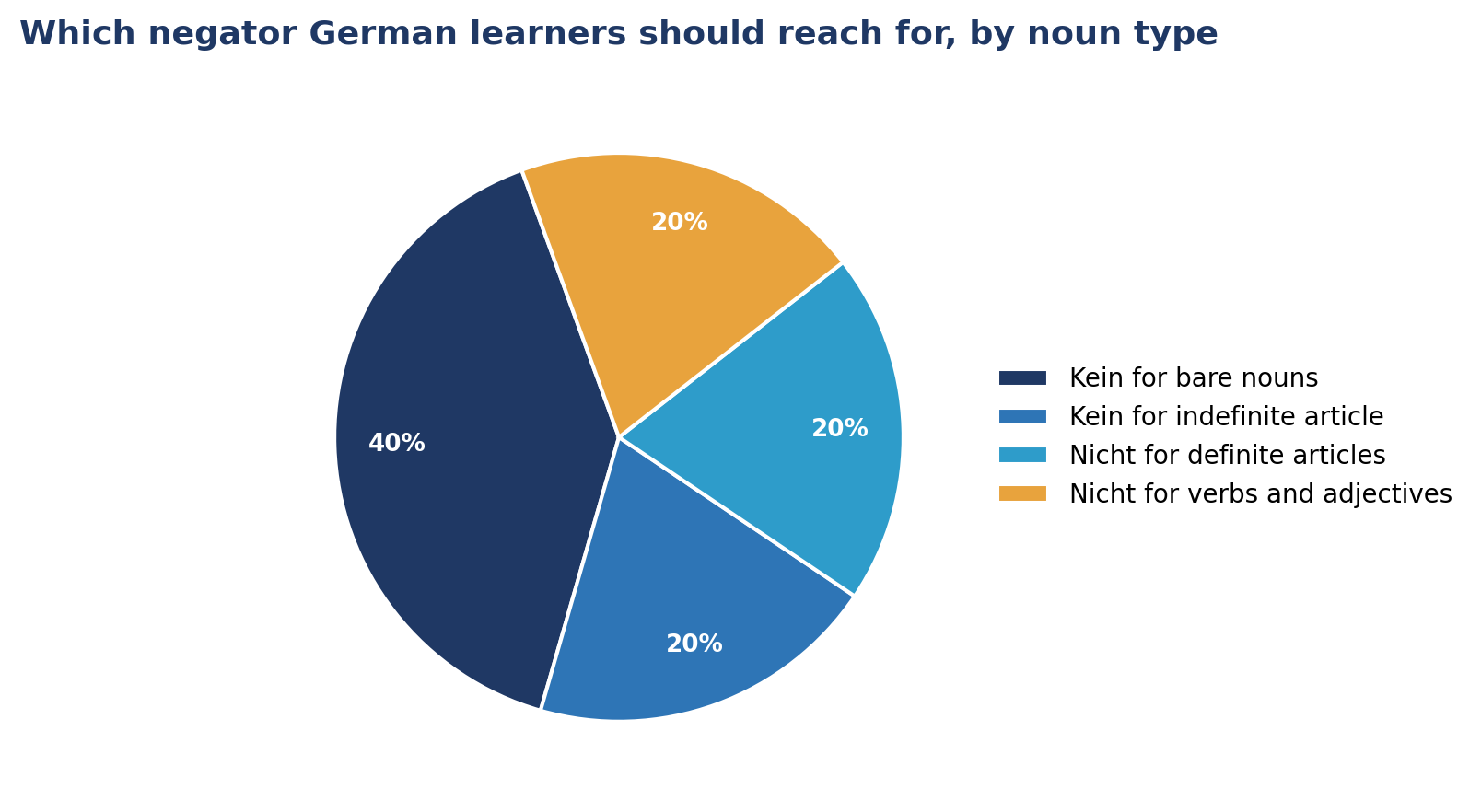
Use kein to negate a noun that has no article or an indefinite article. Use nicht for everything else.
That is it. Ich habe ein Auto becomes Ich habe kein Auto. Ich habe das Auto becomes Ich habe das Auto nicht. The noun with das keeps its article, so kein has no job.
Notice the last row. Possessives like mein, dein, unser already pin the noun down, so nicht takes the job. Same for dieser, jeder, and names.
Where nicht Actually Sits
Here the word nicht behaves like a shy guest. It drifts toward the end of the sentence but never past the verb bracket.
The pattern underneath: nicht stands directly in front of whatever it kills. Kill the whole sentence and it slides to the end. Kill one word and it stands before that word.
Declining kein: The Table That Ends the Confusion
Kein is not a fixed word. It is a possessive-style determiner, and it takes the same endings as mein and dein.
Swiss German speakers and many Austrians will happily say kein where the table says keinen, especially in casual speech. Learn the written standard first, then relax.
Nicht vs kein with Articles That Hide
Some nouns look bare but carry a hidden article. Abstract nouns, mass nouns and idioms are the usual suspects.
The profession row catches everyone. Er ist Lehrer has no article, so the negation needs kein: Er ist kein Lehrer.
Stop rebuilding the same rule every week
Ready to turn reading into real German? Start your self-paced course today.
Start the German course →Create a free accountReading about nicht and kein takes ten minutes. Making it automatic takes reps — short, spoken reps with an AI voice tutor that gives feedback on your sentences before the mistake hardens into habit. That is exactly what a self-paced German course with a personal AI voice tutor does. Button: See the German course →
The Double Negative Myth
German does not stack negatives the way English does.
Words like nichts, nie, niemand, niemals and nirgendwo are negative on their own. Add nicht on top and the meaning flips back toward positive, which is why nicht nichts sounds like a puzzle, not a denial.
Small Words That Change the Tone
Negation in German is not only yes or no. The flavour matters.
Noch nicht versus nicht is a favourite trap. Ich bin nicht fertig means I am not finished and that is that. Ich bin noch nicht fertig means I am not finished yet — and there is hope.
Practice That Actually Sticks
Do not read these tables three times. Convert them.
The recording drill is the cruel one and the useful one. You will hear yourself default to nicht where kein belongs. That hearing, not the table, is what fixes it.
Turn the rule into reflex
Ready to turn reading into real German? Start your self-paced course today.
Start the German course →Create a free accountRules you can recite are not rules you can use at speed. Self-paced speaking practice forces the choice between nicht and kein into the space of a second, until the right word simply arrives. Start with a free account and study at your own pace, any time. Button: Start learning German free →
Frequently Asked Questions
When do I use kein instead of nicht in German? Use kein when you negate a noun without an article or with an indefinite article: Ich habe kein Auto, Ich habe keine Zeit. Use nicht for nouns with definite articles or possessives, and for verbs, adjectives and whole sentences.
Does nicht always go to the end of a German sentence? No, but it drifts there. Nicht stands directly before the element it negates. If it negates the whole statement, it goes as late as possible, right before the final verb element.
Is kein declined like ein or like mein? Like mein. It takes the same endings as possessive determiners: keinen in the masculine accusative, keiner in the feminine dative, keine in the plural, and so on.
Can I use two negatives in one German sentence? Not the way English stacks them. Words such as nichts, nie and niemand are already negative, so adding nicht usually cancels the negation instead of strengthening it.
References & Further Reading
- Duden — the standard reference on German grammar, spelling and usage: https://www.duden.de
- Goethe-Institut — German courses, level descriptions and language resources: https://www.goethe.de
- Deutsche Welle — free German learning programme with grammar explanations: https://learngerman.dw.com
- Rat für deutsche Rechtschreibung — official rules on German orthography: https://www.rechtschreibrat.com
- Deutsche Grammatik, Grammis — research-based reference grammar from the Leibniz-Institut für Deutsche Sprache: https://grammis.ids-mannheim.de