Open a German novel and the past tense is everywhere. Open a German mouth and it vanishes. That gap is the whole story of the Präteritum — the simple past you will read constantly and hear almost never.
What you will get from this guide
- The four endings that cover every regular verb
- The vowel swaps behind the strong verbs
- sein, haben, werden and the six modals, spelled out in full
- A clear rule for choosing Präteritum or Perfekt in real time
What the Präteritum actually is
The Präteritum is German's simple past: one word, no helper. Er kaufte Brot. No hat, no gekauft. Just a stem and an ending glued together.
English does the same thing with he walked and she sang. German does it with er kaufte and sie sang. Different language, same instinct.
The catch is register. Germans use the Präteritum mostly in writing — newspapers, novels, reports, fairy tales — and in speech only for a small, stubborn gang of verbs. For everything else, spoken German reaches for the Perfekt. Miss that split and you sound like a walking novel.
The regular pattern: one stem, four endings
Weak verbs are the friendly ones. Chop the -en off the infinitive, and the stem is yours. Then add four endings and you are done — no vowel drama, no surprises.
Notice two gifts. First, ich and er look identical, so there is one less form to memorise. Second, stems ending in -t or -d (arbeiten, reden, warten) insert an e — arbeitete, redete, wartete — so you can actually pronounce them.
Strong verbs: the vowel swap
Strong verbs do not take -te. They change their vowel and take the same personal endings as the modals: nothing for ich and er, -st for du, -en for the plural.
There is no formula that predicts every swap. There are patterns — ei usually becomes ie or i, e usually becomes a or o — and there is practice. Seven groups cover most of the common verbs, which is exactly why drilling them in bulk beats learning them one at a time.
sein, haben, werden: the three you cannot avoid
These three appear in speech as Präteritum every single day. Learn them cold.
Ich war müde. Wir hatten keine Zeit. Es wurde kalt. Say those and you sound like a human. Say ich bin müde gewesen and you sound like a form letter.
Modal verbs and the vanished umlaut
Modals keep their Präteritum in speech too — ich konnte, ich musste — and here the spelling quietly betrays their origin. In the present tense they carry an umlaut. In the Präteritum it disappears.
No umlaut, no -te on some of them, and mögen turning into mochte. Just memorise the six. They carry more conversation than any other half-dozen verbs in the language.
Six tenses, one system — learn it at your own pace
You have just seen how the Präteritum fits together. Building it into speech takes repetition with feedback. Our self-paced German courses walk you from forms to confident use with a personal AI voice tutor, not a flashcard deck.
Start your German course →Create a free accountHow long until it feels automatic?
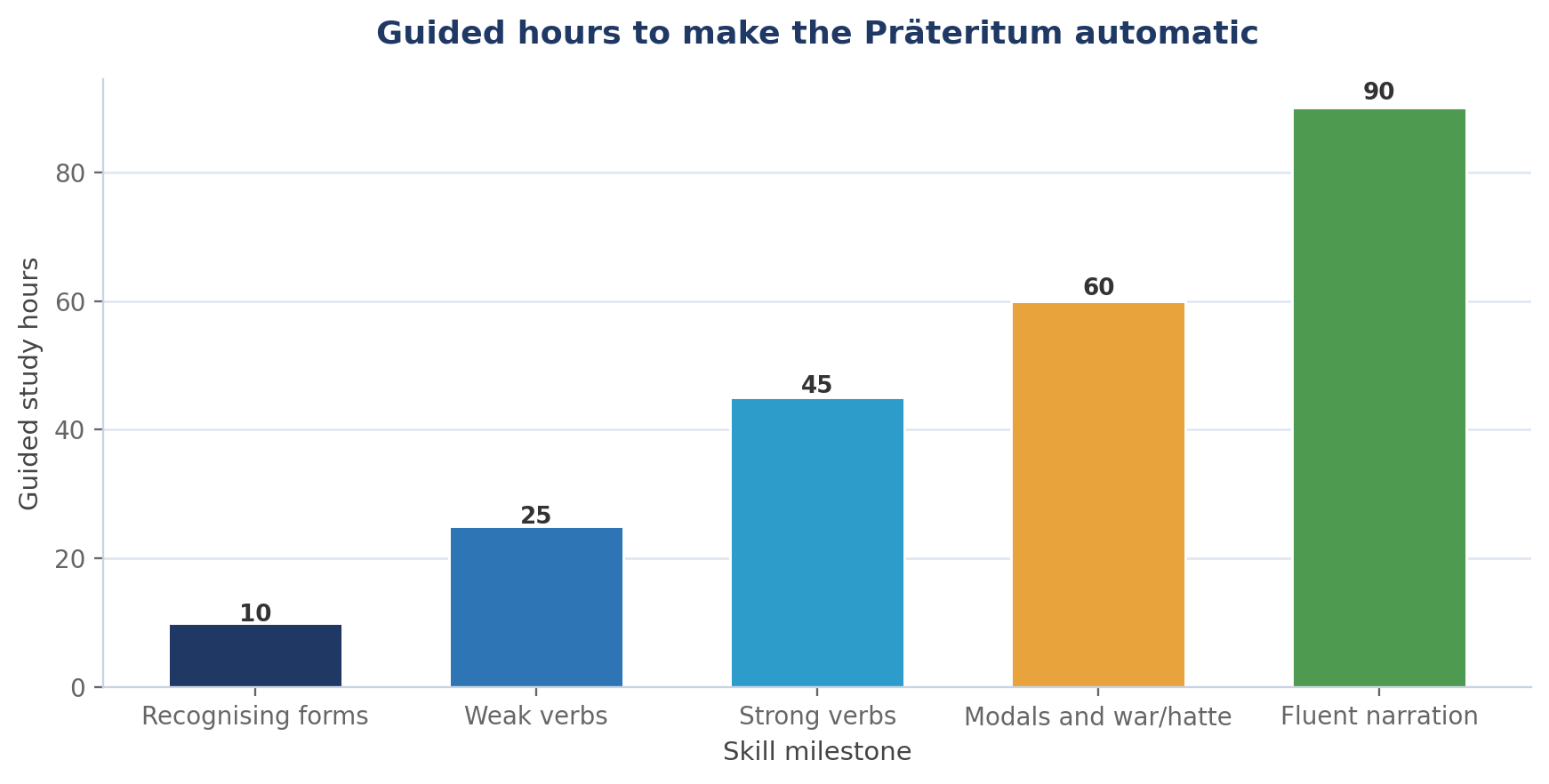
Recognition comes fast. Production takes longer, and it takes longer still in speech, where the Perfekt normally wins. Here is a realistic estimate of the guided work involved.
The last bar is the one that matters. Narrating a story in the past — what happened, in order, with detail — is a different skill from filling in a gap in a workbook.
Präteritum or Perfekt? Choosing in real time
One decision rule covers ninety percent of cases. Use this table as a filter.
The one rule that never fails: if you are speaking and you are unsure, use the Perfekt. It is never wrong in conversation. You will sound informal at worst, never incorrect.
Three mistakes that shout "beginner"
Mixing the two rules for du. With strong verbs it is du gingst, no -e-. With weak verbs it is du kauftest, with the -e-. Write du kaufst and you have slipped into the present tense.
Forgetting the e after -t and -d stems. Er wartete is correct. Er wartte is not a word.
Translating English past perfects literally. I had gone is not ich hatte gegangen in normal German. Either rely on context or use war plus a participle only where the sequence genuinely needs it.
Frequently Asked Questions
Is the Präteritum the same as the simple past? Yes. "Simple past" and "Präteritum" describe the same tense. Some older materials call it the Imperfekt, which means exactly the same thing.
Do I need the Präteritum for the A2 exam? You need to recognise war, hatte and the modals early, and you need to produce them. Full strong-verb narration is a B1 target, and it is assessed in writing more than in speech.
**Why do Germans say ich bin gegangen instead of ich ging?** Habit and register. Spoken German settled on the Perfekt as its default past, while the Präteritum stayed in writing. Both are correct grammar; only one sounds natural in a café.
Can I skip the Präteritum entirely? Only if you never read a German newspaper, never write a formal email and never sit a B1 exam. It is unavoidable in writing, so the honest answer is no.
Read it, hear it, then say it
Grammar you only read stays on the page. Use the Präteritum out loud with your AI voice tutor until it stops feeling foreign.
Start your German course →Create a free accountReferences & Further Reading
- Duden, Die Grammatik (Duden Band 4), Dudenverlag — the standard authority on German verb forms.
- Deutsche Welle, DW Learn German — free grammar units and audio on the past tenses.
- canoo.net, German Grammar — full conjugation tables for every verb: canoo.net
- Goethe-Institut, German language courses and CEFR levels — goethe.de
- Martin Durrell, Hammer's German Grammar and Usage, Routledge.