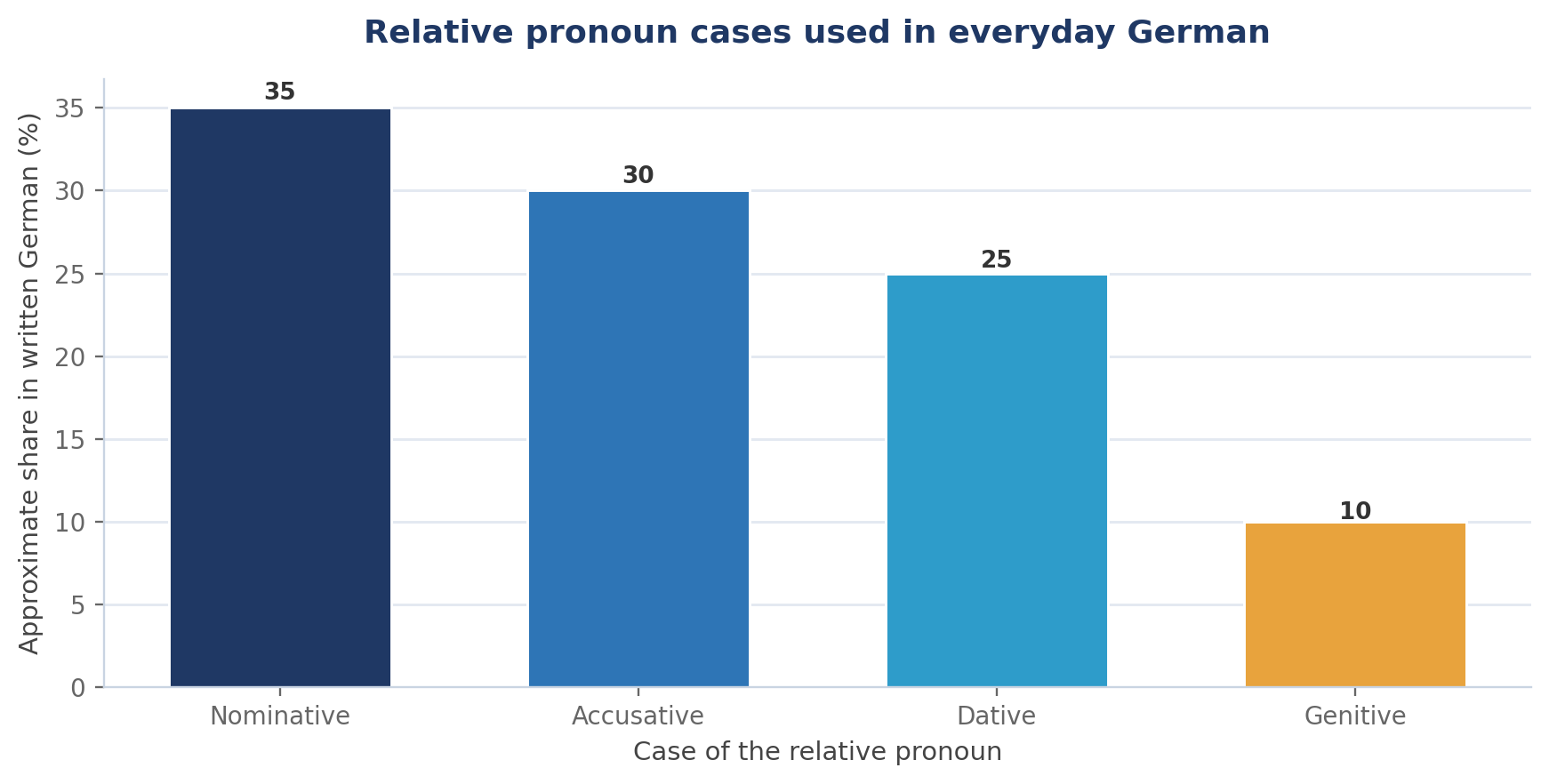
German grammar has a reputation, and it is mostly earned. But relative clauses are one of the most rewarding structures you can learn, because they are the difference between sounding like a phrasebook and sounding like a person. A Relativsatz lets you attach extra information to a noun without starting a brand-new sentence — exactly the way German actually writes and speaks.
There are only three moving parts: the pronoun, the case, and the word order. Get those right and relative clauses stop being scary.
What you will get from this guide
- What a German relative clause is, and how it looks in a sentence
- The full relative pronoun table, by gender, number and case
- The two-step method for choosing the right case every time
- The word-order rule, with a mistake checklist
What a German relative clause is
A relative clause describes a noun in the main clause. In German it has three signature features.
That last point is the one to tattoo on the inside of your eyelids. In a German subordinate clause the conjugated verb goes last. Every time.
The relative pronouns
The German relative pronouns look almost identical to the definite articles. That is both a gift and a trap, because they decline for gender, number and case.
Only four forms break the pattern you already know: dem and denen in the dative, and dessen and deren in the genitive. Everything else shadows the article table.
The two-step method for choosing the case
This is where learners panic. Use this order and the choice becomes mechanical.
Step one: gender and number come from the noun being described. If the noun is der Mann, you start from the masculine column, singular.
Step two: the case comes from the pronoun's job inside the relative clause. Subject means nominative. Direct object means accusative. Indirect object or a dative verb means dative. Possession means genitive.
Mixing the two sources is the classic error: *Das ist der Mann, den dort steht.* The gender came from the noun, but the case was grabbed from thin air. The pronoun is the subject of stehen, so it must be nominative: der dort steht.
Word order inside the clause
The golden rule in one line: relative pronoun first, everything else next, conjugated verb last. If a preposition belongs to the pronoun, it comes before it — mit dem, in dem, auf den.
Notice what happens with a separable verb or a modal: the conjugated part goes to the very end, and any prefix or infinitive sits just before it. *…, das ich gestern gekauft habe.*
Practise relative clauses out loud, with an AI voice tutor that corrects you
Case rules are easy to read and easy to forget. The moment you say der Mann, den dort steht out loud, an AI voice tutor can give you instant feedback before it becomes a habit. That is what a Course Pass is for.
Practise German grammar live →Create a free accountWhere learners actually go wrong
A quick self-check before you write: find the noun, decide gender and number, find the pronoun's job in the clause, then push the verb to the end. Four seconds of discipline prevents four kinds of error.
Relative clauses in real German
Relative clauses are everywhere once you start noticing them: in news articles, instructions, job adverts and everyday speech. They are also a favourite of examiners, because they show whether you can hold a case decision and a word-order rule in your head at the same time. That combination — grammar plus control — is precisely what B1 and B2 writing tasks reward.
Start short. Das ist der Kurs, der mir gefällt. Then add a preposition. Das ist der Kurs, an dem ich teilnehme. Then add a tense. Das ist der Kurs, an dem ich letztes Jahr teilgenommen habe. Three steps, three weeks, permanent skill.
Turn grammar rules into fluent sentences
Reading about Relativsätze builds understanding; speaking them builds fluency. Self-paced German lessons with an AI voice tutor give you the repetition and instant feedback that make a rule disappear into habit.
Explore German lessons →Create a free accountFrequently Asked Questions
**When do I use was instead of der, die, das?** Use was after indefinites such as alles, etwas, nichts and das, and after a whole clause: Das ist alles, was ich weiß.
Do relative clauses always need commas in German? Yes. The clause is set off by commas, and the comma before it is mandatory even when the clause is short.
**Can I use welcher instead of der?** You can — welcher, welche, welches — but it sounds stiff and dated. Prefer der, die, das in speech and modern writing.
Why does the verb go to the end? Because a relative clause is a subordinate clause, and German subordinate clauses place the conjugated verb in final position. It is a rule, not a style choice.
References & Further Reading
- Duden — Die Grammatik: relative clauses and pronouns
- IDS Mannheim — Grammis: information system on German grammar
- Goethe-Institut — German levels and grammar guidance
- Deutsche Welle — Learn German: grammar topics with exercises
- Council of Europe — CEFR descriptors for grammatical range and accuracy