German learners lose more sleep over mich and mir than over any other pair of words. Two tiny syllables, one endless headache. Yet the rule behind them is older and simpler than the grammar books admit. It comes down to a single question: is the person acting, or the person receiving?
Get that question right and the whole case system starts to feel like a system instead of a trap.
What you will get from this guide
- The complete pronoun table for nominative, accusative and dative
- The dative verbs that surprise everyone
- How prepositions decide which case a pronoun takes
- The two-way preposition rule, in one line you will remember
The one question that decides the case
Accusative is the case of the direct object — the thing being done. Dative is the case of the indirect object — the person something is done to or for, or who benefits.
Ich sehe dich. I see you. You are the thing being seen. Accusative. Ich helfe dir. I help you. You are the person benefiting from the help. Dative.
That second sentence is where English speakers stumble, because English uses the same word "you" for both. German refuses to blur the line, and a small set of verbs simply are dative — no logic, just loyalty.
Memorise the diagonal, not the table. mich–mir and dich–dir are the two pairs you will use a hundred times a day. uns and euch never change. Everything else follows.
Dative verbs: the list that breaks the pattern
These verbs take a dative object even when English suggests otherwise. Learn them as a fixed club.
Note the pattern: these verbs describe a relationship, not an action performed on a body. You do not "help someone" the way you "see someone" — you enter into a state of helping. So the person lands in the dative.
Prepositions decide the rest
When a pronoun follows a preposition, the preposition picks the case. There is no choice involved.
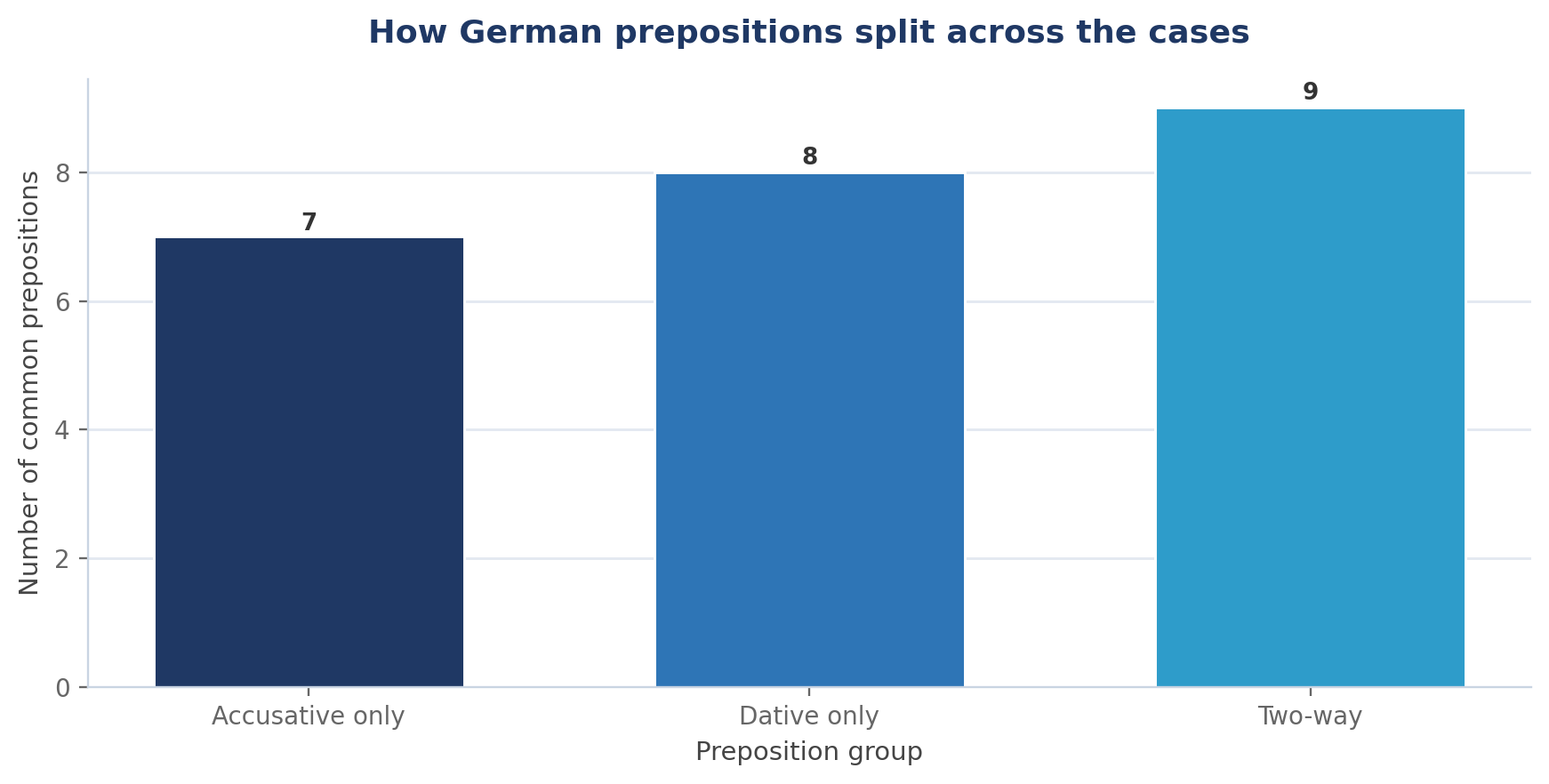
Für mich (for me). Mit mir (with me). Ohne dich (without you). Bei dir (at your place). The dative group is short and worth memorising as a chant: aus, bei, mit, nach, seit, von, zu.
The two-way prepositions follow one rule that never fails:
Movement toward a place takes accusative. Position in a place takes dative.
Learn cases by speaking them, not staring at them
Case tables make sense on paper and vanish in conversation. The only cure is repetition with an AI voice tutor that gives you instant feedback — before mich becomes a permanent habit where mir belongs.
Practice German cases with your AI tutor →Create a free accountWhere learners actually slip
A simple habit kills most of these. Whenever you write a pronoun, ask: who acts, who receives? Then check whether a preposition is present. If it is, the preposition rules. Two seconds of thought beats ten red corrections later.
Fix the case habit before it hardens
Every uncorrected mistake becomes a reflex, and reflexes are expensive to unlearn. An AI voice tutor hears your mich/mir errors in real time and drills them out while they are still soft.
Start practicing with your AI tutor →Create a free accountFrequently Asked Questions
What is the difference between mich and mir? Mich is accusative, used for the direct object: Er sieht mich. Mir is dative, used for the indirect object or with dative verbs and dative prepositions: Er hilft mir, mit mir.
Is dative or accusative more common in German? Accusative appears more often in everyday sentences, but dative dominates with prepositions and a cluster of very common verbs. You cannot skip either.
How do I know if a verb takes dative? Learn the frequent dative verbs as a list — there are only about a dozen that matter at beginner level — and mark them in your vocabulary notebook with a dative example sentence.
Do I have to learn all four German cases at once? No. Start with nominative and accusative, add dative when you meet verbs like helfen, and save genitive for later. Sequence beats overload.
References & Further Reading
- Duden — Die Grammatik, standard reference on German cases
- Goethe-Institut — German language levels and grammar guidance
- Deutsche Welle — Learn German: grammar topics and exercises
- Council of Europe — CEFR descriptors for grammatical range and accuracy
- IDS Mannheim — Grammis, the grammar information system of German