Ask a German what they are doing tomorrow and you will not hear werden. You will hear the present tense wearing a time word like a false moustache: Morgen rufe ich dich an. The real future tense exists, it is elegantly simple, and native speakers mostly keep it in the drawer for emphasis, promises and predictions.
What you will get from this guide
- Werden conjugation without the usual muddle
- Futur I word order, drilled clearly
- Futur II and the two things it can say
- Why Morgen fahre ich beats Ich werde fahren
Werden First, Because Everything Rides On It
Werden is a chameleon. It means "to become" as a full verb, and it builds the future as an auxiliary. Both jobs live in the same conjugation.
Learn this table cold. Almost every future mistake traces back to a missing umlaut-free wirst or a lazy werd in third person.
Futur I: werden plus Infinitive at the End
The rule is short. Take werden, put it in position two, and park the infinitive at the very end of the sentence.
With a modal verb in play, German stacks them: Ich werde morgen kommen müssen. Two infinitives at the end, in reverse order. It looks absurd and it is perfectly correct.
When the Future Tense Actually Earns Its Place
That third row catches learners out. Futur I also expresses a guess about the present: Er wird wohl krank sein means "He is probably ill right now", not tomorrow.
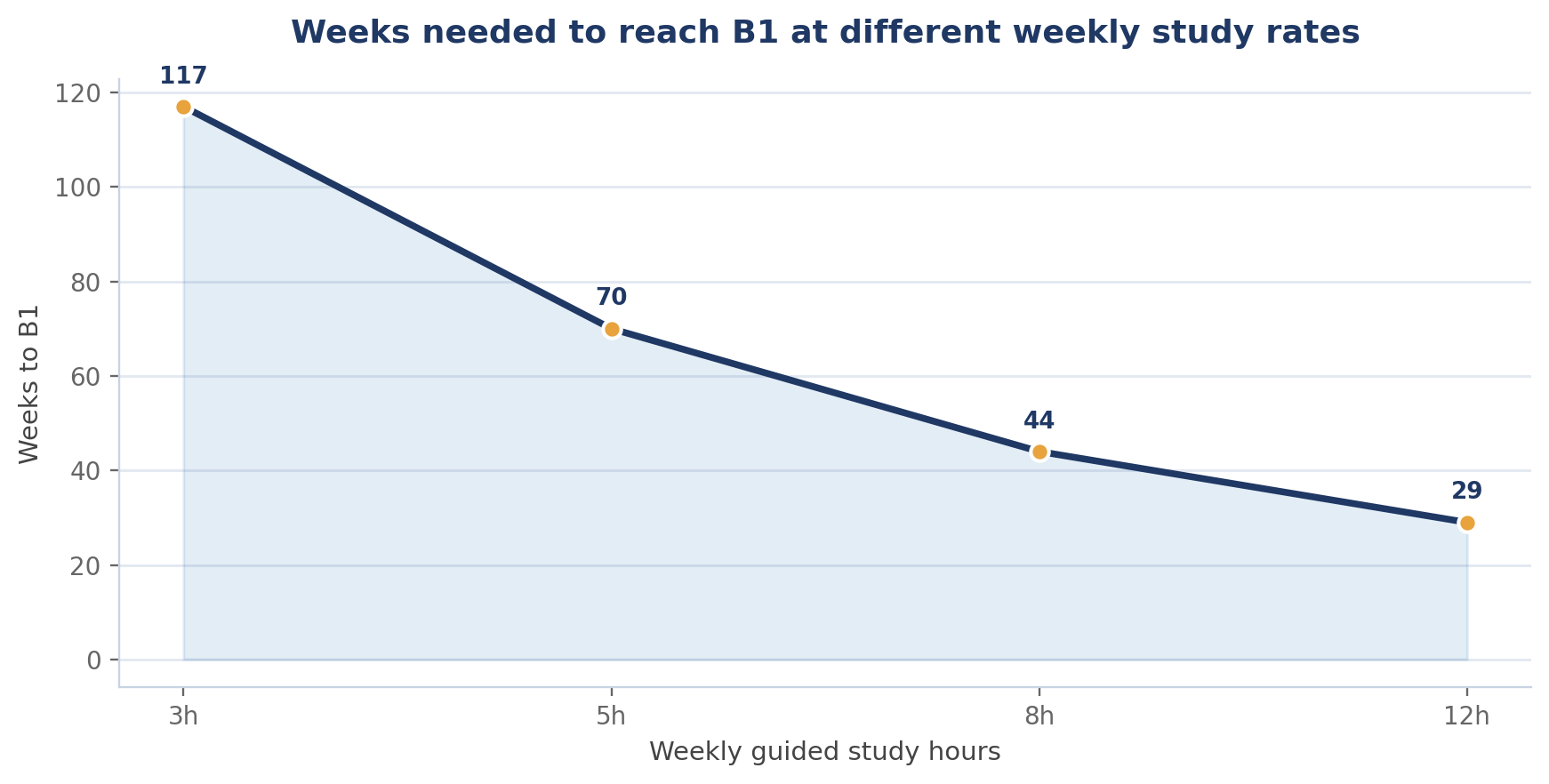
Grammar like the future tense is cheap to learn and expensive to automate. The hours are the price of automation.
Say it right, the first time
Word order is where self-study quietly fails, because nobody hears your mistakes. With a personal AI voice tutor, speaking practice gives you feedback when the infinitive drifts to the middle of your sentence.
See the German course →Create a free accountWhy the Present Tense Usually Wins
German conversation treats the present tense plus a time marker as the normal future. It is shorter, warmer and far more common in speech.
The pattern is not random. Time words — morgen, nächste Woche, um acht, später, bald, in zwei Tagen — do the future work themselves, so the verb can stay in the present.
Futur II: The Tense Almost Nobody Uses (Until They Need It)
Futur II is werden plus the past participle plus haben or sein, bundled at the end.
Two jobs, one form: a completed future action, or an educated guess about something already finished.
Five Mistakes That Give You Away
Practise It Out Loud
Take five things on your calendar this week and say each one twice: once with the present tense and a time word, once with Futur I. Feel the difference in weight. Then write three promises in Futur I and read them aloud. Grammar only becomes grammar when your mouth has done it a hundred times.
Build the habit with a voice tutor listening
Self-paced AI voice lessons take you from recognising a structure to producing it under pressure. Structured speaking practice with AI feedback, a clear path from A1 to B2.
Create a free account →Create a free accountFrequently Asked Questions
Do Germans use the future tense at all? Yes, but less than textbooks suggest. In everyday speech the present tense with a time word dominates. Futur I appears for predictions, promises and assumptions.
What is the difference between werden and wollen? Werden means to become or will. Wollen means to want. Ich werde is "I will", ich will is "I want" — a distinction that changes the meaning of a sentence completely.
How do I say "I will" in German? As a full sentence about the future, use ich werde plus an infinitive at the end. For a plan, use the present tense: Ich mache das morgen.
Is Futur II worth learning at A2? Learn to recognise it early and use it later. Recognising werde ... gemacht haben in a work email matters long before you produce it yourself.
References & Further Reading
- Duden — German grammar reference, authoritative rules on tense and word order
- Goethe-Institut — German courses and levels, CEFR-aligned learning and exam information
- DW Learn German, free Deutsche Welle courses from A1 upwards
- DWDS — Digitales Wörterbuch der deutschen Sprache, corpus examples of werden in real usage
- Leibniz-Institut für Deutsche Sprache, grammar research and corpus data