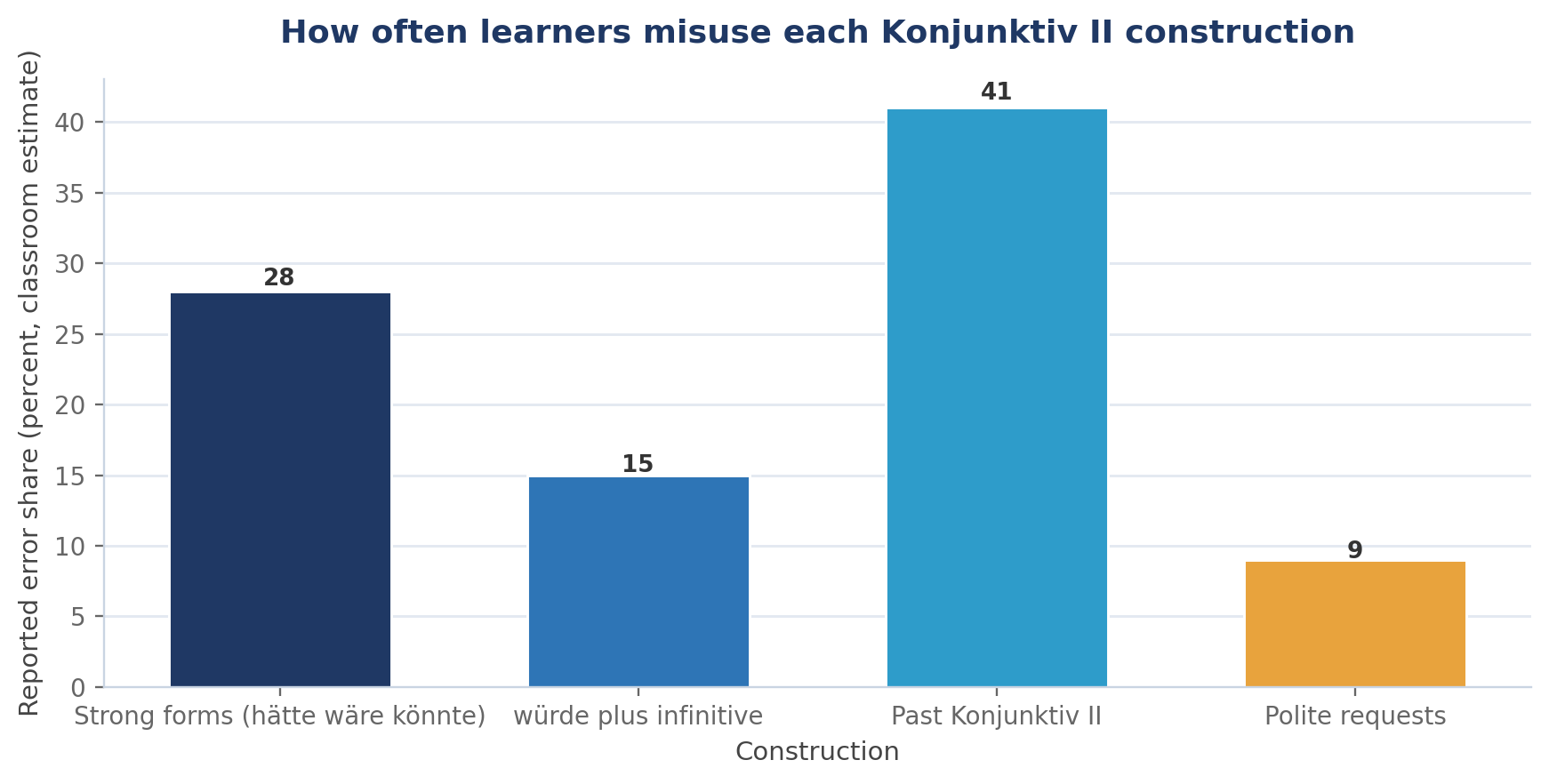
Every German learner meets the same villain. It is not the vocabulary. It is the moment a textbook writes der Mann in one sentence and den Mann in the next, and nobody explains why the word just changed clothes. The Konjunktiv II is that villain's older, more unsettling cousin.
But here is the secret nobody tells you early enough: Konjunktiv II is the polite, imaginary, what-if mood. It is German's way of saying "would", "could", "if only". Once you see it that way, it stops being a monster and becomes the most human thing in the language.
What you will get from this guide
- What the Konjunktiv II actually does in real German
- The two-building-block system: würde + infinitive, and the strong forms
- Full conjugation tables for hätte, wäre, könnte, müsste, should
- Past Konjunktiv II, polite requests, and the traps that trip learners
What the Konjunktiv II Is For
German uses Konjunktiv II for four jobs. Learn the jobs first; conjugation is easy once you know why you are conjugating.
Notice something: none of these describe what is. They describe what is not — the missing time, the unwritten day, the wish unfulfilled. Konjunktiv II lives in the gap between reality and desire. That gap is where most of human conversation happens.
The Two Ways to Build It
German gives you two routes, and good speakers mix them freely.
Route one: würde + infinitive. This is the default for most verbs. Take werden in its Konjunktiv II form (würde), conjugate it, and add the infinitive at the end.
Route two: the strong forms. The most frequent verbs refuse to use würde. They have their own one-word forms, and Germans use them constantly. Ignore these and you sound robotic. Master them and you sound fluent.
The rule of thumb: if the verb appears in the top 20 German verbs, it probably has its own form. Everything else takes würde.
Conjugating hätte and wäre
These two carry enormous weight. Hätte and wäre appear in almost every conditional sentence you will ever speak.
Look closely at ich and er/sie/es. They are identical. No -e ending, no -t. That is a Konjunktiv II signature: it deliberately blurs the ich and er forms so you cannot confuse them with the plain past tense.
würde + Infinitive: Full Conjugation
The infinitive always lands at the end of the clause. Always. In a subordinate clause, the whole würde engine moves to the end: Ich weiss, dass er warten würde.
The Past Konjunktiv II: hätte/wäre + Participle
This is where learners sweat. The past Konjunktiv II is built with hätte or wäre plus the past participle. Choose the helper exactly as you would for the normal perfect tense: hätte for most verbs, wäre for movement and change-of-state verbs.
Compare with the double infinitive construction, which German prefers with modals: Ich hätte kommen können — "I could have come." Both infinitives stack at the end. Yes, it sounds like a train coupling cars. That is German.
Conjugation tables are not the problem. Speaking them is.
You can read hätte and wäre all day and still freeze when a colleague asks Was würdest du machen? A personal AI voice tutor drills these forms out loud until they arrive without translation, and you study at your own pace, any time.
Practise German grammar with your AI tutor →Create a free accountPolite German: The Real Everyday Payoff
This is why Konjunktiv II matters more than the subjunctive in most languages. German politeness runs on it. Compare the pairs below and feel the temperature change.
Ich hätte gern is the single most useful phrase in this entire article. It works in bakeries, restaurants, offices, and hotel receptions across Germany, Austria, and Switzerland. Learn to say it without thinking and you will sound polite in a country where politeness is structural.
Three Traps That Break Your Konjunktiv II
The würde-with-wäre trap. Never say Ich würde sein. Say Ich wäre. Never say Ich würde haben. Say Ich hätte. These two verbs reject würde entirely, and learners break this rule more than any other.
The wäre-with-motion trap. For past unreal sentences, remember wäre covers the verbs that take sein in the perfect tense. Ich wäre gegangen, not Ich hätte gegangen.
The wenn-then word order trap. In a wenn clause, the verb goes to the end: Wenn ich reich wäre, ... But you can drop wenn and start with the verb instead: Wäre ich reich, würde ich reisen. Both are correct; the second sounds literary and elegant.
Should You Use Konjunktiv II or Konjunktiv I?
Short version: Konjunktiv I is for reported speech in journalism and formal writing. Konjunktiv II is for everything imaginary, polite, and hypothetical in everyday speech. If you are speaking German, you need Konjunktiv II roughly a hundred times for every Konjunktiv I.
Duden lists hätte, wäre, würde, könnte, and müsste among the most frequent verb forms in spoken German. That is your priority list. Learn five words, unlock half the mood.
From textbook tables to sounding like a person
A self-paced course with a personal AI voice tutor takes you through hätte, wäre, könnte in real conversation — the bakery, the meeting, the polite complaint. Grammar sticks when you practise speaking and get instant AI feedback.
Start German with your AI tutor →Create a free accountFrequently Asked Questions
Is Konjunktiv II the same as the subjunctive in English? Partly. It covers what English expresses with "would", "could", "should", and "if I were". English lost most of its subjunctive, so German appears to have more of it. It does not have more moods; it just marks them more visibly.
When should I use würde instead of the strong form? Use the strong form for high-frequency verbs — sein, haben, können, müssen, dürfen, sollen, mögen, wissen. Use würde + infinitive for everything else. When in doubt with a rare verb, würde is safe.
Do Germans actually say "ich würde sagen"? Constantly. Ich würde sagen is a standard softener, roughly "I would say". It appears in meetings, podcasts, and university seminars every few minutes.
How do I practise Konjunktiv II at home? Rewrite your day in the unreal: Ich hätte länger schlafen sollen. Ich wäre gern ins Kino gegangen. Five sentences a night, out loud, and the forms become muscle rather than memorisation.
References & Further Reading
- Duden — Die Grammatik, Konjunktiv II formation and usage: https://www.duden.de/sprachwissen/grammatik
- Goethe-Institut — German grammar and course material by CEFR level: https://www.goethe.de/en/spr/kup.html
- Deutsche Welle — Deutsch lernen, grammar units including Konjunktiv II: https://learngerman.dw.com/en/overview
- Leibniz-Institut für Deutsche Sprache — grammatical reference on mood and modality: https://www.ids-mannheim.de/
- Council of Europe — CEFR descriptors for grammatical range at B1–B2: https://www.coe.int/en/web/common-european-framework-reference-languages