You learn anrufen — to call. You feel good. Then German hands you Ich rufe dich morgen an and the verb has been cut in half and scattered across the sentence.
This is the separable verb, and it is one of the most recognisable features of German. It is also completely rule-based. Once you see the machine, you will never be confused by it again.
What you will get from this guide
- Why prefixes split and what they do to meaning
- The exact position of the prefix in every tense and clause type
- A list of inseparable prefixes you must never split
- The three traps that catch learners at B1 and beyond
What a Separable Verb Actually Is
German builds new verbs by attaching a particle to a base verb. Some particles stick permanently. Others detach and travel to the end of the clause.
These are called trennbare Verben — separable verbs. In a simple main clause, the particle is pushed to the very end.
The prefix behaves like a boomerang. It leaves the verb and lands at the end.
The Rule in One Table
Learn this table and you know 90% of the system.
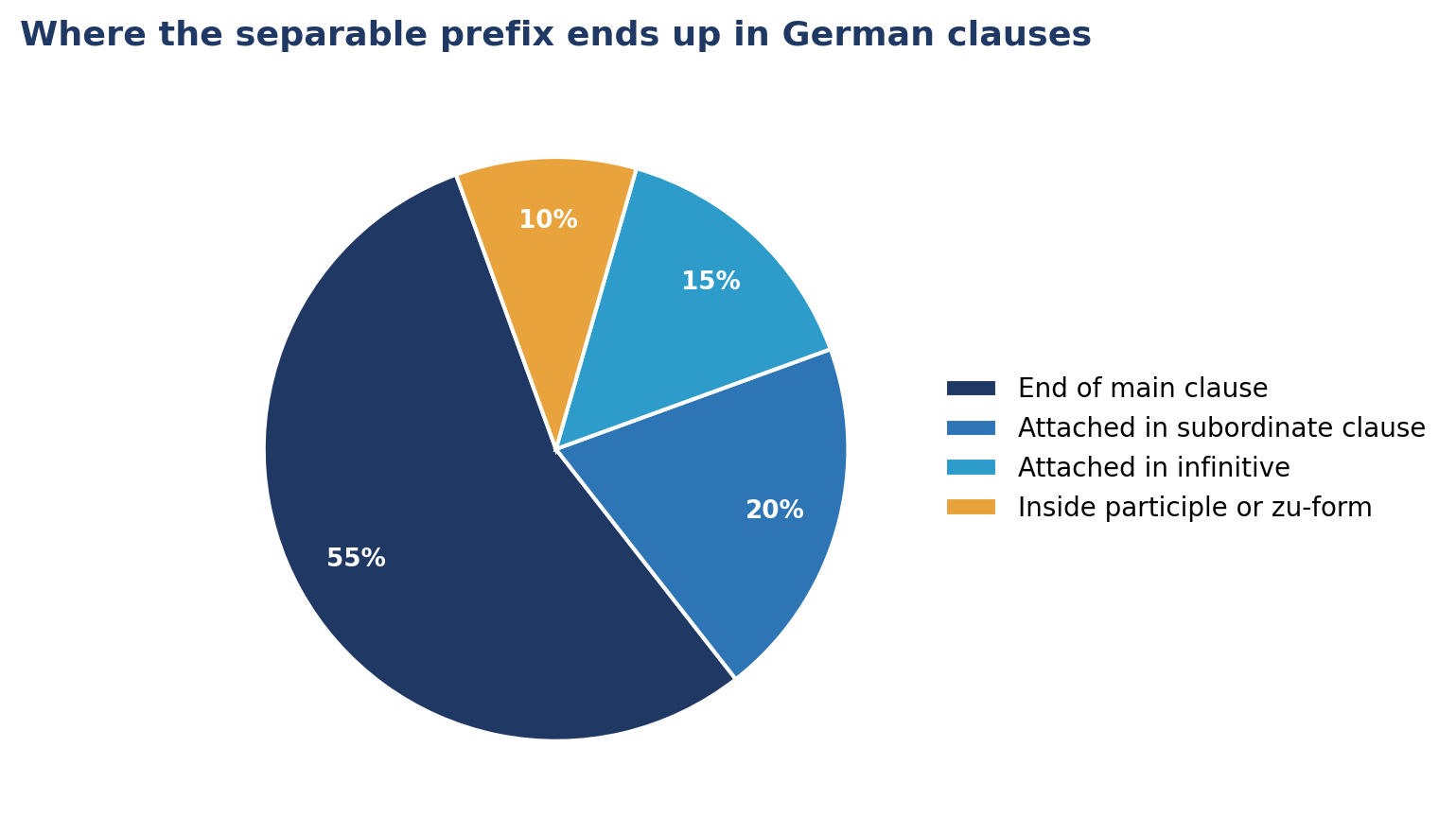
The stunning part is the last three rows: when the verb is already at the end of the clause, the prefix stays attached. No splitting needed.
The Prefix Changes the Meaning
The particle is not decoration. It rewrites the verb.
Learn the verb and its prefix as one word, always. Never rufen then an — the meaning lives in the pair.
Separable verbs are simple. Hearing them at speed is not.
Our AI voice tutor drills these patterns in spoken practice until Ich rufe dich an arrives in your ear as one unit, not three fragments.
Practise German verbs live →Create a free accountThe Common Separable Prefixes
Memorise this list and you will recognise most separable verbs on sight.
Some prefixes are always separable: auf-, aus-, ein-, mit-, nach-, vor-, weg-, zu-, zurück-, zusammen-. You can spot them a mile away.
The Trap: Inseparable Prefixes
This is where intermediate learners slip. Some prefixes never split.
And their past participles take no ge-: verstanden, besucht, entschieden, erzählt. Notice there is no geverstanden. That would be a giveaway mistake.
Note the last row carefully. Separable verbs do take ge-, and it goes between the prefix and the stem: an + ge + rufen.
The zu-Infinitive Trick
When you use zu with an infinitive, separable verbs place zu between prefix and stem.
Write it as one word. anzurufen, not an zu rufen.
A Weekly Drill That Makes It Automatic
This is a pattern, and patterns need repetitions, not explanations.
Do that four times a week for a month and separation stops being a decision. It becomes a reflex.
Turn grammar you understand into grammar you use.
Understanding the rule takes five minutes. Making it automatic takes guided practice with an AI voice tutor that gives feedback on every mistake. Come and drill it properly in a self-paced German course.
Start practising German verbs →Create a free accountFrequently Asked Questions
How do I know if a German verb is separable or not? Check the infinitive's stress. Separable verbs are stressed on the prefix (AUFstehen, ANrufen), inseparable verbs are stressed on the stem (verSTEHen, beSUchen). Dictionaries mark this.
Do modal verbs make separable verbs split? No — the opposite. With a modal verb the infinitive stays whole at the end: Ich muss früh aufstehen.
What happens in the perfect tense? The ge- goes between prefix and stem: aufgestanden, angerufen, eingekauft. Inseparable verbs take no ge- at all.
Are separable verbs used in every tense? Yes, in all tenses and moods. The rule is always the same: split in a main clause, attached in a subordinate clause, attached with modals and infinitives.
References & Further Reading
- Duden — Die Grammatik, the standard German grammar reference, with entries on trennbare Verben.
- Goethe-Institut — grammar resources and A1–B2 courses covering verb prefixes and word order.
- Deutsche Welle Deutsch lernen — free grammar units on separable verbs with audio practice.
- Canoonet — a free German grammar, spelling and dictionary resource including verb valency.
- Schiller, Deutsche Grammatik reference materials from university German departments — standard treatment of Verbzusätze.
Learn the particle with the verb. Then let the boomerang fly.