Ich freue mich. Three words, and two of them mean "me". Every German learner stares at that sentence sooner or later and asks the obvious question: why is the verb doing something to itself?
Welcome to german grammar reflexive verbs — the topic that turns polite textbook German into the way people actually talk.
What you will get from this guide
- What "reflexive" really means, without the jargon fog
- Accusative or dative — the decision rule
- Word order in main and subordinate clauses
- The 20 verbs worth memorising first
What a Reflexive Verb Really Is
A reflexive verb is one where the subject and the object are the same person. You are not doing something to someone else. You are doing it to yourself, or in your own interest.
English has an echo of this: I wash myself, she hurt herself. German simply does it far more often, and often where English drops the idea entirely.
The reflexive pronoun changes with the subject. Learn it as a chant, the way German children do.
Accusative or Dative? The One Rule You Need
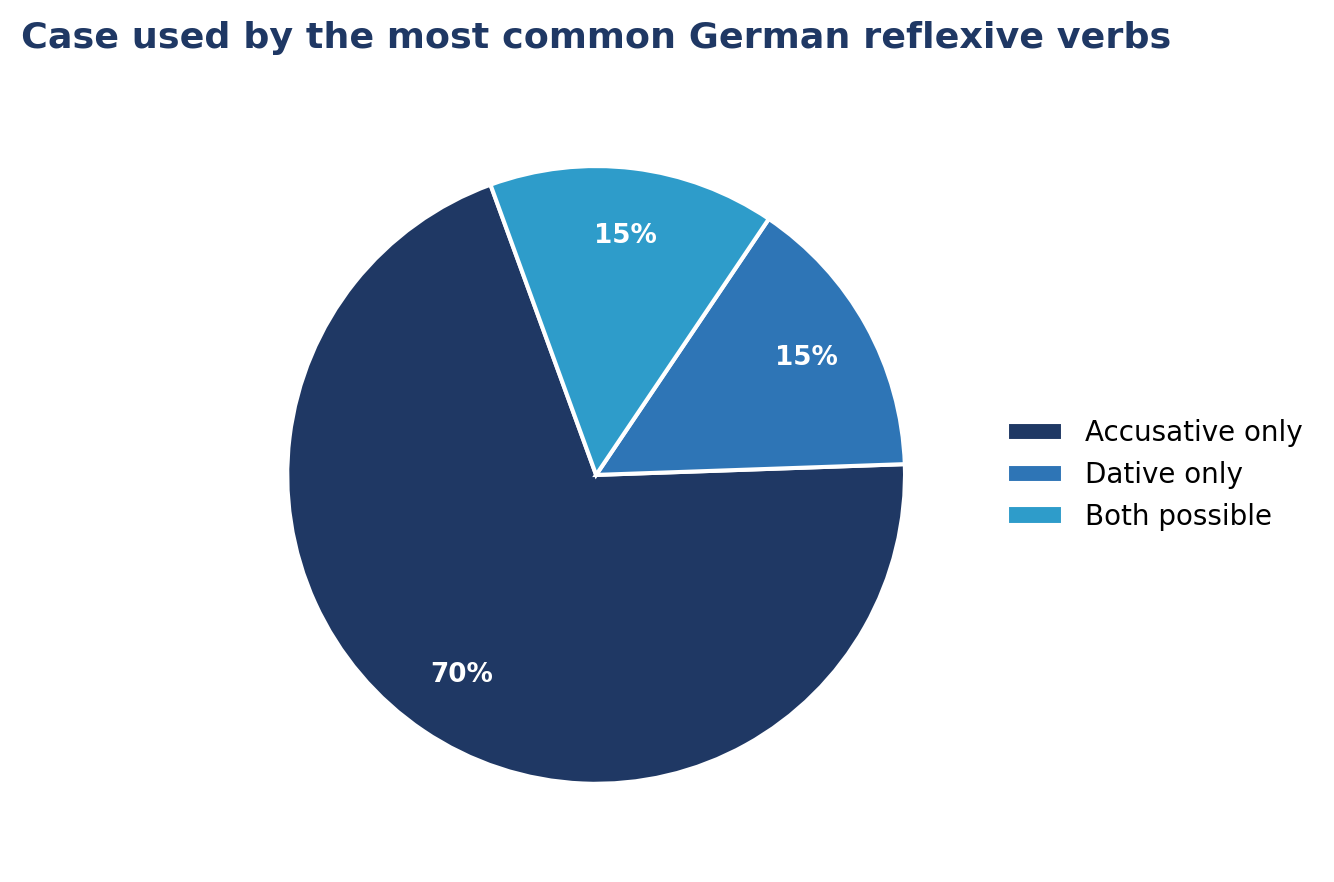
Almost every German reflexive verb takes the accusative pronoun. You only switch to dative when there is already a direct object in the sentence — the accusative seat is taken.
Ich wasche mich. — no other object, so mich, accusative.
Ich wasche mir die Hände. — the hands are the direct object, so the pronoun steps aside into the dative: mir.
That is the whole rule. One sentence to remember it: when someone else's noun is being acted on, you take the dative.
Word Order: Where Does sich Go?
In a main clause, the reflexive pronoun follows the conjugated verb and sits before the other objects. In a subordinate clause, the whole verb block moves to the end — but the pronoun still comes early.
- Ich erinnere mich nicht an seinen Namen.
- Er hat sich gestern verletzt. (after the auxiliary, before the time word)
- Ich weiß, dass er sich nicht daran erinnert. (subordinate: verb at the end)
With modal verbs, the reflexive pronoun attaches to the subject, not to the infinitive at the end.
Trickier Than It Looks: Dative Pronouns and Prepositions
Some verbs only work with a fixed preposition: sich interessieren für, sich freuen über, sich ärgern über, sich erinnern an. When the object is a thing, German uses a da- word. When it is a person, it uses a preposition plus pronoun.
Ich freue mich über das Geschenk. — thing.
Ich freue mich über ihn. — person.
Ich freue mich darauf. — a coming event.
Those little darauf, daran, davon forms are the difference between stiff textbook German and speech that flows.
Rules you can read. Reflexes you have to build.
Reflexive verbs only stick when you get corrected in the moment — mich or mir, daran or an ihn. A personal AI voice tutor gives you the reps textbooks cannot, with speaking practice and instant feedback, at your own pace.
See the German course →Create a free accountThe Verbs Worth Learning First
You do not need all of them. These twenty carry most of daily conversation, and half are the ones learners get wrong under pressure.
And a warning pair: sich vorstellen means "to introduce oneself" or "to imagine" — not "to introduce someone else". That is jemanden vorstellen, no sich at all.
Verbs That Are Reflexive in German but Not in English
This is where translation betrays you.
Flip it too: spüren means to sense something, but sich fühlen is how you feel in yourself.
Three Mistakes That Give Learners Away
Forgetting the pronoun in the perfect tense. Ich habe gefreut is wrong. It needs mich: Ich habe mich gefreut.
Reaching for dative too early. Ich interessiere mir sounds wrong to every German ear. The verb takes accusative.
Translating the English. I remember becomes Ich erinnere — and the sentence falls over. Reflexive verbs have to be memorised as whole units: sich erinnern an, pronoun included.
Practise Out Loud, Not on Paper
German reflexives are muscle memory. You can fill in fifty worksheets and still freeze at the bakery. Say the sentence, hear the pronoun, fix the case — with AI feedback listening. The AI voice tutor catches mir/mich in a second, and that correction is worth an hour of silent study. Start with a placement check on the German course page.
Get mich and mir right in real time
Self-paced German lessons built around the grammar that actually gets used, with AI voice-tutor corrections in the moment and a plan that runs from A1 to B2.
Start your German course →Create a free accountFrequently Asked Questions
**Are all German verbs with sich truly reflexive?** No. Many are "reflexive use" of ordinary verbs — sich waschen, sich sehen. Others are only reflexive by nature, like sich beeilen. Both are listed with sich in the dictionary.
**Do I have to use selbst too?** Only for emphasis: Ich habe es selbst gemacht means I did it myself, by me and nobody else. It is a separate word from the reflexive pronoun.
**What about einander?** It replaces sich when two or more people act on each other: Wir helfen einander. Common in writing, understood everywhere.
How many reflexive verbs do I need for B1? Around 60–80 in daily use. Twenty will cover most conversations; the rest arrive naturally through reading and listening.
References & Further Reading
- Duden — Die Grammatik — the standard reference for German grammar, including reflexivity.
- Deutsche Welle — Learn German — free graded courses with grammar explanations.
- Goethe-Institut — German courses and exams — level descriptions and certification.
- gesetze-im-internet.de — real German legal texts for advanced reading practice.
- Common European Framework of Reference (CEFR) — the level scale used in German courses.