Mit dem Auto. Für den Mann. Wegen des Wetters. Three little phrases, three different cases, one very annoyed learner.
Here is the relief: German prepositions are not random. Each one is loyal to a case. Learn the loyalty, and the endings stop being guesswork. This guide gives you the lists, the logic and the traps — the full picture of German grammar prepositions and the cases they take.
What you will get from this guide
- The four preposition families and how to spot them fast
- Accusative, dative and genitive lists with worked examples
- The motion-versus-location rule for two-way prepositions
- The contractions and traps that make you sound fluent
German Prepositions Are Loyal to a Case
A German preposition is a small word that bosses the noun after it. The boss decides the case. The case decides the article. Change the boss, change the article.
Der Mann becomes für den Mann (accusative) or mit dem Mann (dative). Same man. Different clothes.
Four families exist:
That table is your whole map. Everything below is detail.
Accusative Prepositions: The Seven That Never Waver
These seven always take the accusative, no matter what the sentence is doing.
Memory hook: durch, für, gegen, ohne, um rhymes. Add bis and entlang and you have all seven. Note that entlang usually follows its noun, and bis often pairs with dative when a second preposition follows (bis zum Bahnhof).
Dative Prepositions: The Eight You Meet Every Day
Dative prepositions are the workhorses. You cannot order coffee without three of them.
Say the sequence aloud: aus, bei, mit, nach, seit, von, zu — German schoolchildren do exactly this, and so should you.
Stop memorising lists. Start using them in conversation.
Knowing that mit takes the dative is easy. Producing it at speed, mid-sentence, while someone waits for your answer — that takes guided reps with a personal AI voice tutor that corrects you in real time, at your own pace.
Book a German course pass →Create a free accountGenitive Prepositions: Short, Formal, Worth Owning
The genitive family is small and slightly stiff — perfect for essays, reports and any moment you want to sound educated.
Spoken German often dodges the genitive — you will hear wegen dem Regen in casual conversation. Learn the genitive form, recognise the shortcut, and decide which room you are standing in.
Two-Way Prepositions: The Motion Rule That Fixes Everything
Nine prepositions switch cases. The switch is not arbitrary. Ask one question: is something moving into a new place, or already sitting there?
Movement gets den/die/das. Position gets dem/der/dem. Watch the verb pairs too: legen/liegen, stellen/stehen, setzen/sitzen, hängen/hängen.
Contractions, Verb Pairs and Other Fluency Shortcuts
Germans compress prepositions and articles constantly. If you say zu dem Arzt, you are correct — and instantly marked as a textbook. Use the contractions.
Then there is the second layer: verbs that drag a fixed preposition along. Warten auf (accusative), denken an (accusative), helfen bei (dative), sich interessieren für (accusative). Learn the verb and its preposition as one unit — like a phone number. Never learn warten alone.
How to Practise Without Drowning
Do this in three passes.
Then get a human to hear pass 3. Errors in case endings are almost invisible to you and glaringly obvious to a native ear. That gap is where progress hides.
Your case endings deserve an audience.
Self-paced lessons with a personal AI voice tutor give you the one thing a list cannot: instant feedback that notices when you say mit der Auto and fixes it before it becomes a habit. Structured speaking practice, real conversation, steady progress from A1 through B2.
Start with a free placement check →Create a free accountFrequently Asked Questions
Do I have to memorise all the preposition lists? The accusative and dative lists, yes — they are short and they pay rent daily. Genitive prepositions you can learn more slowly, since you will mostly read them before you need to produce them.
**Why does in sometimes take the accusative and sometimes the dative?** Because in is a two-way preposition. Direction into a place takes the accusative (in die Stadt), while position inside a place takes the dative (in der Stadt). One question — moving or staying — decides it.
**Is wegen dem Wetter wrong?** Standard German wants the genitive: wegen des Wetters. In everyday speech the dative is common. Learn the standard form first, then let the shortcut in when you hear it around you.
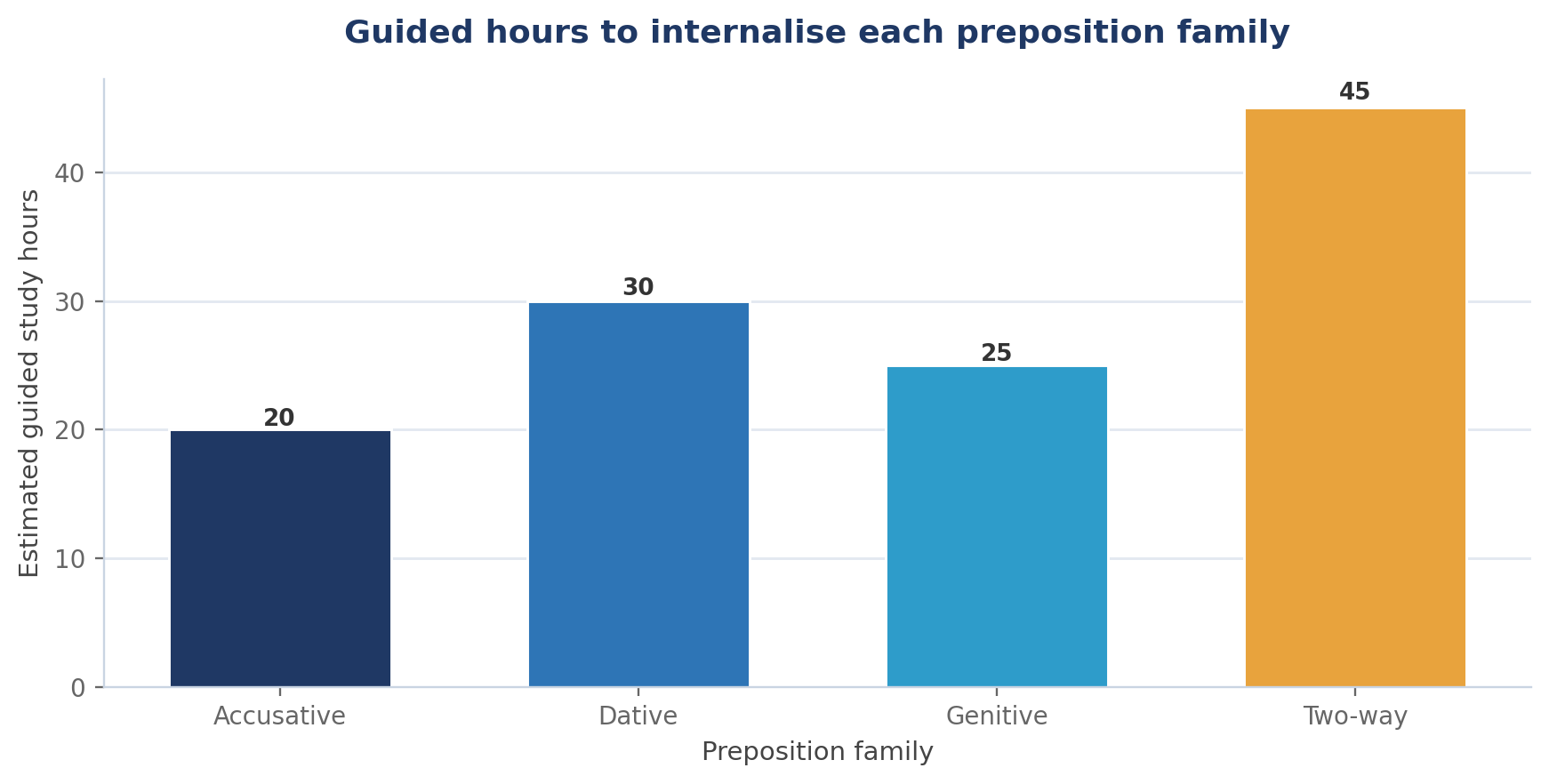
How long until case endings feel automatic? Learners usually control the accusative within weeks and the dative within a few months of regular speaking. Full automaticity across all four cases takes longer — see the estimate chart above, and treat it as a planning figure, not a promise.
References & Further Reading
- Duden — Die Grammatik on prepositional government and case.
- Goethe-Institut — free exercises and CEFR-aligned practice materials for German learners.
- Deutsche Welle — Deutsch lernen — structured video and audio courses covering cases.
- Rat für deutsche Rechtschreibung — official rules on German orthography and grammar.
- Council of Europe — CEFR — the level framework behind A1 to B2 planning.