*Ein guter Mann. Der gute Mann. Ein guter Mann.*
Same adjective. Three different costumes. And nobody in the textbook explains that the ending is not decorating the adjective at all — it is carrying the article's job when the article cannot do it itself.
Understand that one sentence and the three tables collapse into one rule.
What you will get from this guide
- The signal rule that replaces rote memorisation
- The three declension tables, plainly set out
- A decision order you can run in your head
- Drills that make the endings automatic
The Real Rule Behind Adjective Endings
The ending shows gender, case and number. But the article often shows it already. German hates saying the same thing twice.
So the ending does one of two jobs: it repeats information the article already gave (weak), or it supplies the information the article failed to give (strong). That is the whole system.
Ask one question: does something before the adjective already show gender, case and number? If yes, the adjective relaxes. If no, it works.
The Three Tables, Side by Side
Learn these as one grid with three behaviours, not three separate grids.
Weak declension is almost boring. After der-words, the adjective is -e in the five nominative-singular and accusative-neuter/feminine slots, and -en everywhere else. That is the entire pattern.
Now the mixed table, with ein:
The mixed table is weak, except in three slots where ein has no ending of its own. There, the adjective steps in: guter, gute, gutes.
The Strong Table: When Nothing Helps You
With no article in front, every signal sits on the adjective.
Look at the strong endings. They are der, die, das wearing adjective clothing: -er, -e, -es, -en, -em. If you know the definite article, you already know the strong table.
A Decision Order You Can Actually Run
Four steps, in this order, every time.
Step 4 is where beginners leak points. In the weak and mixed tables, -en is the default. Only five slots take -e.
You know the rule. Now make it automatic.
Adjective endings are the classic case of "understood in a table, fumbled in a sentence." Your AI voice tutor hears your ending the moment it leaves your mouth and gives instant feedback — which is the only way this rule becomes reflex.
Practise with your AI German tutor →Create a free accountThe Traps That Catch Almost Everyone
Five patterns cause most mistakes. Learn the traps, not more rules.
That plural dative row trips up even B2 learners: mit den guten Freunden needs the noun to take an extra -n, because dative plural always does.
The Adjective-Noun Agreement Drill
Ten sentences a day. Change one variable each round: swap the article, swap the gender, swap the case, swap the noun.
Say them out loud. Adjective endings live in your mouth, not your eyes.
How Fast Do These Endings Stick?
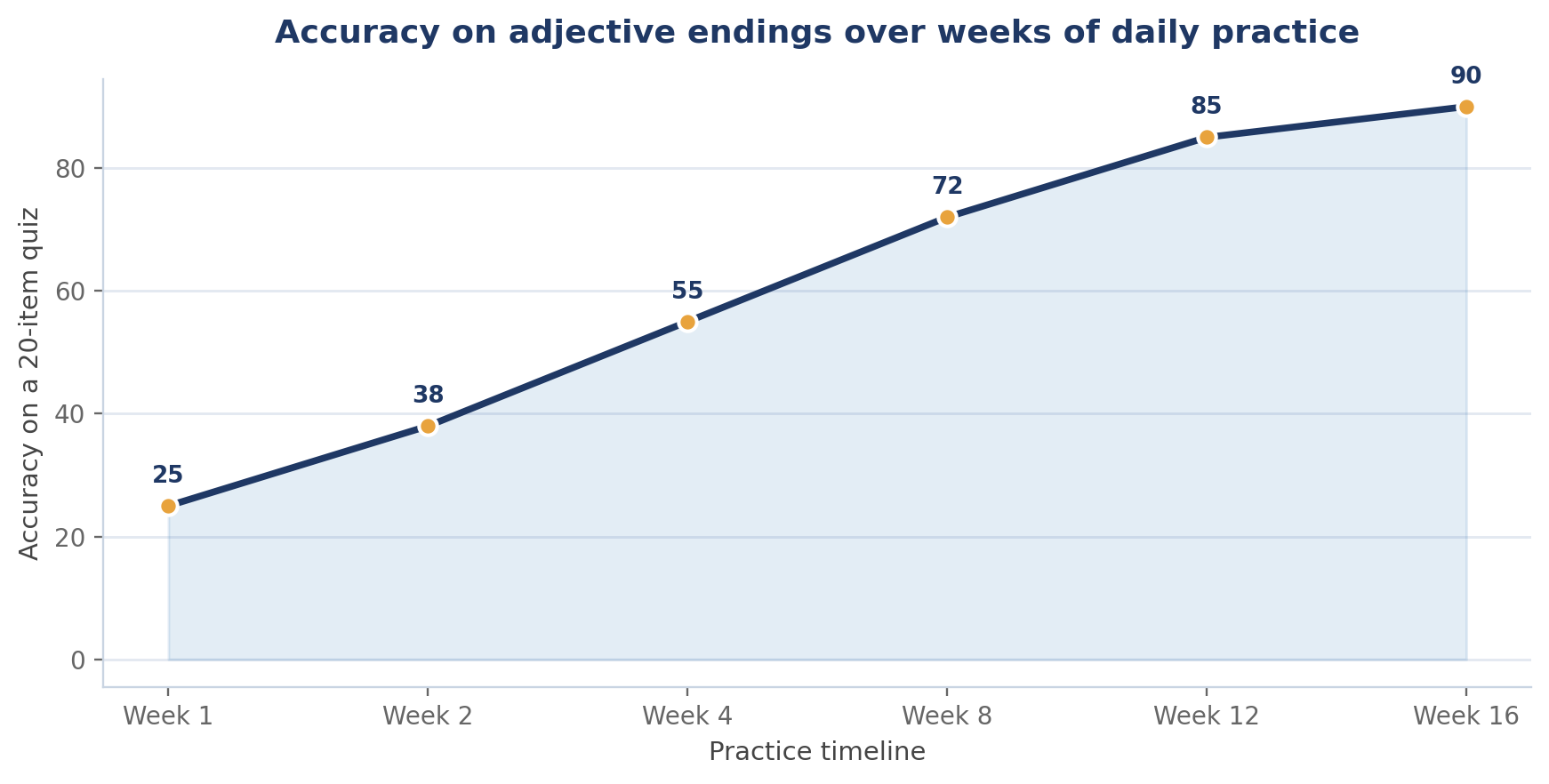
Skill acquisition here is mechanical. It follows a predictable curve.
Week one feels hopeless. Week four feels mild. Week twelve, you stop thinking about it — which is exactly the goal. The endings should never occupy conscious attention in a real conversation.
Where Adjective Endings Meet Real German
In speech, Germans are forgiving. In writing and exams, they are not. Goethe B1 and B2 writing tasks dock points for ending errors the way English examiners dock apostrophe errors.
So build two habits. In speaking practice, aim for fluency and let the endings wobble. In writing practice, slow down and check every adjective against the decision order. Two different modes, two different standards.
Turn the table into instinct.
Nobody masters adjective endings by reading about them. They master them by getting corrected forty times in conversation until -en simply sounds wrong when it is wrong. That is what our self-paced AI voice tutor delivers.
Start your German course →Create a free accountFrequently Asked Questions
What is the easiest way to remember German adjective endings? Master the decision order: check for an article, then whether it is a der- or ein-word. After der-words and ein-words, the default is -en; only a handful of slots take -e.
What is the difference between weak, strong and mixed declension? Weak follows der-words, strong follows no article, mixed follows ein-words. The adjective carries more of the signal as the article carries less.
Do I need to learn the Genitive adjective endings? Recognise them. Use them in formal writing. In everyday spoken German, von plus dative usually replaces the genitive anyway.
Why does "mit guten Freunden" have two n's? Dative plural adds -n to the noun unless the plural already ends in -n or -s. The adjective takes -en and the noun takes its own dative plural ending.
References & Further Reading
- Duden — Die Grammatik, the standard descriptive grammar of German.
- Goethe-Institut — free grammar practice and CEFR-aligned writing criteria.
- Deutsche Welle Deutschtrainer — audio drills covering adjective endings.
- Hammer's German Grammar and Usage — the reference English speakers rely on.
- Council of Europe, CEFR Companion Volume — the level framework behind exam criteria.
Run the decision order once more, out loud. Then do it again tomorrow.