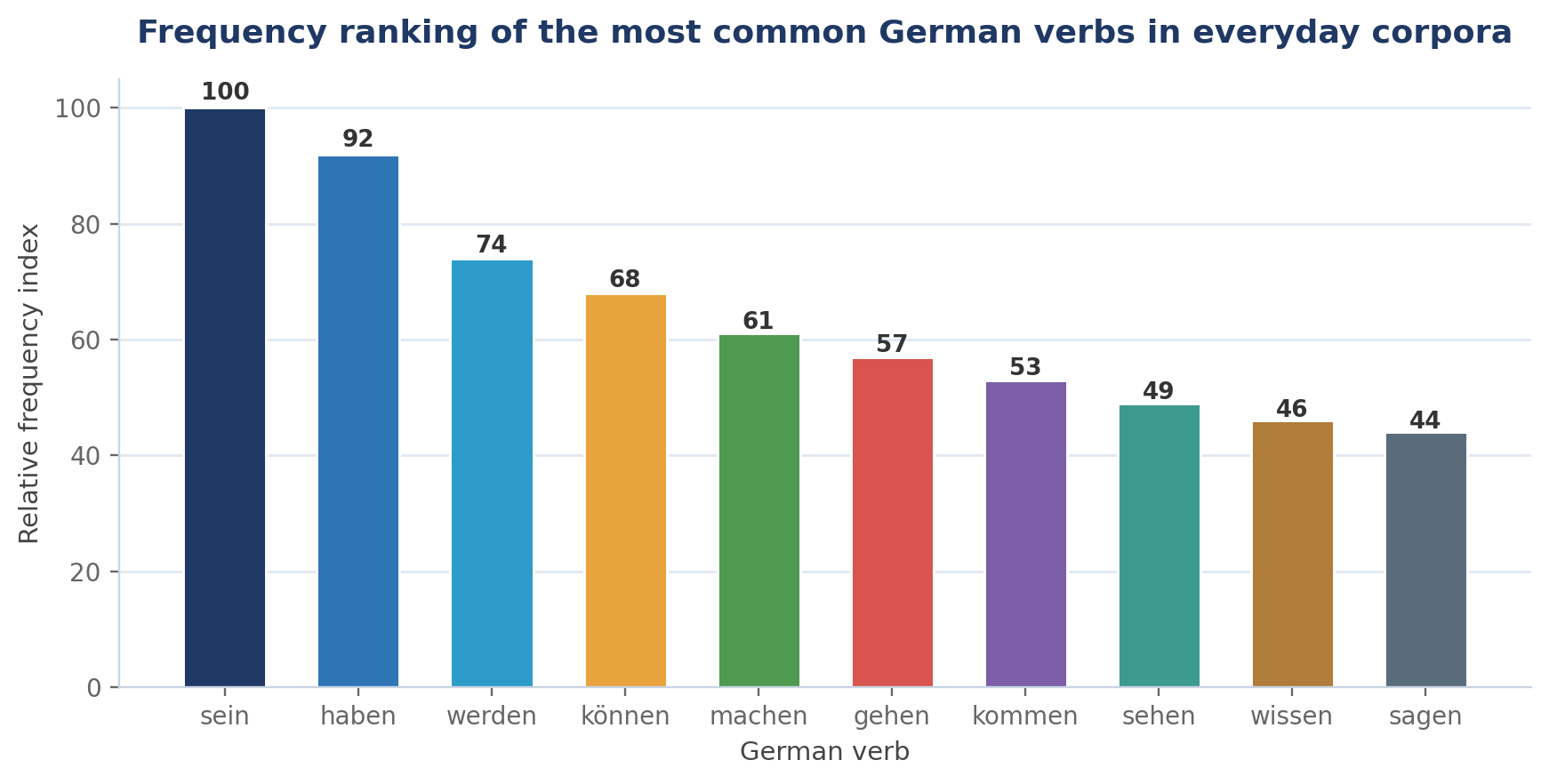
If you learned only fifty German words and wanted maximum conversational return, you would learn verbs. Nouns give you topics; verbs give you sentences. They are the difference between pointing at a train and saying Ich nehme den Zug um acht — I am taking the eight o'clock train.
This is the list that pays for itself fastest. Fifty verbs, grouped by what they actually do for you, each with its key forms and a sentence you could use this week.
How to use this list
- Learn in groups, not alphabetically — function first
- Say every example aloud; verbs live in sentences
- Master sein, haben and werden before anything else
- Add the past participle as you go, not later
The three verbs that build everything
Two of these are auxiliary verbs; the third is the most useful verb in the language.
Werden is the quiet workhorse. It forms the future tense, the passive voice, and a surprising number of everyday expressions. Learn it properly and German unlocks.
Movement: ten verbs that put you somewhere
Communication: the verbs that make you a person
Thinking, wanting and knowing
The pair wissen and kennen is worth pausing on, because English flattens both into "know". Wissen is for facts and information. Kennen is for familiarity — people, places, films. Ich weiß ihn is wrong; Ich kenne ihn is right.
Working, doing and building
Another English trap: lernen means studying a subject, while studieren means being a degree student. Ich lerne Deutsch is what a language learner says.
Feeling, eating and living
That is the fifty — and note how many are core German verbs that also function as modals or auxiliaries. Learn these, and you can build thousands of sentences.
Ready to turn reading into real German? Start your self-paced course today.
Start the German course →Create a free accountVerbs only become yours when you say them out loud
You can read Ich hätte gern a hundred times and still freeze when a waiter is waiting. A personal AI voice tutor turns this list into reflex — real sentences, real speed, with instant AI feedback as you practise at your own pace.
Button: Explore the self-paced German Course Pass →
The forms you should learn with each verb
German has a strong regular pattern plus roughly 200 strong verbs with vowel changes. The fifty above include most of the ones you will meet daily.
How to learn them fast
A useful weekly rhythm: five new verbs, twenty sentences, one recording. Five verbs a week means the full fifty in ten weeks — with the forms still attached, which is the part most learners lose.
Ready to turn reading into real German? Start your self-paced course today.
Start the German course →Create a free accountPractise these fifty verbs with proper pronunciation
Create a free languageskills.net account to get spoken verb drills, audio examples and A2 listening practice built around the most frequent German verbs.
Button: Create your free account →
Frequently Asked Questions
What is the most common verb in German? Sein (to be), followed closely by haben (to have) and werden (to become). All three also serve as auxiliary verbs.
How many German verbs do I need to speak? Around 500 verbs cover most everyday speech, and the fifty here cover an enormous share of what you will actually say.
**What is the difference between wissen and kennen?** Wissen is knowing facts and information; kennen is being familiar with people, places or things. English uses "know" for both.
Should I learn the simple past or the perfect tense first? Learn the perfect tense for speaking and the simple past for reading and writing. Both matter, but spoken German leans heavily on the perfect.
References & Further Reading
- Goethe-Institut — German courses, exams and A2 vocabulary specifications
- Duden — Verb conjugation and frequency reference
- Deutsche Welle — Deutsch lernen, free courses and listening
- telc — Language tests and CEFR alignment
- Council of Europe — CEFR levels and descriptors