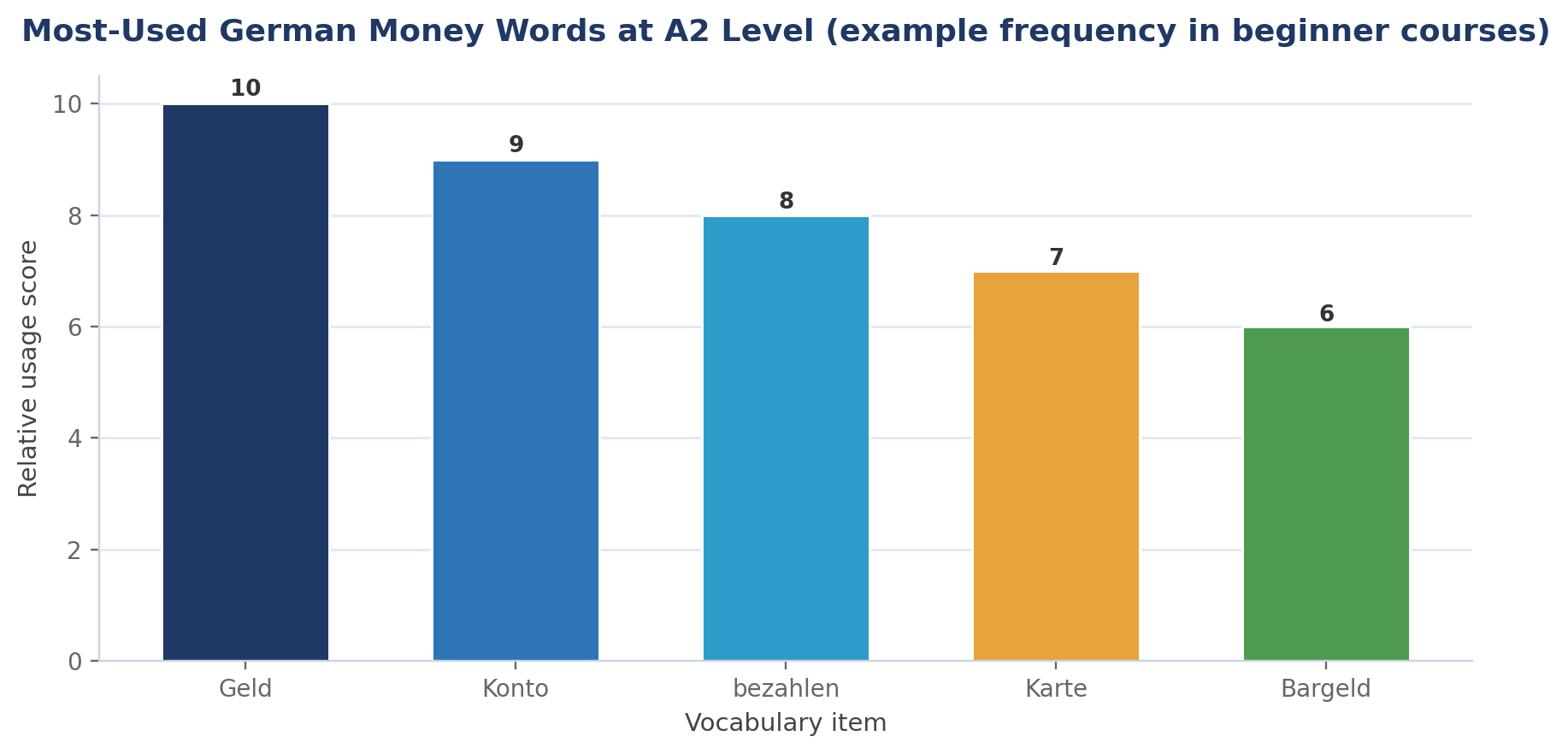
Money talk is everywhere in German-speaking Europe — and once you own the words, every shop, ATM and bank counter becomes a classroom. If you are at A2 level and tired of nodding politely while a cashier asks something you only half-understand, this guide is your shortcut. We will walk through the German vocabulary for money and banking, word by word, with real examples you can steal today and use tomorrow. Let's make your German wallet speak fluent German — fast, fun and fearless!
The Absolute Core: Money Words You'll Use Daily
Start with das Geld (money) — the word you will meet a thousand times. From there, several everyday companions follow you everywhere.
Notice how often mit (with) appears when people talk about paying — mit Bargeld, mit Karte, mit dem Handy. That little preposition is your best friend in any checkout line.
At the Bank: Das Konto and Friends
The heart of German banking vocabulary is das Konto — the account. Almost every bank phrase orbits this one word.
A quick grammar win: das Konto is neuter, so it becomes das Konto, des Kontos, dem Konto, das Konto. In the plural it shifts to die Konten — and that tiny "e-n" ending shows up in sentences like Ich habe zwei Konten (I have two accounts).
Verbs That Move Your Money
Now the action words. These are the verbs you will actually say at a counter, an app or a machine.
Careful with leihen: it means both "to lend" and "to borrow" depending on context — Ich leihe dir Geld (I lend you money) versus Ich leihe mir Geld (I borrow money). German speakers keep the two straight through the little pronoun dir or mir. Context is king!
Paying in the Real World: Phrases That Save You
This is where vocabulary turns into confidence. Learn these as whole chunks rather than separate words — your brain will retrieve them faster under pressure.
One delightful detail: in many German-speaking shops, the cashier asks "Haben Sie es passend?" — literally "Do you have it fitting?" It means do you have exact change? Answer Ja, passend or shake your head and hand over a note. You will feel instantly local.
Turn These Words Into Real Conversations
Our German Course Pass pairs every banking word with native audio so your ears learn as fast as your eyes. Start with today's vocabulary and you'll hear every phrase clearly the very first time.
Unlock the German Course Pass →Create a free accountNumbers, Prices and Talking About Amounts
Money is numbers, and German numbers can be a tongue-twister. Two facts make them manageable: hundreds are simple, and the infamous "backwards" tens follow one rule — units before tens, joined by und.
For prices, remember Das macht … — "That comes to …" — the most natural way a German speaker announces a total. It is short, friendly and unmistakably native.
Opening an Account: A Mini Dialogue
Reading a whole exchange cements vocabulary far better than isolated words. Here is a short, realistic scene at a bank counter.
Words to steal from this scene: der Ausweis (ID card), kostenlos (free of charge), die App (app) and gern (gladly / with pleasure). Use gern whenever you accept something politely — it makes you sound warm, not robotic.
Small Habits, Big Fluency
Vocabulary sticks when it meets your daily routine, so attach German to real moments. Say Ich hebe Geld ab when you visit an ATM. Whisper Das ist mir zu teuer when you see a pricy tag. Check your Kontostand (account balance) and name it out loud. If you want a structured path from single words to full, flowing conversations, pair this list with our free signup and start building listening habits from day one.
Hear Every Word in Native German
Reading builds recognition, but listening builds real fluency — and our Course Pass gives you thousands of native clips. Join today and the next German conversation about money will feel like a friendly chat, not an exam.
Get Your German Course Pass →Create a free accountFrequently Asked Questions
What is "das Konto" in English? Das Konto means "account" — usually a bank account. Its plural is die Konten, and it is one of the most common nouns in German banking vocabulary.
How do I say "to withdraw money" in German? Use the separable verb abheben: Ich möchte 100 Euro abheben. The main verb goes to the end of the sentence in a modal construction.
Is "Geld" countable in German? Usually not. Like English "money", das Geld is generally used without a plural in everyday speech, though die Gelder exists in formal or financial contexts.
What's the difference between "überweisen" and "einzahlen"? Überweisen means to transfer money between accounts, often digitally, while einzahlen means to deposit cash or funds into an account at a bank or machine.