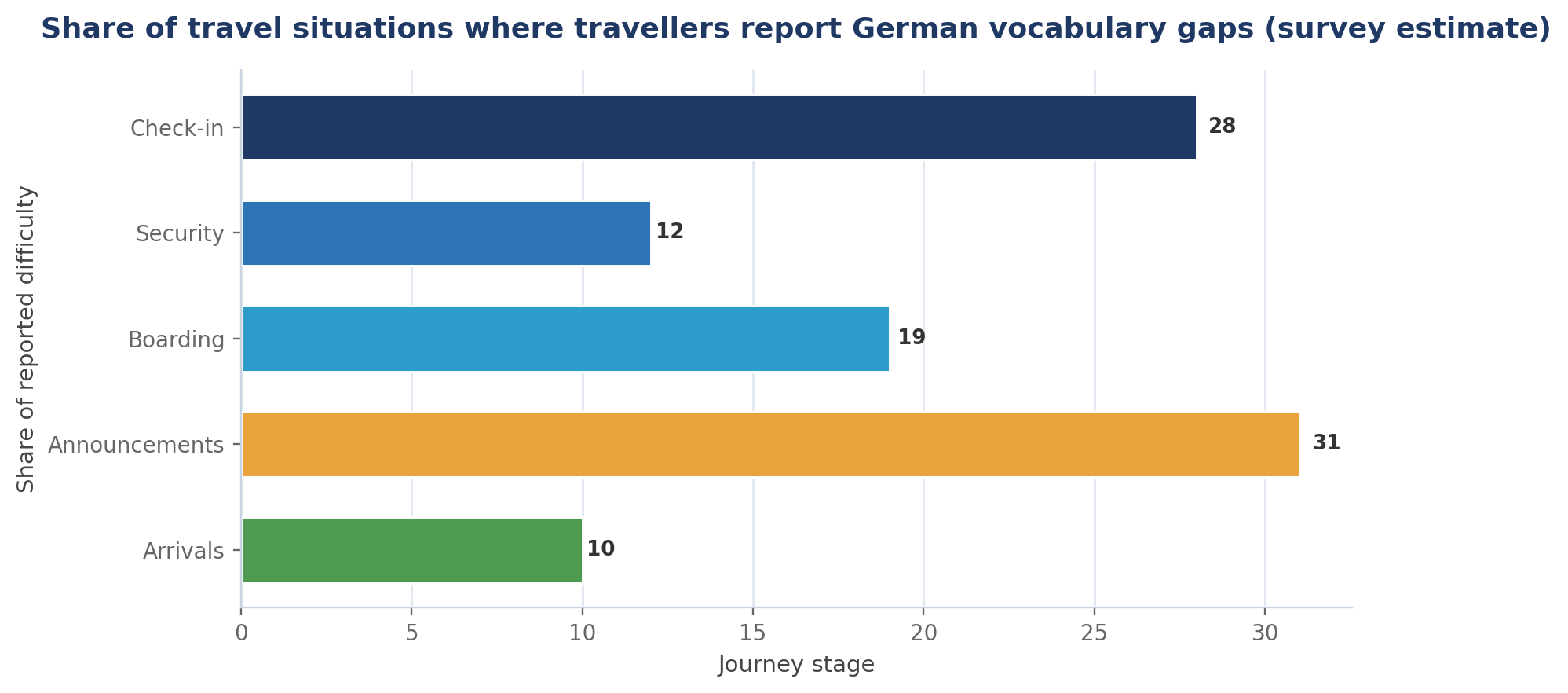
You have ninety seconds at the check-in desk, a queue behind you, and a clerk speaking fluent Bavarian at full speed. German airport vocabulary is not about sounding clever. It is about not missing your flight.
Here is every word and phrase you actually need, arranged in the order you will meet them.
What you will get from this guide
- The core German vocabulary at the airport, grouped by journey stage
- Ready-to-use phrases for check-in, security and boarding
- Listening cues for announcements you cannot pause
- The words that mean the opposite of what English speakers expect
Stage 1: Arrival and Check-In
The words come fast here, but the set is small and repetitive. Learn these and the desk stops being scary.
Useful lines at the desk:
- Ich möchte einchecken. — I would like to check in.
- Hier ist mein Pass und meine Bordkarte. — Here is my passport and boarding pass.
- Ich habe nur Handgepäck. — I only have hand luggage.
- Ist das Gepäck bis Wien durchgecheckt? — Is the luggage checked through to Vienna?
Stage 2: Security and Departures
Listen for "Flug LH 1045 nach Wien ist verspätet" — flight LH 1045 to Vienna is delayed. The pattern is always Flug + number + nach + destination + status.
Stage 3: On the Plane
Phrases that carry you through boarding:
- Entschuldigung, das ist mein Platz. — Excuse me, that is my seat.
- Können Sie mir helfen, das Handgepäck zu verstauen? — Can you help me stow my hand luggage?
- Ich hätte gern ein Glas Wasser. — I would like a glass of water.
- Wie lange dauert der Flug? — How long does the flight take?
Stage 4: Arrivals and Transfers
The one sentence every traveller should own: Mein Koffer ist nicht angekommen. — My suitcase has not arrived.
Vocabulary you can read is not vocabulary you can hear
Airport announcements give you one shot. Train your ear with self-paced listening practice and an AI voice tutor that speaks at real speed.
Start German listening practice →Create a free accountThe Words That Trip English Speakers
Three false friends lurk in every airport in the German-speaking world.
And one useful distinction: der Flug is the flight itself. Der Flugsteig is where you stand. Signage uses both, sometimes on the same sign.
How to Learn This Vocabulary Fast
Blocks of ten beats lists of a hundred. Take one stage per day — check-in on Monday, security on Tuesday — and rehearse the phrase pairs aloud until they leave your mouth without permission. Then simulate the announcement: play a German airport announcement on your phone and try to catch the flight number, the destination and the status. That single drill trains more real-world listening than an hour of vocabulary cards.
Fly through a German-speaking airport with confidence
Twenty core phrases, practised aloud with a self-paced AI voice tutor, beat a hundred flashcards you never say out loud.
Start your German course →Create a free accountFrequently Asked Questions
What is the most important German airport phrase? Wie komme ich zum Gate? — How do I get to the gate? It works at every terminal, and staff will point and repeat slowly if needed.
Is "Terminal" the same in German? Yes, das Terminal is used almost identically. Note that der Termin means an appointment, so do not mix them.
Can I get by in German airports with English? At major hubs like Frankfurt or Zurich, yes. At regional airports, and on announcements, German dominates. A2-level vocabulary makes the difference between following and guessing.
How do I understand fast airport announcements? Listen for three anchors: the flight number, the destination after nach, and the status word at the end. You do not need every word — only those three.
References & Further Reading
- Goethe-Institut — A2 level descriptors and travel topics: https://www.goethe.de
- Deutsche Welle — Nicos Weg A2 (travel and airport scenes): https://learngerman.dw.com
- Duden — German dictionary and word forms: https://www.duden.de
- Frankfurt Airport — official multilingual passenger information: https://www.frankfurt-airport.com
- Council of Europe — CEFR A2 "can-do" statements: https://www.coe.int/en/web/common-european-framework-reference-languages