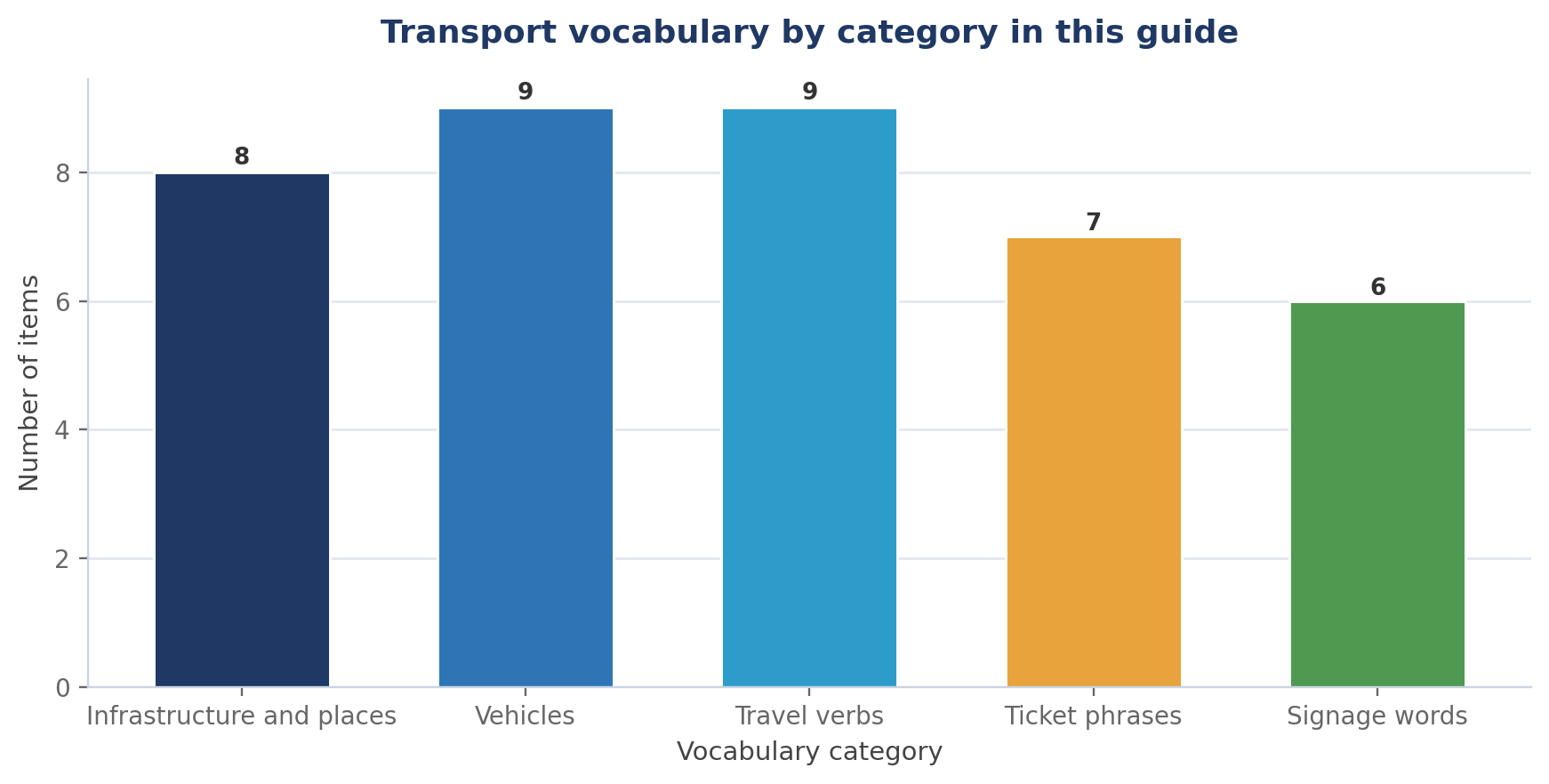
Transport vocabulary is the first German you will actually need. Before you can discuss hobbies or debate politics, you need to find the platform, buy the right ticket, ask when the train leaves and understand why it is late. Germany runs on public transport, and the language of it is compact, repetitive and learnable in a fortnight.
Learn these words properly and every journey becomes a small language lesson instead of a small crisis.
What you will get from this guide
- Core transport nouns with article and plural
- The verbs and phrases for buying tickets and asking directions
- The words on departure boards you must recognise fast
- The distinctions German makes that English does not
Places and infrastructure
Note das Gleis, which is neuter and the standard word on departure boards. Der Bahnsteig is a synonym used for the platform itself, and you will see both in German stations.
Vehicles
The compound patterns are worth noticing. U-Bahn is Untergrundbahn, the underground railway; S-Bahn is the suburban Schnellbahn. German compresses information into single words, and the abbreviations follow the same logic.
Verbs of travel
The separable verbs are the ones to drill. Umsteigen, einsteigen and aussteigen all split in the present tense, and their prefixes travel to the end of the sentence.
Turn station vocabulary into real journeys
Reading Gleis on a page is not the same as catching it in a station announcement at speed. A personal AI voice tutor trains your ear on the exact words you will hear over the loudspeaker, at your own pace.
Practise German listening with your AI tutor →Create a free accountBuying tickets and asking your way
Einfach oder hin und zurück? is the question you will hear first at any ticket counter, and answering it fluently saves a full exchange of gestures.
Departure-board and announcement words
Recognising these fast matters more than producing them.
Verspätung is the most useful word on this list, and the most commonly heard. Der Zug hat 10 Minuten Verspätung is a sentence you will use before you use most greetings.
German distinctions English blurs
Learning a language means learning where it draws lines that you would not. Transport German draws several, and getting them right makes you sound considerably less like a visitor.
How to practise this vocabulary
The role-play matters most. Ticket-counter German is one of the few conversations you can rehearse in full and then walk into almost unchanged.
Learn German for the journeys you actually take
Self-paced AI-tutor lessons build the vocabulary of real situations — stations, tickets, delays, connections — with instant feedback before the trip, not after.
Explore self-paced German lessons →Create a free accountFrequently Asked Questions
What is the German word for train station? der Bahnhof. A small stop or halt is die Haltestelle for buses and trams, and der Haltepunkt for minor rail stops.
How do I say "one return ticket" in German? Eine Fahrkarte hin und zurück, bitte. A single is einfach.
**What does Gleis mean?** It means the track or the numbered platform area — for example, Gleis 5. The physical platform is der Bahnsteig.
How do I say the train is late? Der Zug hat Verspätung or Der Zug hat zehn Minuten Verspätung.
References & Further Reading
- Deutsche Bahn — Train travel and ticketing information
- Goethe-Institut — German A1 exam and vocabulary guidance
- Deutsche Welle — Nicos Weg: free A1 German course
- Duden — German dictionary with genders and plural forms
- DWDS — Digital Dictionary of the German Language, with corpus examples