You land in Frankfurt. The announcements are fast, the signs are long, and the person at the counter just asked you something you did not catch. This is the moment travel German stops being a hobby and becomes a superpower.
The good news is that you do not need fluent German to travel confidently. You need about 90 words and 12 sentences. This guide gives you exactly those — organised by the situation you will actually face, with pronunciation and a full example for each.
How to use this guide
- Scan the tables once now, then come back to the scenario you're about to face.
- Say each phrase out loud three times. Travel German is muscle memory, not theory.
- Anything in italics is the German; the brackets show a rough pronunciation.
- Check the listening box below — hearing a phrase once beats reading it ten times.
Where Travel German Gets Used Most
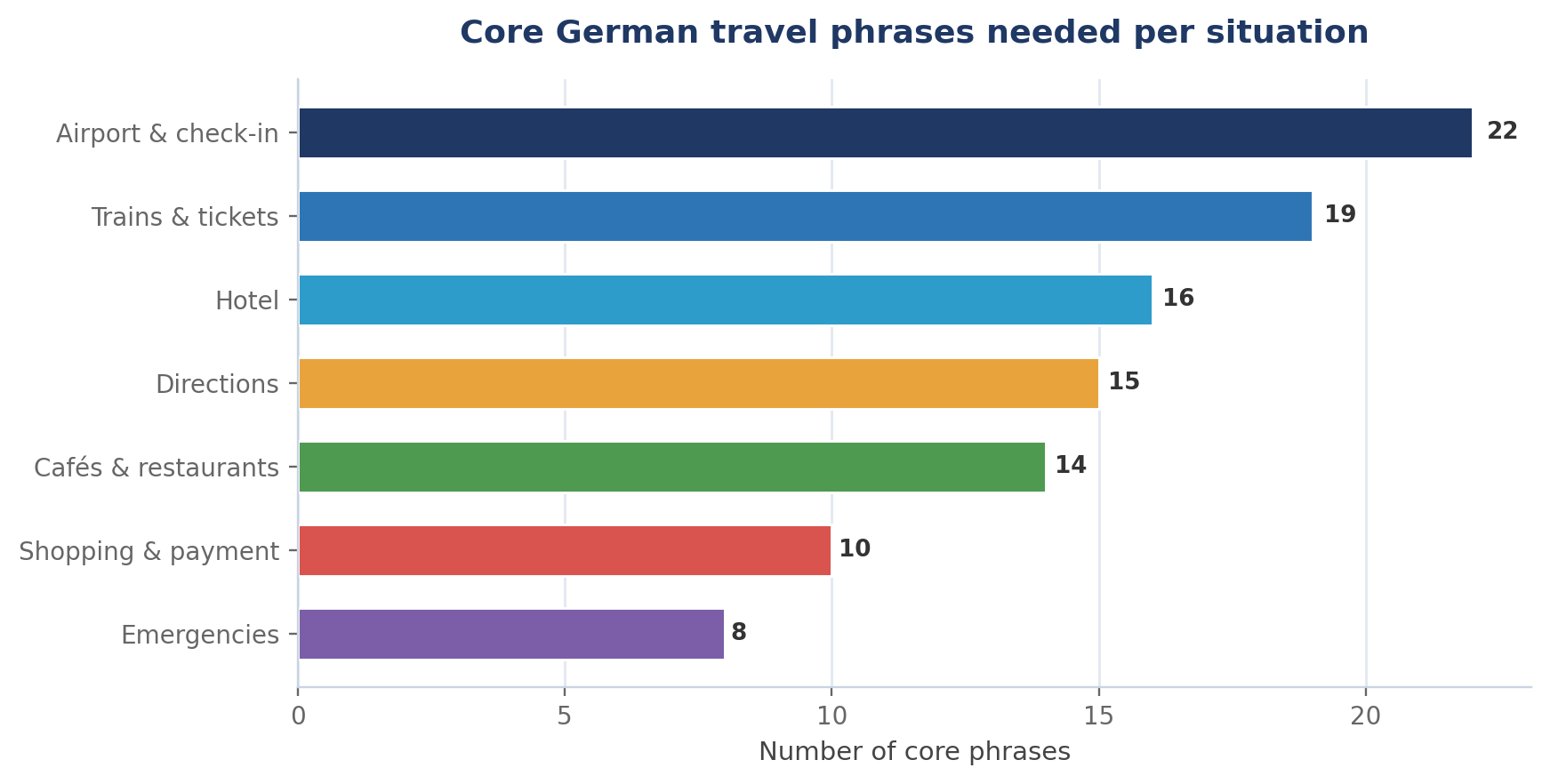
Not all vocabulary is equally useful. Here is where the real demand sits across a typical trip.
Spend your first hour on airport and train vocabulary. Those two situations cover roughly 40% of every conversation you will have in your first two days abroad.
At the Airport and at Check-In
Ready-made sentences
- Wo ist das Terminal 2? — Where is Terminal 2?
- Ist der Flug nach München pünktlich? — Is the flight to Munich on time?
- Mein Koffer ist nicht angekommen. — My suitcase has not arrived.
- Ich habe nur Handgepäck. — I only have hand luggage.
Trains, Trams and Public Transport
German rail vocabulary is the single highest-value set in this entire article. Germany runs on trains, and the ticket machines speak only German at the worst possible moments.
Ready-made sentences
- Eine Fahrkarte nach Berlin, bitte. — One ticket to Berlin, please.
- Muss ich umsteigen? — Do I have to change trains?
- Von welchem Gleis fährt der Zug ab? — From which platform does the train depart?
- Ist dieser Platz noch frei? — Is this seat still free?
Hotels and Accommodation
Ready-made sentences
- Ich habe eine Reservierung auf den Namen Kumar. — I have a reservation under the name Kumar.
- Ist das Frühstück inklusive? — Is breakfast included?
- Können Sie mir ein Taxi rufen? — Can you call me a taxi?
- Ich möchte auschecken, bitte. — I would like to check out, please.
Asking for Directions Without Panicking
Ready-made sentences
- Entschuldigung, wo ist der Bahnhof? — Excuse me, where is the train station?
- Ist es weit von hier? — Is it far from here?
- Können Sie das auf der Karte zeigen? — Can you show me on the map?
- Ich habe mich verlaufen. — I'm lost.
Read the phrases — then hear them at real speed
Vocabulary you've only read will vanish the moment a train conductor speaks to you. LanguageSkills.net listening labs use authentic German audio — station announcements, café orders, hotel check-ins — so your ear learns the phrases your eyes already know. Free accounts get a starter listening pack; Course Pass holders get graded sets from A1 to B2.
Try a free German listening drill →Create a free accountCafés, Restaurants and Paying
Ready-made sentences
- Ich nehme das Tagesangebot. — I'll take the daily special.
- Ist das vegetarisch? — Is that vegetarian?
- Kann ich mit Karte zahlen? — Can I pay by card?
- Zahlen, bitte! — The bill, please!
Survival Phrases for Emergencies
That last pair is arguably the most valuable two sentences in the entire article. Germans are famously willing to help — they simply need to know that you need a slower tempo.
How to Actually Make This Vocabulary Stick
Reading a list builds recognition. Travel needs production. Here is the routine that works:
- Group by scenario, not alphabet. Learn the seven airport phrases together so one cue triggers the whole set.
- Always attach audio. German spelling misleads English speakers constantly — Straße is "SHTRAH-se", not "stray-zee".
- Rehearse aloud, in character. Stand up, imagine the counter, say the line. Silent review does not transfer to speech.
- Use the two escape hatches. Wie bitte? ("Pardon?") and Können Sie das langsamer sagen? will rescue you more times than any noun.
- Test under mild pressure. An AI voice tutor that replies unexpectedly trains you far better than a flashcard that always waits.
Practise these phrases with your AI voice tutor before your trip
Our German course is built around real situations — check-in desks, ticket counters, restaurant tables — with an AI voice tutor that replies at natural speed and gives you feedback on your pronunciation on the spot. One hour of guided speaking practice is worth five hours of solo reading.
Start your German speaking practice →Create a free accountFrequently Asked Questions
How many German words do I need for a trip? Around 80–120 words plus a dozen fixed sentences covers a two-week trip comfortably. Prioritise transport, accommodation, directions and payment vocabulary.
Do Germans speak English to tourists? Often, especially in cities and among younger people. But opening in German — even with Entschuldigung, sprechen Sie Englisch? — is consistently received better, and many smaller towns and older people genuinely prefer German.
Is Austrian or Swiss German vocabulary different? A little. In Austria, Erdäpfel replaces Kartoffeln (potatoes) and Sackerl replaces Tüte (bag). Swiss German differs far more in speech, but written Swiss German is essentially standard German, so your vocabulary transfers.
What is the politeness rule I should know? Use the formal Sie with strangers, officials and anyone older. Use du only with friends, family and people who invite it. When in doubt, stay formal — nobody is offended by Sie, while an unwanted du can feel presumptuous.
Should I learn numbers before travelling? Yes — numbers appear in prices, platforms, room numbers and times. Learn 1–100 actively; it is the highest-leverage two hours you can spend.
The Takeaway
Travel German is a small, bounded, extraordinarily useful skill. Ninety words. Twelve sentences. Seven scenarios. Learn them with audio, rehearse them out loud, and you will move through Germany, Austria and Switzerland with a confidence that feels disproportionate to the effort involved.
Then, when you're back home and realise you enjoyed it — that's the moment the real learning starts.
From survival phrases to real conversations
The gap between "I can order a coffee" and "I can hold a conversation" is about 300 guided hours — and a structured course that keeps you moving. LanguageSkills.net takes you there with guided lessons, listening labs, speaking practice with AI feedback and printable study materials.
Continue with the German Course Pass →Create a free accountReferences & Further Reading
- Goethe-Institut, Wortliste for Start Deutsch 1 (A1) — thematic vocabulary groups
- Deutsche Welle, Deutschtrainer and Nicos Weg — travel-themed A1 dialogues
- Deutsche Bahn, official station and ticketing vocabulary (bahn.de)
- Duden, Deutsches Universalwörterbuch — article and gender reference
- Österreichisches Wörterbuch — Austrian standard vocabulary differences
- Council of Europe, CEFR Companion Volume — A1 spoken interaction descriptors