You step out of Munich Hauptbahnhof, phone at four percent, and the only person nearby speaks Bavarian at the speed of a hailstorm. This is the moment where a hundred words decide your entire day. Learn the vocabulary of getting around and the city stops being a maze.
What you will get from this guide
- The exact phrases for asking directions politely
- Real answers you will hear — and how to decode them fast
- Transport, ticket and station vocabulary in one place
- A listening routine that trains your ear before you travel
How to Ask — The Phrases That Work
There is a formula, and Germans respect formulas. Open with an apology-question, ask clearly, then repeat the answer back. Phrasebooks skip the repeating part, and it is the most useful step of the three.
Note the contraction you will hear a thousand times: zum = zu dem, and zur = zu der. That is why it is zum Bahnhof but zur Post. Learn the pair as chunks, not as grammar.
The Vocabulary Core — Places and Things
What You Will Hear Back
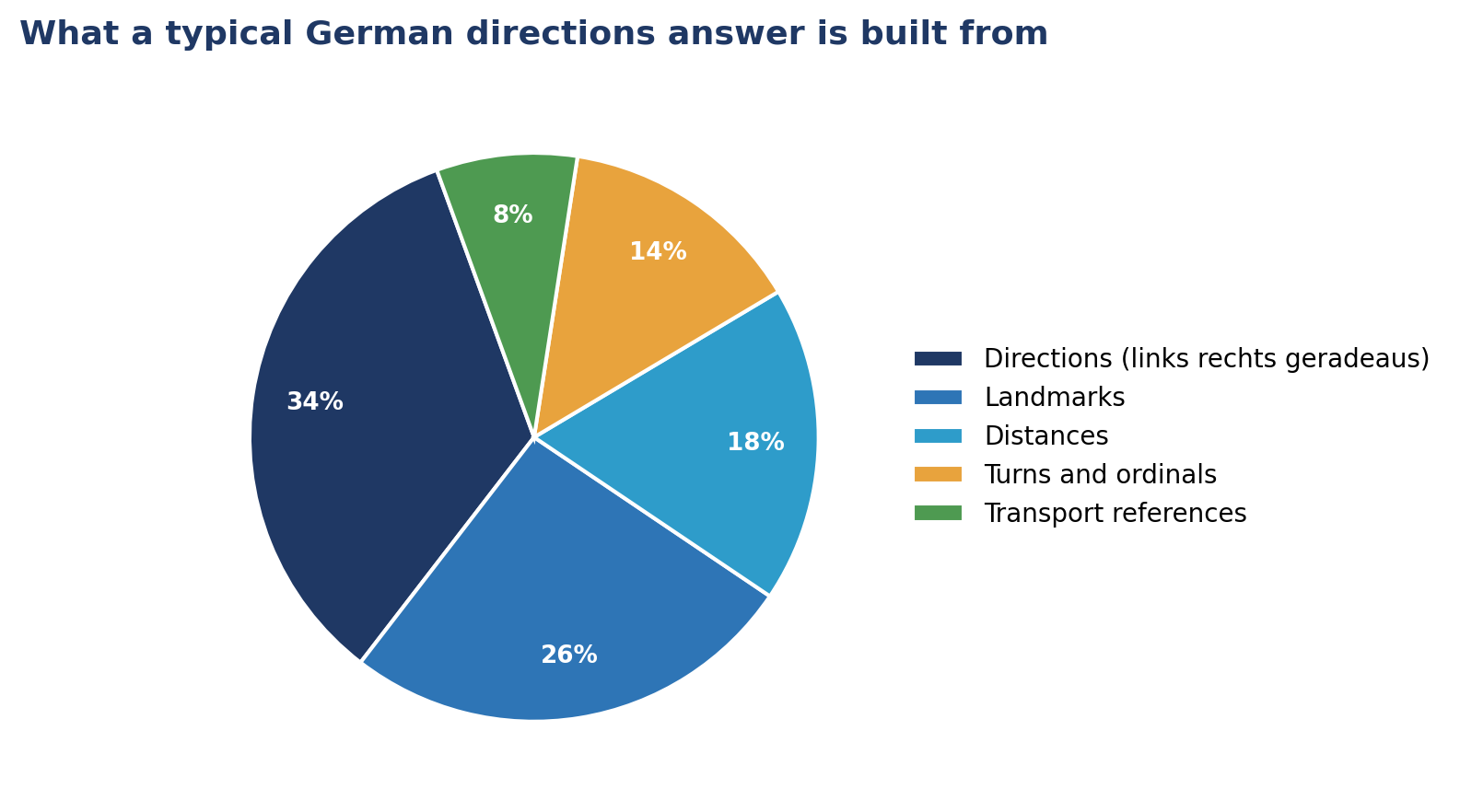
This is where travellers drown. The answer comes fast, and it is built from a tiny set of words repeated in different orders.
The Numbers You Must Not Miss
If you only catch one word in an answer, make it the number. Die zweite Straße links and die dritte Straße links are three blocks apart.
Germans measure distance in minutes, not metres. Take the hint and ask how long, not how far.
Transport Vocabulary — Stations, Tickets, Platforms
Two vocabulary facts save real money. Einfach means one-way; hin und zurück means return. And umsteigen — to change trains — is the verb you will need most and recognise least when spoken quickly.
Asking Without Asking: Reading the City
Signs do half the work. Learn the top ten and you barely need to speak.
Reading signs is easy — the fast answer is the hard part
You can decode every sign in Berlin and still freeze when a passer-by replies in a burst of geradeaus, dann die zweite links, hinter der Ampel. Self-paced German listening and speaking practice with an AI voice tutor trains your ear on exactly this: real voices, real speed, real feedback.
Practise German live →Create a free accountThe Two-Minute Survival Script
Practise this aloud until it comes out without thinking. It covers ninety percent of real situations.
You: Entschuldigung, wie komme ich zum Hauptbahnhof?
Them: Gehen Sie hier geradeaus, dann die zweite Straße links, über die Brücke. Der Bahnhof ist auf der rechten Seite.
You: Also geradeaus, zweite links, über die Brücke, rechts. Vielen Dank!
That final repetition is your safety net. It confirms you understood, and if you got it wrong, the person will correct you before you walk away — which is exactly what you want.
Polite Exits and Follow-Ups
That last phrase is quietly powerful. Nobody is annoyed by a learner who says they are learning. They are annoyed by a tourist who assumes everyone speaks English.
Learn the words now, use them on your first street corner
Vocabulary you have never heard spoken does not survive contact with a fast-talking local. Self-paced German lessons with an AI voice tutor turn this word list into automatic responses — so the answer arrives, and you already know where the second left is.
Start free at LanguageSkills →Create a free accountFrequently Asked Questions
What is the most useful German phrase for asking directions? Wie komme ich zum...? — how do I get to...? It works for stations, museums, hotels and squares. Add Entschuldigung in front and it is polite in any city.
How do I say "turn left" in German? Biegen Sie links ab. In casual speech you will hear links on its own, or die nächste links. The verb is abbiegen, which separates: biegen... ab.
**What does gegenüber mean?** It means "opposite" or "across from". Die Apotheke ist gegenüber means the pharmacy is on the other side of the street. Listen for it — it tells you to look up, not further ahead.
Is English enough to get around Germany? In big cities, often. In smaller towns, stations at night, and with older speakers, German is what you need. A hundred words of directions vocabulary removes almost all of that risk.
References & Further Reading
- Goethe-Institut. A1 syllabus and travel-themed course materials, goethe.de.
- Deutsche Welle. Nicos Weg A1 units on Wegbeschreibung and Verkehrsmittel, dw.com.
- Duden. Deutsches Universalwörterbuch, Dudenverlag.
- Deutsche Bahn. Station and platform signage conventions and travel information, bahn.de.
- Council of Europe. Common European Framework of Reference for Languages: Companion Volume, 2020.