You can order a coffee in German and chat about the weather. Then a classmate asks you "Hast du die Hausaufgaben gemacht?" and you understand every word individually while somehow missing the whole sentence.
School vocabulary is unforgiving that way. It appears in textbooks, Podcasts, university emails and half the small talk you will have with German speakers under thirty. It is also one of the fastest vocabularies to master, because the words cluster tightly around a handful of situations.
What you will get from this guide
- Core school and study nouns with gender and plural
- Study verbs, each with a real example sentence
- Classroom and exam phrases you can use tomorrow
- The compound-word trick that multiplies your vocabulary
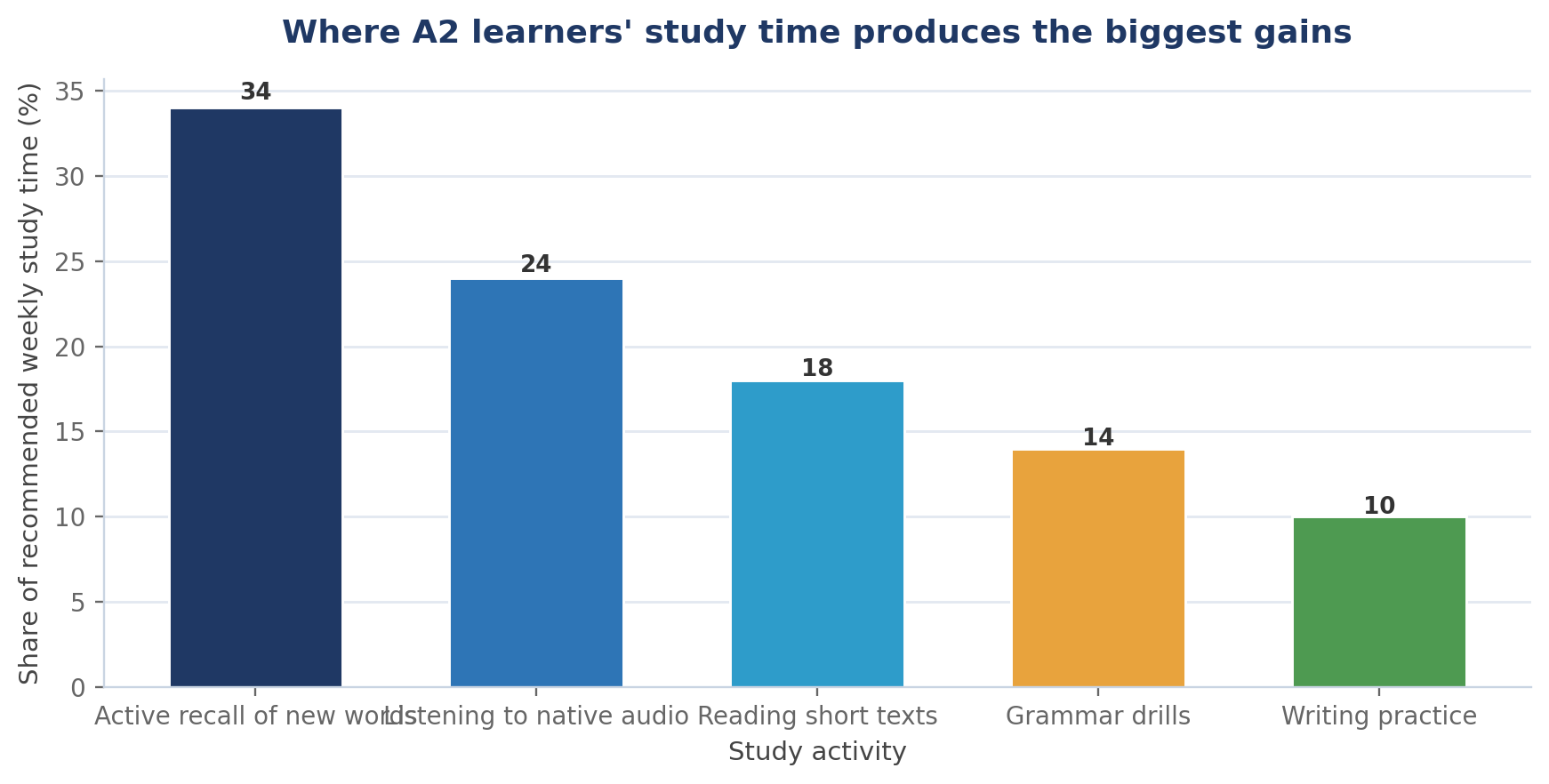
- A chart of where your study minutes are best spent
The nouns you will use every single day
Gender is the part English speakers skip and then regret. Learn these three at a time as article + noun + plural.
Two patterns worth noticing immediately. Feminine nouns ending in -ung are almost always regular (die Prüfung → die Prüfungen). And every noun is capitalised in German — a small gift that makes new words easy to spot in a text.
Study verbs, with examples that actually sound German
Verbs are where vocabulary becomes ability. Ten verbs, ten sentences.
Note the trap: lernen covers studying a subject, while studieren means studying at a university. Saying Ich studiere Deutsch can imply a degree programme; Ich lerne Deutsch is what you mean in a language class.
Classroom and university words
The physical vocabulary matters more than it looks. Half of these appear on signage, timetables and forms.
A single German habit makes these far easier to retain: attach each word to a place you have actually seen it. Mensa sticks after one lunch; Immatrikulation sticks when you have filled in the form.
The compound-word trick that doubles your vocabulary
German builds new words by gluing existing ones together — and the gender is decided by the last element. Learn this once and you unlock hundreds of words for free.
This is the single most efficient vocabulary tool in German. Whenever you meet a long word, split it at the capital letters and read the pieces — the meaning almost always assembles itself.
Phrases that make you sound at home in a lesson
Vocabulary you cannot deploy is vocabulary you do not own. These twelve phrases are used constantly in real classrooms.
One cultural detail: German school grades run from 1 (best) to 6 (worst), the reverse of many systems — so eine Eins is excellent news, not a warning.
Ready to turn reading into real German? Start your self-paced course today.
Start the German course →Create a free accountStop collecting words and start using them
A vocabulary list is silent. A personal AI voice tutor turns those twelve phrases into reflex — you say them, the AI corrects your word order and pronunciation, and by the third repetition the phrase belongs to you.
Button: Explore the German course pass →
How to make this vocabulary stick
The habit that separates A2 from B1 is not more words — it is using the same 300 words in more situations. Shadowing slow German audio is the fastest way to move a word from "recognised" to "spoken". Deutsche Welle's Langsam gesprochene Nachrichten is ideal for exactly this, and free.
Ready to turn reading into real German? Start your self-paced course today.
Start the German course →Create a free accountTry a free account before you commit
Create a free languageskills.net account and put these words into guided listening practice — no payment needed to start, and nothing to lose except the awkward pause.
Button: Create your free account →
Frequently Asked Questions
What is the German word for school? Die Schule (plural die Schulen). A pupil is der Schüler or die Schülerin, and a school subject is das Fach.
How do I say "homework" in German? Die Hausaufgabe (plural die Hausaufgaben). The everyday question is Was haben wir auf?
Should I learn the article with every noun? Always. German gender is not predictable from meaning, so der, die or das must be memorised as part of the word — ideally with its plural.
**Is studieren the same as lernen?** No. Lernen means to learn or study a subject; studieren means to study at a university as a degree student.
References & Further Reading
- Goethe-Institut — German courses, levels and free learning resources
- Deutsche Welle — Deutsch lernen: free courses and *Langsam gesprochene Nachrichten*
- Duden — Official German dictionary, gender and plural reference
- telc — German language examinations and CEFR alignment
- Council of Europe — CEFR levels and descriptors