You have rehearsed Guten Tag for three weeks and now a receptionist in Munich is asking you four questions in nine seconds. Hotel German is a small, closed vocabulary — maybe 120 words — and once you own it, check-in becomes routine instead of cardio. Here is the whole set, with examples you can steal.
What you will get from this guide
- The core nouns and phrases for booking, checking in, staying and checking out
- Ready-made sentences for the ten moments that actually happen
- A pronunciation-and-listening hit list of the words that catch learners out
The Twenty Words That Do Most of the Work
Notice that every compound takes the gender of its last element. Zimmer is das, so Einzelzimmer, Doppelzimmer and Hotelzimmer are all das. That single rule saves you hundreds of article mistakes.
Checking In: The Six Sentences You Need
Say the reservation sentence slowly and you will be understood anywhere in the German-speaking world. The receptionist will then speed up. That is normal, and it is not a verdict on your German.
Asking About the Room
The pattern worth memorising is Wäre … möglich? — "would … be possible?" It is polite, flexible, and works for nearly every request you will ever make in a hotel.
The Verb Family You Will Reuse
Übernachten is the verb that separates tourists from learners. It means specifically "to spend the night", and Germans use it constantly: Wo übernachtest du in Berlin?
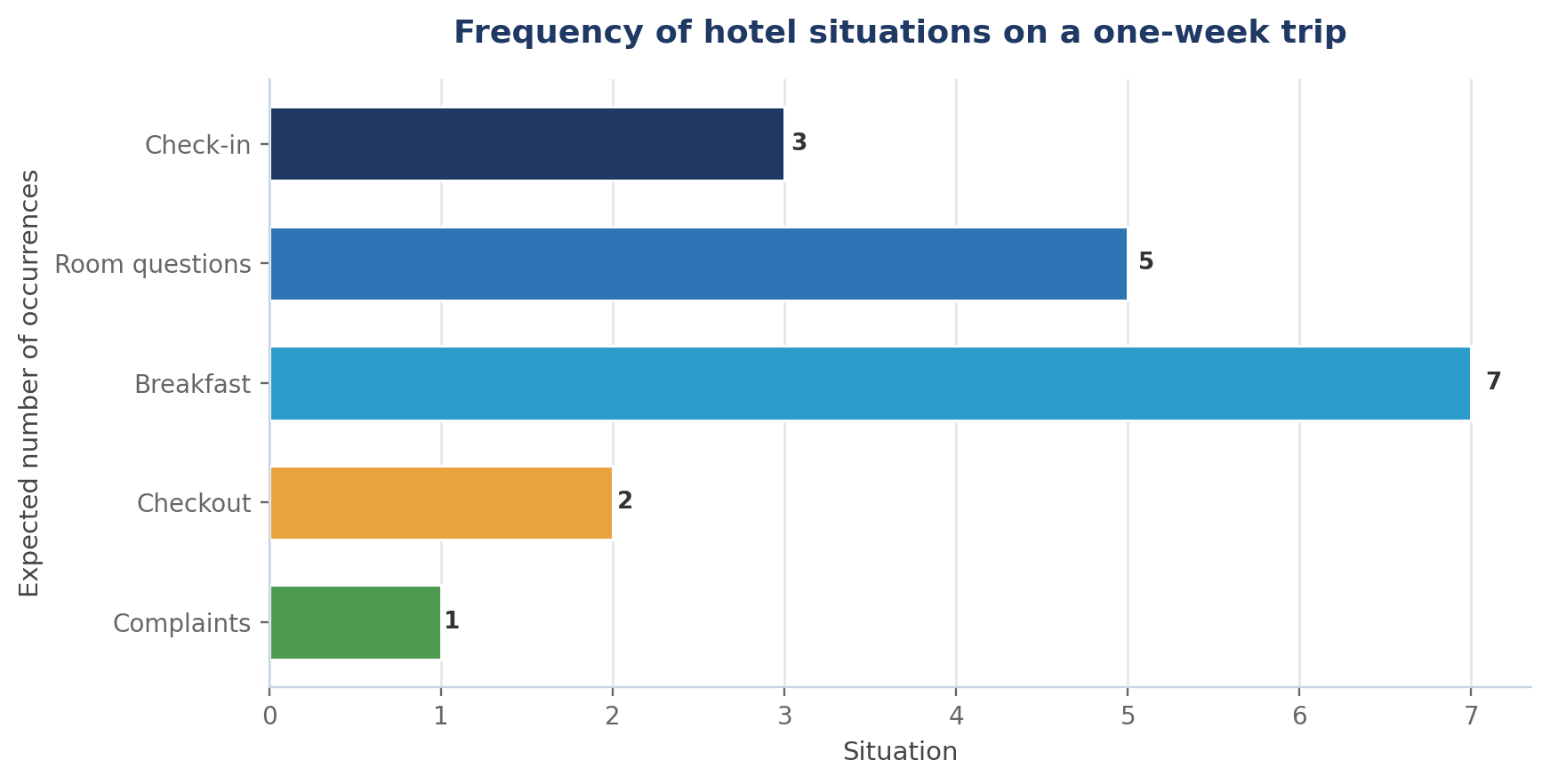
How often does each situation come up on a typical trip? Roughly like this.
Breakfast wins. Learn the breakfast words and you will use them every single morning.
Vocabulary you hear beats vocabulary you read
Train your ear on real hotel dialogues with your personal AI voice tutor, so the receptionist's rapid-fire questions stop sounding like weather.
Start German listening practice →Create a free accountAt Breakfast and Around the Building
Ist hier noch frei? is the most useful sentence in the German-speaking world. It works in hotels, trains, cafés and beer gardens.
Checking Out Without Surprises
Three sentences, in this order, and you are out the door.
- Ich möchte auschecken, Zimmer 214.
- Könnte ich bitte die Rechnung haben?
- Kann ich mit Karte bezahlen?
Then check the folio. Nebenkosten — minibar, parking, city tax — are where unexpected numbers live. In many German cities there is a Kurtaxe or City Tax per night, and it is normal to pay it separately.
Words That Trick the Ear
Doppelzimmer versus Zweibettzimmer causes real arguments at real desks. A Doppelzimmer has one double bed. A Zweibettzimmer has two singles. Get it wrong and you will be sharing a duvet with a colleague.
Arrive ready, not rehearsing
Focused speaking practice with your AI voice tutor covers every hotel dialogue you will ever have. Walk up to that desk and enjoy it.
Start speaking German →Create a free accountFrequently Asked Questions
How do I say "I have a reservation" in German? Ich habe eine Reservierung auf den Namen … — add your surname. For a restaurant it is Ich habe einen Tisch reserviert.
Do I need to speak German in hotels in Berlin or Vienna? Almost never, but it changes the interaction completely. Staff switch to English instantly and warmly when you try German first.
What is the difference between Pension and Hotel? A Pension is a small family-run guesthouse, usually with breakfast and fewer services. A Hotel is a licensed commercial establishment, often with a reception that is staffed around the clock.
How do I complain politely? Use Ich möchte etwas reklamieren plus the problem, then a softener: Könnten Sie das bitte prüfen lassen? Germans complain directly but politely; calm and specific works best.
References & Further Reading
- Goethe-Institut, Wortliste for A1–A2 (accommodation and travel vocabulary) — goethe.de
- Deutsche Welle, Deutschtrainer travel dialogues — dw.com/deutschlernen
- Duden, Deutsches Universalwörterbuch, Dudenverlag
- Council of Europe, CEFR Companion Volume (2020) — A2 can-do descriptors
- Österreich Werbung, practical travel and Ortstaxe information — austria.info