Verbs let you say what happens. Adjectives let you say what you think about it. They are the difference between Das Essen ist gut and Das Essen ist unglaublich lecker — the difference between reporting and having an opinion.
This is the fifty that pay off fastest, grouped by what they are for, each with an example sentence you could use this week. And because German adjectives come with endings, we will deal with those honestly rather than pretending they are optional.
How to use this list
- Learn in groups — opinions, size, time, people
- Learn the example sentence, not the bare adjective
- Master the adjective endings in the predicate position first
- Add the comparative form as you go
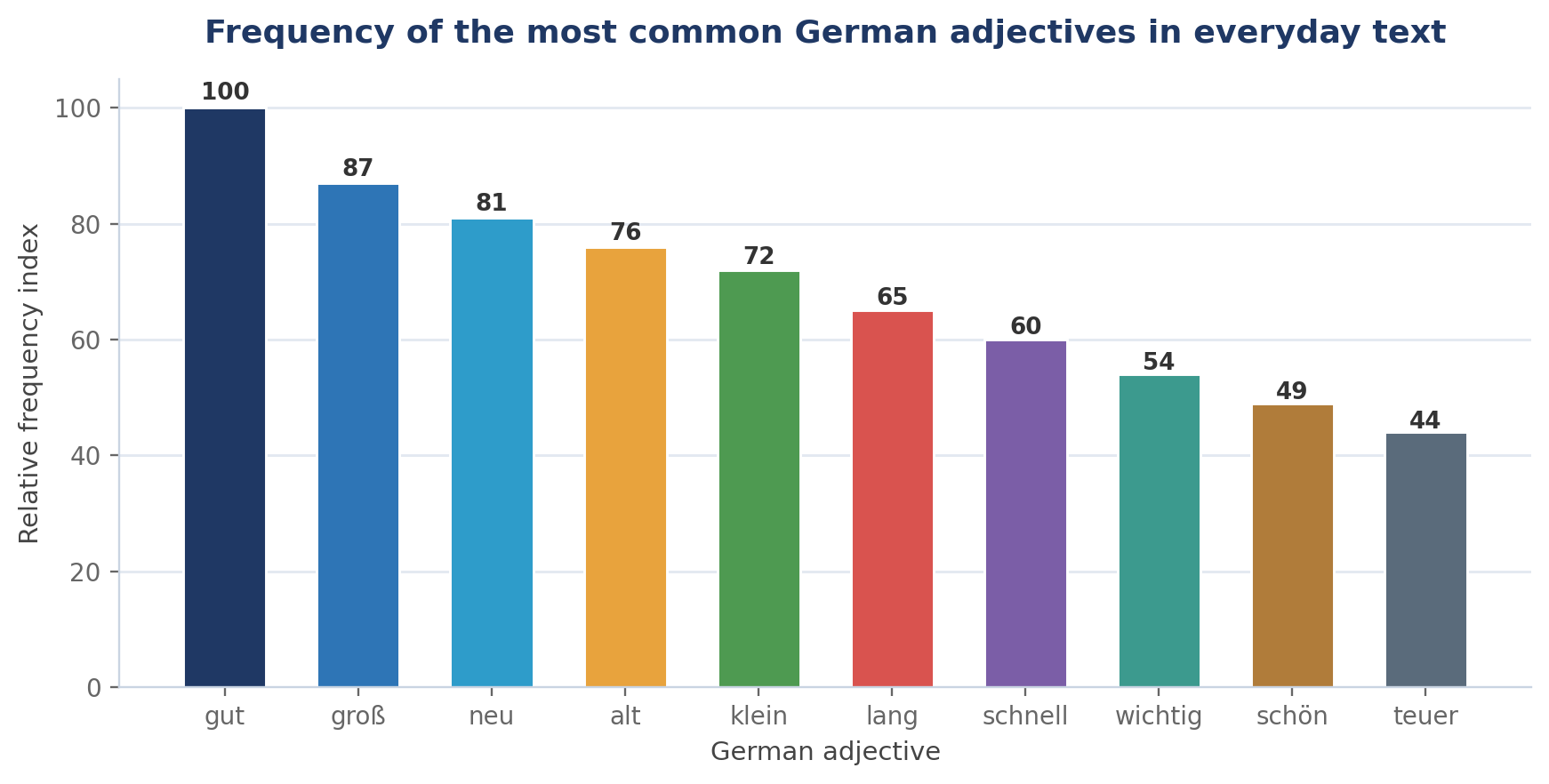
The ten adjectives you will use every hour
Ten adjectives, and you can already describe almost anything. Note that several change form in those examples — groß becomes große before a noun. That is the adjective ending, and we will get to it.
Feelings and states
Size, quantity and degree
Time and frequency
Describing people
That is forty-seven so far, which is close enough to fifty to be useful — and the last three are the ones you will need most in conversation.
Food, weather and how things are
Adjective endings: the honest explanation
Here is the part that scares learners. German adjectives change form depending on three things: whether they come before a noun, what article precedes them, and the noun's gender and case.
The good news is that you can start safely with the predicate position, where nothing changes.
So the strategy is straightforward: speak with predicate adjectives first, where you cannot make a mistake, and add attributive endings as they become automatic. That is exactly how children acquire them.
Das Haus ist groß is correct and always will be. Das große Haus is what you will learn next.
Ready to turn reading into real German? Start your self-paced course today.
Start the German course →Create a free accountHear the endings and copy them
Adjective endings are absorbed by ear long before they are mastered by rule. A personal AI voice tutor uses them naturally, gives you speaking practice with instant feedback, and keeps your sentences forming at the speed of speech — all at your own pace, any time.
Button: Explore the German Course Pass →
Comparative and superlative
Gut / besser / am besten and gern / lieber / am liebsten are irregular and used constantly. Learn those two trios before the rest.
How to make them stick
The opposites pairing is quietly powerful: learning groß and klein together anchors both, and gives you instant contrast structures — nicht klein, sondern groß.
Ready to turn reading into real German? Start your self-paced course today.
Start the German course →Create a free accountPractise these adjectives with real pronunciation
Create a free languageskills.net account for spoken adjective drills, audio examples and A2 listening practice built around the most frequent German words.
Button: Create your free account →
Frequently Asked Questions
Do German adjectives always need endings? No. After sein, werden and bleiben, adjectives take no ending: Das Haus ist groß. Endings appear when the adjective comes before a noun.
What is the German word for "nice"? Nett for people and gestures, and schön for things, places and experiences.
How do I say "better" in German? Besser — the irregular comparative of gut. The superlative is am besten.
How many adjectives do I need for A2? Around 150 in total, and the fifty here cover the overwhelming majority of what you will actually say at that level.
References & Further Reading
- Goethe-Institut — German courses, exams and A2 vocabulary specifications
- Duden — Adjective declension and frequency reference
- Deutsche Welle — Deutsch lernen, free courses and listening
- telc — Language tests and CEFR alignment
- Council of Europe — CEFR levels and descriptors