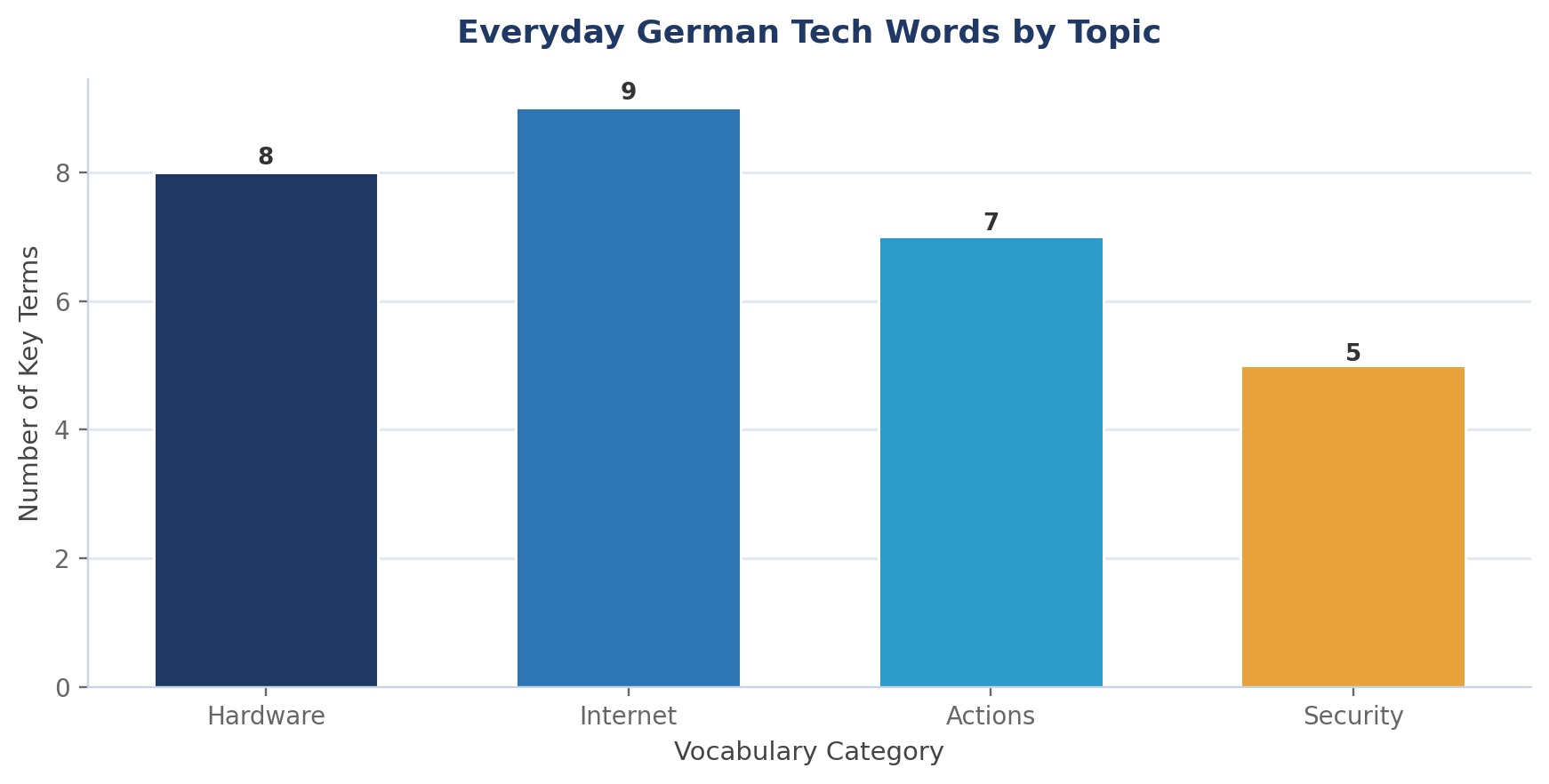
Your phone is in your hand. Your laptop is open. And in German, both are quietly waiting for you to give them a name. That is the beautiful thing about German vocabulary technology — it lives everywhere around you, every single day, and it rewards you the moment you start using it.
Here is the good news: German is famously logical when it comes to tech. Many words are simply borrowed from English, and the rest follow patterns you can guess. So let's plug in, boot up, and build the digital vocab you actually need at B1.
The Absolute Core: Devices and Hardware
Start with the objects you touch every day. The most important thing to notice is the article — never learn a noun without its der, die, or das.
A friendly warning: das Handy is a German invention — the English "handy" means something else entirely. Germans created this word, so give it the respect it deserves.
The Internet: Words You'll Use Every Day
Now the words that connect you to the whole world. According to surveys of online behaviour, German-speaking adults spend several hours per day online — so these terms show up constantly in real conversation.
Notice the pattern? Words ending in -ung and -e are usually die. That single rule will save you hundreds of mistakes.
Stop memorising — start hearing
Words stick for good when your ears do the work, not just your eyes. Our German course pass turns these exact lists into guided lessons with an AI voice tutor you can replay anywhere, at your own pace.
Unlock the German course pass →Create a free accountVerbs: What You Actually Do Online
Nouns get you names. Verbs get you sentences. Here are the action words German speakers reach for constantly.
Watch out for herunterladen and hochladen — they are separable verbs, so the prefix jumps to the end of the sentence. Once you see it, you can't unsee it.
Security and Social: Talk Like a Native
Finally, the words that keep you safe and keep you connected.
One link away from speaking practice
Reading a list is step one; speaking it out loud is where progress really happens. Join free at LanguageSkills signup and practise these words with AI speaking feedback today.
Start practising German now →Create a free accountFrequently Asked Questions
Are German tech words mostly English? Many are, especially newer ones like Computer, Laptop, and Internet — German simply borrowed them. But plenty of older terms are genuinely German, such as das Handy, der Bildschirm, and die Tastatur, and these are the ones worth drilling.
How do I know if a tech noun is der, die, or das? Use the endings. Words in -ung, -e, and -schaft are nearly always die; words in -er for devices are usually der; and das tends to cover short, borrowed, or abstract nouns. When in doubt, always learn the article as part of the word.
What level should I be to learn this vocabulary? These terms sit comfortably in the B1 range — useful for managing devices, messaging friends, and describing your online habits. Absolute beginners can still memorise the nouns, since singular forms work fine in simple sentences.
Which verbs are trickiest for learners? The separable ones. Herunterladen, hochladen, and anmelden split in the sentence, so the prefix moves to the end. Master that pattern and your German instantly sounds more natural.