Healthcare is the one field where language failure has consequences beyond embarrassment. You can muddle through a misheard restaurant order. You cannot muddle through a misheard dosage.
That gravity is exactly why healthcare employers in Japan set the language bar high — and why preparation has to be specific. General Japanese gets you to the hospital door. Clinical Japanese is what lets you walk through it.
What this guide covers
- The level employers actually expect
- Core medical vocabulary by category
- Patient-facing phrases that build trust
- The register rules in clinical settings
- A realistic preparation timeline
The level employers expect
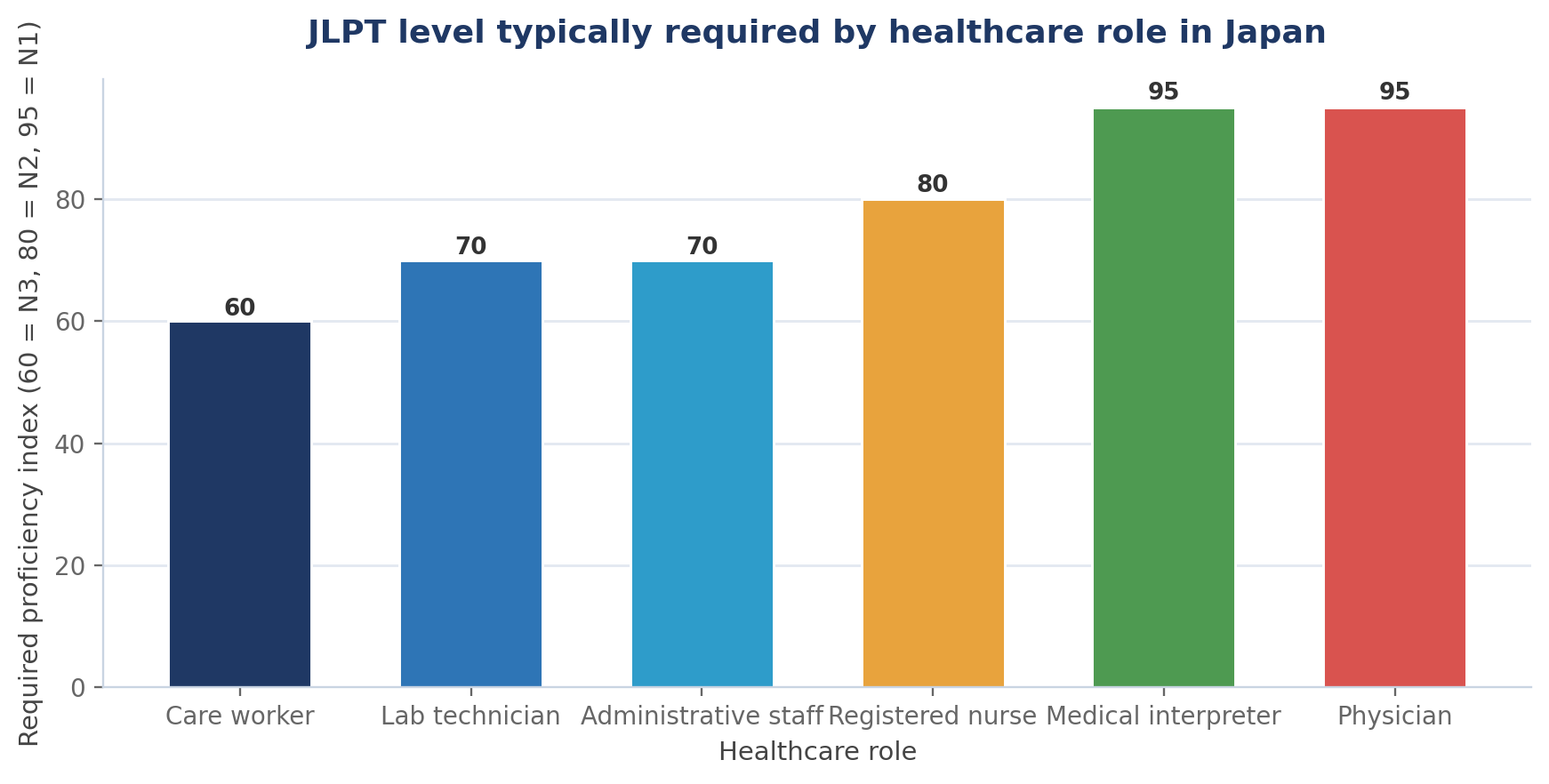
Healthcare roles in Japan generally ask for N2 or higher, and for good reason: you need to follow a doctor's instructions at speed, read charts, and reassure frightened people.
The gap between N3 and N2 in healthcare is not decorative. N3 covers everyday conversation; N2 covers the specialised vocabulary, formal register and reading speed clinical work demands.
Core medical vocabulary
Start with the words you will meet hourly, not the words that sound impressive.
Twelve words that appear in almost every clinical interaction. Learn the kanji, not just the reading — you will meet them written on charts and forms.
Body parts and pain expressions
Patients describe pain in specific ways, and the vocabulary is highly patterned.
Note the grammar pattern: body part + が + 痛い/苦しい. Learn the frame once and you can express pain in any location.
Patient-facing phrases that build trust
Clinical language has two jobs: accuracy and reassurance. These phrases do both.
That last phrase is used constantly in healthcare, and it is one of the warmest things you can say. Learn it early.
Register rules in clinical settings
Healthcare register is stricter than most workplaces, and the rules are consistent.
Two conventions matter. First, avoid casual forms with patients even if they are young — it reads as disrespectful in a care setting. Second, learn to report to seniors in keigo; verbal handover is a daily task, not an occasional one.
Ready to turn reading into real Japanese? Start your self-paced course today.
Start the Japanese course →Create a free accountBuild clinical Japanese with a personal AI voice tutor
Healthcare Japanese is a specialised register that generic courses rarely reach. languageskills.net's self-paced AI voice tutor lets you rehearse patient conversations, handover reporting and formal keigo with speaking practice and instant AI feedback, studying any time at your own pace.
Button: Explore the Japanese Course Pass →
Where the real difficulty sits
The third row deserves honesty. Delivering difficult information in a second language requires both language and composure, and it should be rehearsed rather than improvised. Most hospitals have scripted phrasing for exactly this reason.
A realistic preparation timeline
Two years from beginner to workplace-ready is an honest estimate, and it assumes consistent study. Shorter is possible with intensive instruction; much shorter is not realistic.
Ready to turn reading into real Japanese? Start your self-paced course today.
Start the Japanese course →Create a free accountKnow where you stand before you apply
A free languageskills.net account includes a level check against JLPT and CEFR descriptors, so you can see how far your Japanese is from the clinical requirement.
Button: Create your free account →
Frequently Asked Questions
What Japanese level do nurses need in Japan? Typically JLPT N2, with N1 preferred for roles involving significant patient consultation and documentation.
Is medical Japanese different from general Japanese? Yes. It uses specialised vocabulary, kanji-heavy compounds and a stricter formal register than everyday conversation.
How long does it take to learn medical Japanese? From beginner level, roughly two years to reach N2 with clinical vocabulary and register training added on top.
Can I work in Japanese healthcare without N1? Yes — care work and technical roles often accept N3–N2. Roles with substantial patient consultation generally expect N2 or higher.
References & Further Reading
- Japan Foundation — JLPT level descriptions and Japanese-language education
- JLPT — Official Japanese-Language Proficiency Test
- JASSO — Study and work in Japan, qualifications guidance
- NHK World — Easy Japanese and practical medical vocabulary resources
- Council of Europe — CEFR levels and descriptors