Your first day in a German office, someone says "Hast du einen Termin?" and you are not sure whether that means a meeting, a calendar entry or a hospital appointment. It means all three, depending on the sentence.
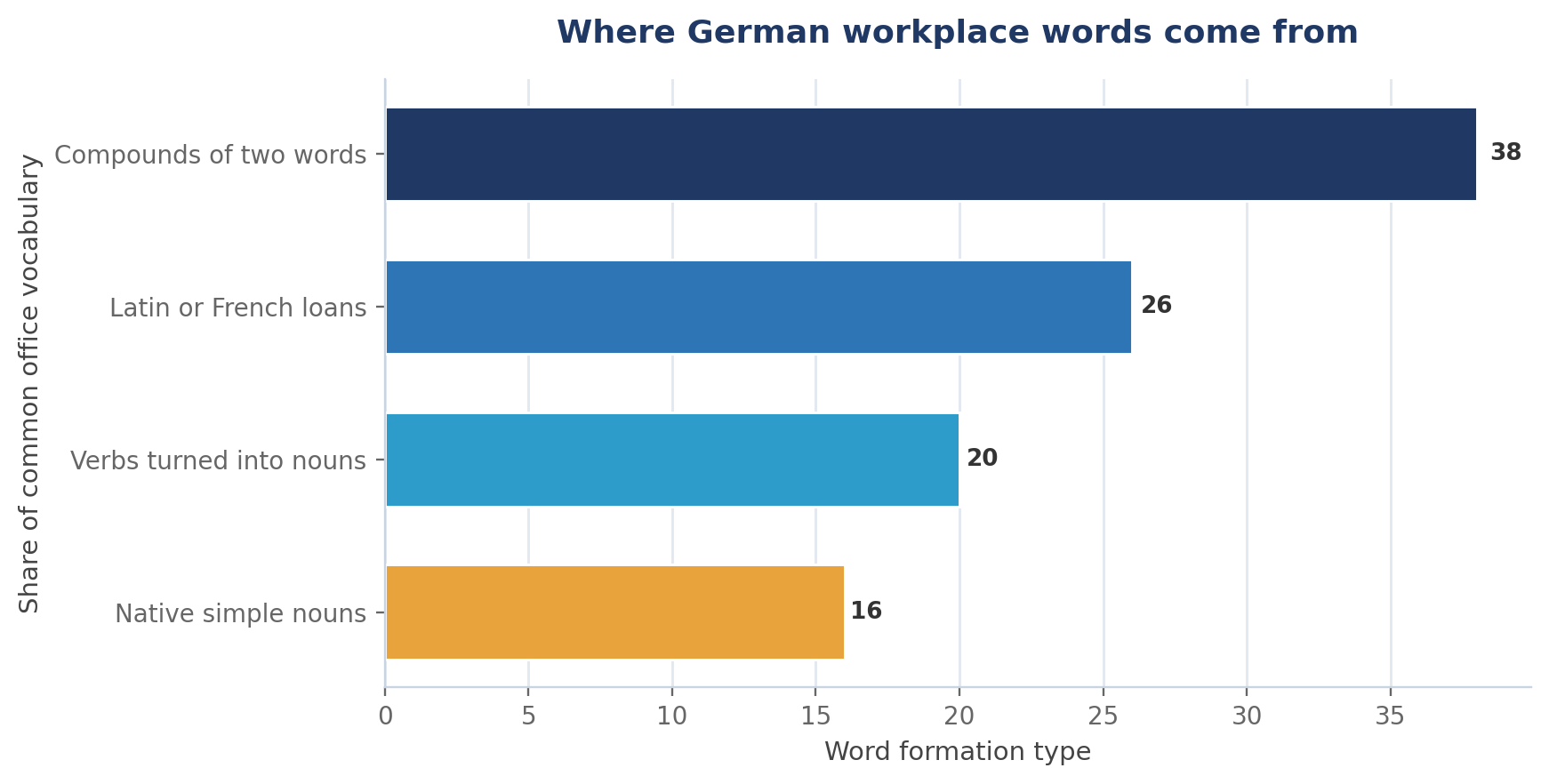
German office language is compact, literal and full of compound nouns that look terrifying until you crack them open. Here are the words you will actually hear, with sentences you can steal.
What you will get from this guide
- The core A2 German vocabulary for work, grouped by situation
- Real example sentences, not isolated word lists
- The compound-noun trick that unlocks thousand-letter words
- Email and phone phrases that make you sound professional
The Eight Words You Hear Before Ten O'Clock
Start with the daily spine. These come up in every office, every morning.
That last one, Feierabend, is untranslatable and essential. It is the sacred moment work ends — and using the word correctly marks you as someone who understands German working culture.
The Compound Noun Trick
German builds words like Lego. Die Arbeit (work) plus der Platz (place) gives der Arbeitsplatz — the workplace. Once you see the bricks, the skyscrapers stop being scary.
The gender always comes from the last brick. Die Zeit makes die Arbeitszeit feminine. Das Gespräch makes das Vorstellungsgespräch neuter. Learn the final element, inherit the gender.
Your First Week: People and Places
Navigating the building and the org chart needs about twenty words. These are they.
Learn die Kantine first. Nobody trusts a colleague who eats alone at their desk.
Vocabulary sticks when you say it out loud
Ready to turn reading into real German? Start your self-paced course today.
Start the German course →Create a free accountOur self-paced German courses use workplace scenarios — meetings, calls, small talk by the coffee machine — with a personal AI voice tutor that gives you instant feedback on your speaking. A1 to B2 available.
Button: Practise work German live →
Contracts and Conditions: The Serious Words
A2 learners often need these because of job centre appointments, contracts and paperwork. They matter.
Die Probezeit is worth memorising precisely: six months is standard, and knowing the term helps you negotiate calmly.
Email and Phone Phrases That Sound Professional
German business writing is direct. It skips the four-line warm-up English emails often use, and gets to the point in the second sentence.
That closing line is non-negotiable. Mit freundlichen Grüßen is the default; Liebe Grüße is for people who have shared a coffee.
Verbs That Run the Office Day
Verbs carry German sentences, and a small set repeats endlessly at work.
Note verschieben — postponing is a national sport, and the verb is used constantly.
Small Talk by the Coffee Machine
Fluency at A2 is not built in the meeting room. It is built in the two minutes before it.
Na is not a word you will find in most textbooks. It is a sound Germans make constantly, and it never fails.
Gender, Plurals and the Memory Trick
German nouns demand gender and plural. There is no shortcut, but there are patterns.
Learn every noun with its article attached and plural noted: die Frist, die Fristen. It feels slow for three weeks and then saves you years.
Hear these words in real German, every week
Ready to turn reading into real German? Start your self-paced course today.
Start the German course →Create a free accountStart with a free account, take a level check, and begin a self-paced course where workplace vocabulary becomes automatic through guided lessons and speaking practice with your AI voice tutor.
Button: Create your free account →
Frequently Asked Questions
What German words do I need for work at A2 level?
Around 200 to 300 workplace words cover most daily needs: colleagues, meetings, tasks, deadlines, contracts, holidays and simple email phrases. Start with the twenty most frequent and add ten a week.
Is Feierabend really used every day?
Yes, constantly. Feierabend means the end of the working day, and Germans use it as both a fact and a small celebration: Ich mache jetzt Feierabend.
How do I know the gender of a German compound noun?
The gender comes from the final component. Die Besprechung makes die Teambesprechung feminine, and das Gespräch makes das Vorstellungsgespräch neuter. Learn the last brick and inherit its gender.
Should I use du or Sie at work in Germany?
Start with Sie unless the workplace is clearly informal or a colleague offers du. Many teams switch to du quickly, but letting the German speaker make the first move is always safer.
References & Further Reading
- Goethe-Institut — level descriptions and vocabulary expectations for German at A1 to B2.
- Duden — Deutsch als Fremdsprache: Standardwörterbuch, a learner's dictionary with usage examples.
- Deutsche Welle — Deutsch lernen, free graded listening material including workplace dialogues.
- Bundesagentur für Arbeit — official German-language information on contracts, probation periods and employment terms.
- Institut für Deutsche Sprache (IDS Mannheim) — corpus-based resources on contemporary German vocabulary and word formation.